Ask any pet owner which nation loves its animals the most and you'll get the same answer: theirs, usually delivered with a spaniel asleep on their feet. So we went looking for evidence that's harder to fudge. We checked two places no owner can sweet-talk: the insurance policy and the bank statement.
The verdict? Sweden insures its pets as if they were members of the family. Americans outspend everyone in total. And Australians spend the most per head and per animal, while leaving the large majority of their pets uninsured. Love, it turns out, is not the same thing as cover.
Sweden walks it. A Novus survey of more than 10,000 owners for Agria and the Swedish Kennel Club, published in April 2026, found that more than 90% of Swedish dogs and 65% of cats were insured. With 951,000 dogs and 1.58 million cats in the country, that works out at roughly three in every four dogs and cats with cover. Agria has been insuring animals since 1890, when its first policyholder was a horse, so Swedes have had a while to get used to the idea.
Even the cats are coming round. The share of insured Swedish cats has climbed from 56% in 2020 to 65%. Monica Tuvelid, who heads Agria in Sweden, called it "a lovely sign of better animal welfare" (translated from Swedish).
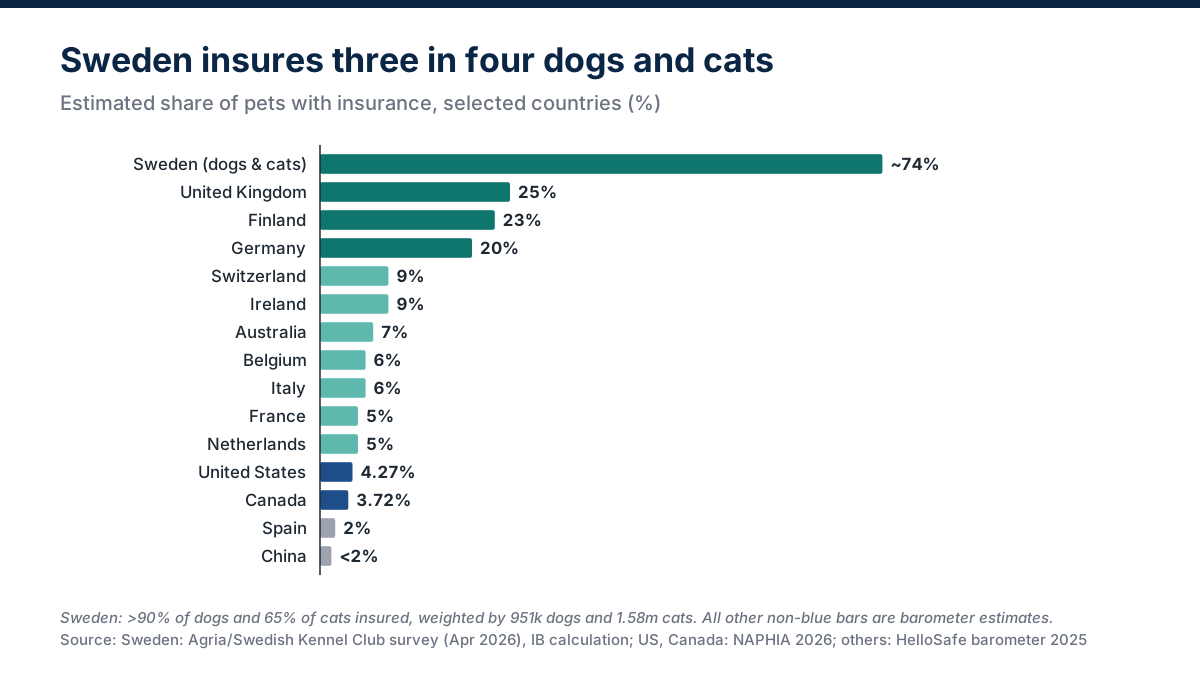
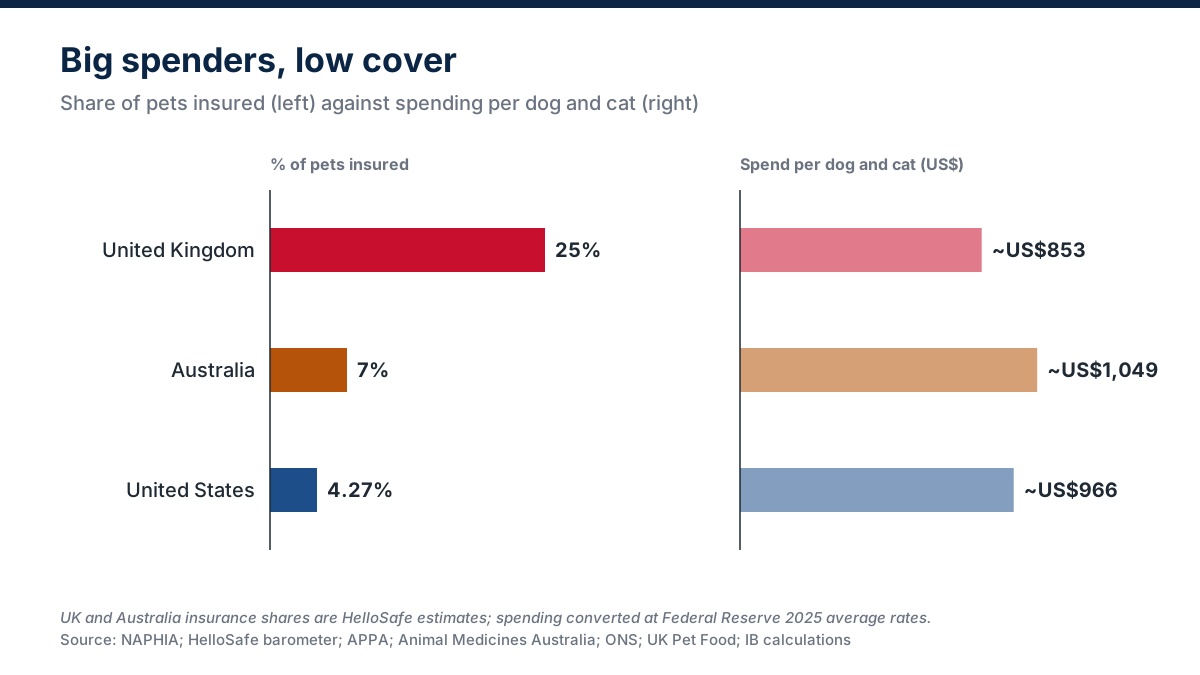
Below Sweden, the numbers get fuzzier, because few countries count insured pets officially. HelloSafe's 2025 Global Pet Insurance Barometer estimates the UK at about 25%, Finland at 23% and Germany at 20%. Switzerland and Ireland sit near 9%, Australia at 7%, and Belgium and Italy at about 6%. France and the Netherlands come in at around 5%.
British owners certainly use their cover. ABI members paid a record £1.23bn in pet claims in 2024, on roughly 4,900 claims a day. Treating a dog that has eaten something it shouldn't, such as chocolate or a small household item, costs around £4,000, according to the trade body. That is a lot of swallowed socks.
Read next: Canada lags global leaders in pet insurance adoption
Then there's North America. The US has 6.98 million insured pets, which sounds impressive until you realise it's just 4.27% of the country's dogs and cats, according to the North American Pet Health Insurance Association. Canada manages 3.72%. Spain sits near 2%, and China, home to an estimated 220 million pets, below 2%.
Read next: NAPHIA: Only 4.27% of US pets insured despite decade of double-digit growth
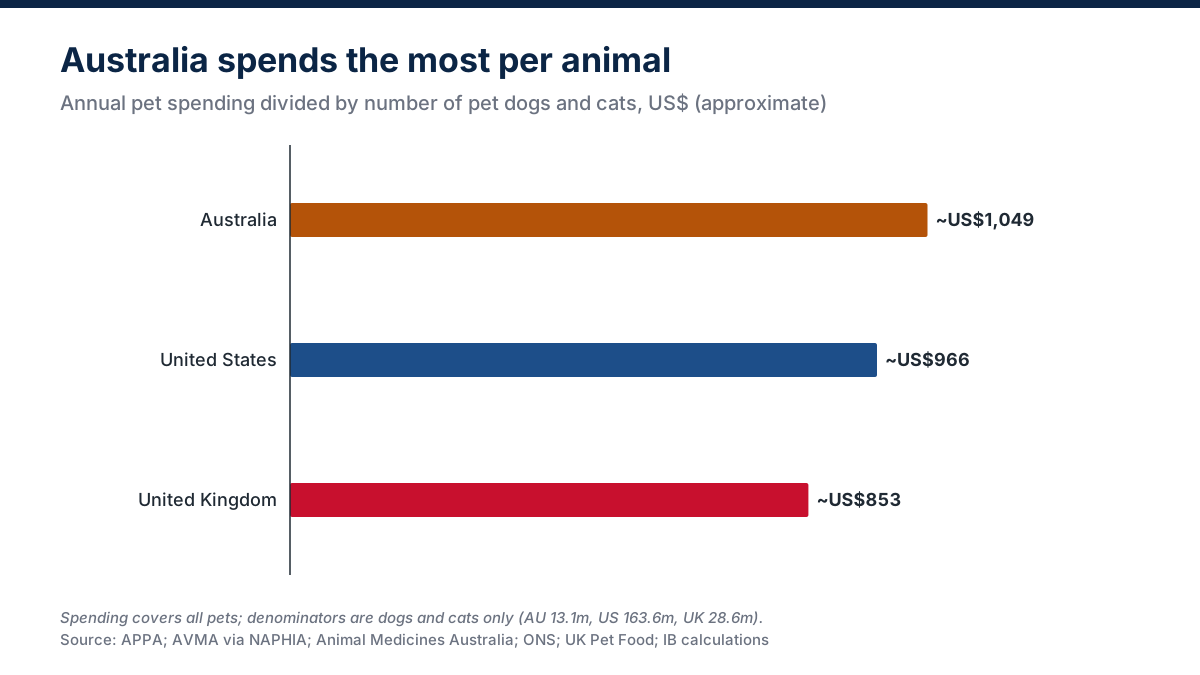
Comparing pet spending across borders is trickier than getting a cat into a carry basket, because every country measures it differently. Three publish recent, national, all-in figures covering food, vet care, products and services: the US, the UK and Australia. We divided each total by the human population and by the number of pet dogs and cats.
|
Country |
Total annual pet spending |
Per person |
Per dog and cat |
|---|---|---|---|
|
United States |
US$158bn |
~US$462 |
~US$966 |
|
United Kingdom |
£18.5bn (~US$24.4bn) |
~£267 (~US$352) |
~£647 (~US$853) |
|
Australia |
A$21.3bn (~US$13.7bn) |
~A$775 (~US$500) |
~A$1,626 (~US$1,049) |
Per-person and per-pet figures are IB calculations. Populations: US Census Bureau (341.8m, July 2025), ONS (69.3m, mid-2024) and ABS (27.5m, March 2025). Converted at the US Federal Reserve's 2025 average rates of US$1.3192 per pound and US$0.6450 per Australian dollar. Spending covers all pets; the per-pet column divides by dogs and cats only.
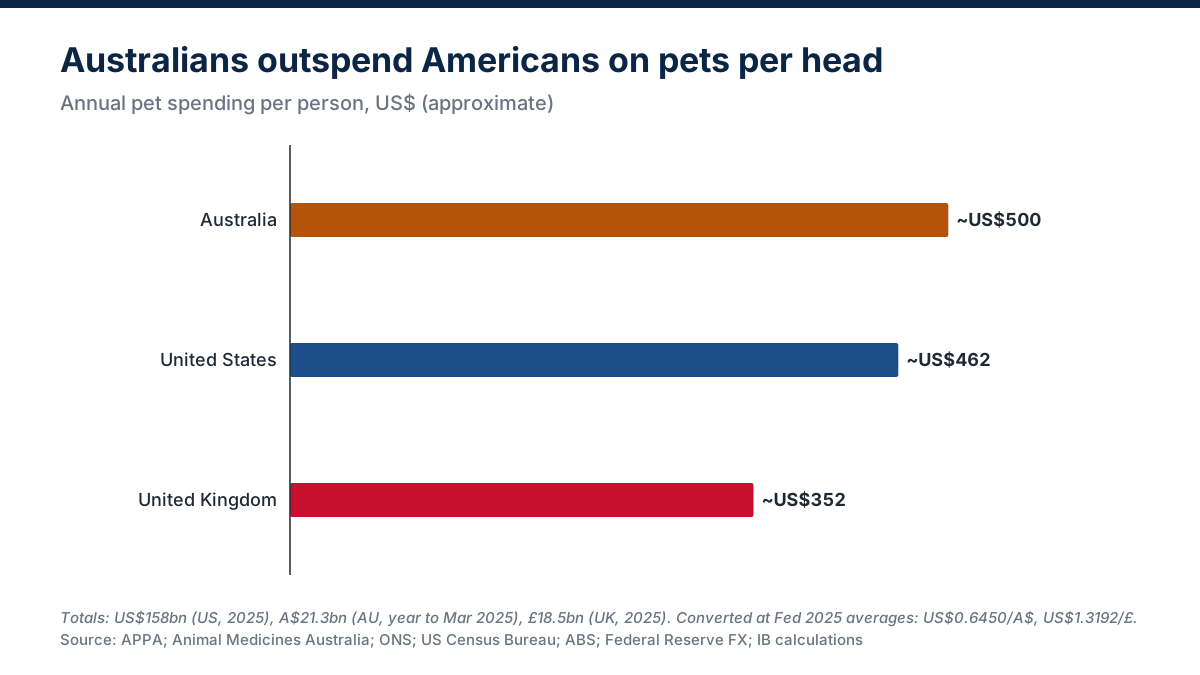
Total: America, by a country mile. The American Pet Products Association put US pet spending at US$158bn in 2025, up 3.7%, and expects US$165bn this year. That's more than six times the UK's bill. Pet food and treats alone accounted for about US$68bn.
Per person: Australia, by a whisker. Australians spent an estimated A$21.3bn on their animals in the year to March 2025, according to Animal Medicines Australia. That's roughly US$500 for every man, woman and child, nudging past the US at about US$462. It helps that Australia now has more pets (31.6 million) than people (27.5 million), and that 73% of households keep at least one.
Per pet: Australia again. Spread across an estimated 13.1 million dogs and cats, Australian spending comes to about US$1,049 an animal. The US is close behind at about US$966. Britain, at about US$853, is hardly mean either. Households spent around £18.5bn on pets and vet services in 2025, based on ONS consumer trends data, and the country's dog population has jumped by 3 million in five years to 15.5 million, according to UK Pet Food. Somebody is buying all those doggie pyjamas.
And the rest of the world? Few countries publish all-in figures that include vet bills, but two big markets give a partial picture. In Germany, pet trade bodies IVH and ZZF put spending on pet food and supplies at just under €7bn in 2025, for 15.7 million cats and 10 million dogs. That's about US$95 a head and US$308 per dog and cat, before any vet visits. Japan's pet business market was worth about ¥1.86tn in fiscal 2023, according to Yano Research. That covers food, supplies, pet sales, insurance and even funerals, but appears to exclude vet care. Spread across 15.95 million dogs and cats, as counted by the Japan Pet Food Association, it comes to roughly US$830 per animal. That puts Japanese owners within sniffing distance of the Brits before a single vet bill, even if, at about US$106 a head, the country as a whole spends far less.
Germany and Japan are shown as hatched bars in charts 2 and 3 because their totals exclude vet care. Converted at the Federal Reserve's average rates of US$1.1306 per euro (2025) and ¥140.50 per dollar (2023, matching Japan's fiscal year).
It isn't all indulgence. Animal Medicines Australia found around one in six dog and cat owners had put off check-ups or cut back on medication because of cost. Executive director Ben Stapley said it was concerning to see owners "feeling forced into decisions that put their animals at risk".
Read next: Pet insurance claims exceed £1 billion market for the third consecutive year – ABI
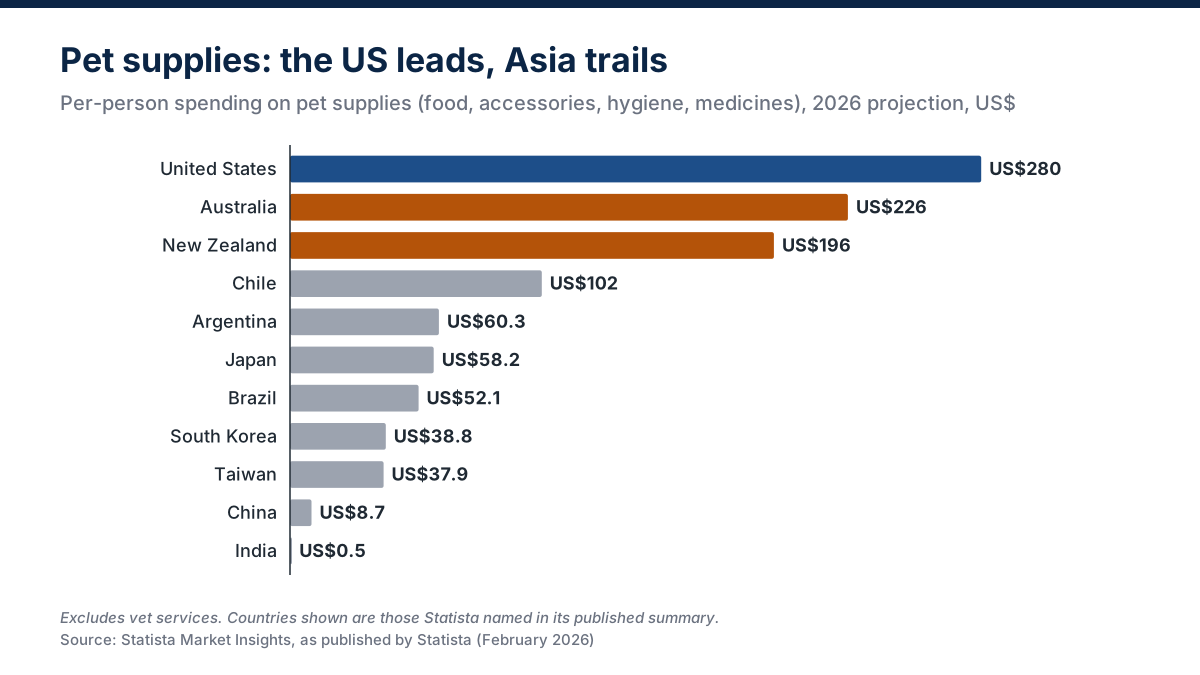
For a wider, if also narrower, view, Statista's market data compares per-person spending on pet supplies (food, accessories, hygiene products and medicines, but not vet bills) across dozens of countries. The US leads at around US$280 a head in 2026, ahead of Australia (US$226) and New Zealand (US$196). Japan comes in at about US$58, South Korea at US$39 and China at under US$9, so the pampered-pet capital of the world is still firmly English-speaking.
Put the two rankings side by side and the opportunity practically wags its tail. Australia and the US are among the most generous pet owners on the planet, yet fewer than one in 14 Australian pets and one in 23 American pets carry insurance. Sweden and the UK show how far penetration can climb once cover becomes a habit rather than an afterthought.
That gap is why carriers keep piling into under-insured markets, and why forecasters remain bullish. One recent projection has the global pet insurance market passing US$113.7bn by 2035.
The catch is the same everywhere. Vet costs keep climbing, and money owners happily spend on gourmet treats doesn't automatically stretch to a premium. Turning devotion into policies will take simpler products and brokers who can explain them. The pets, for their part, declined to comment.
Read next: Pet insurance market to soar past $113.7B by 2035 as vet costs climb: Report