South Korea’s major insurers reported falling net profits in the third quarter of 2026 despite stronger core insurance results, as rising market interest rates drove bond valuation losses across the sector.
The Bank of Korea raised its base rate twice in consecutive meetings this year, lifting it from 2.5% to 2.75% in July and then to 3.0% in August, according to Trading Economics. Those hikes, the first since 2023, pushed bond prices lower and generated mark-to-market losses that wiped out underwriting gains at multiple carriers.
For brokers and intermediaries with exposure to Korean carriers or their regional operations, the results point to a market where insurers are absorbing losses on both sides of the balance sheet. The combination of investment volatility and rising claims costs could lead to changes in underwriting appetite and pricing in the quarters ahead.
Read more: Investment income masks underwriting stress in South Korea’s H1 results
The table below shows how third-quarter results diverged between insurance and investment performance across four major Korean insurers, based on data reported by Chosun Biz.
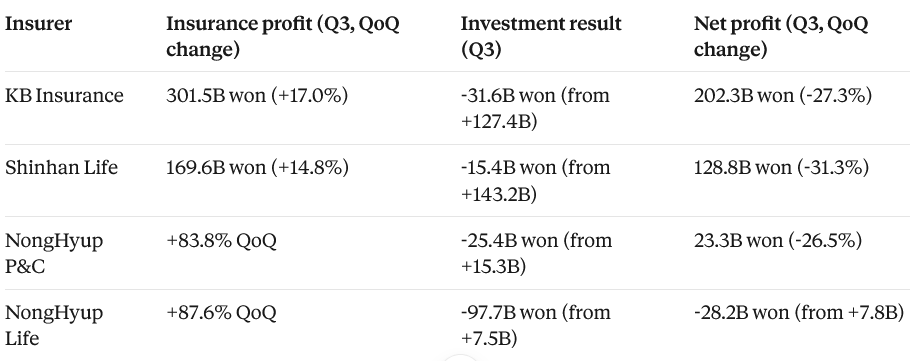
In every case, insurance operations improved while investment performance deteriorated. KB Insurance’s investment result swung by 159.0 billion won in a single quarter, driven by valuation losses on marketable securities and derivatives amid increased volatility in interest rates and exchange rates.
NongHyup Life was hit hardest. After posting 7.8 billion won in net profit the prior quarter, it recorded a 28.2 billion won net loss. Cumulative net profit through nine months plunged 96.8% year over year to 6.8 billion won.
KB Insurance’s cumulative nine-month net profit fell 11.2% compared with the same period in 2025, to 681.1 billion won.
Read more: Bond market collapse exposes a two-tier Korean insurance sector
Insurers invest premiums in bonds and other financial assets. When market interest rates rise, bond prices fall, producing valuation losses. The scale varies by insurer depending on portfolio structure. Companies that hold assets whose valuation changes flow through profit and loss statements face the most earnings volatility.
The industry’s average K-ICS (Korean Insurance Capital Standard) solvency ratio stood at 216.1% at the end of March 2026, according to Asia Economy. A new basic-capital K-ICS threshold of 50%, announced by the Financial Services Commission (FSC) and set to take effect in March 2027, will add further scrutiny to carriers with weaker capital quality, according to Asia Economy’s reporting on the FSC announcement.
Under the new rules, insurers that fall below the 50% basic-capital threshold will receive a management improvement recommendation. Those that remain below the standard after a grace period could face prompt corrective action.
The investment-side losses compound existing underwriting stress. The Seoul Economic Daily reported in August that the four largest non-life insurers posted a combined first-half auto insurance loss ratio of 84.5%, up 1.9 percentage points year over year. The top five carriers swung to a combined 10.5 billion won auto underwriting loss, compared with a 126.1 billion won profit a year earlier.
That followed the first auto premium increase in five years, at roughly 1.3% to 1.4% in February, but renewals have been too slow to offset rising repair and claims costs.
The fourth quarter brings seasonal risk. Non-life insurers typically face higher claims from traffic accidents, fires, and respiratory illness-related hospitalisations during winter months.
“In general, in the fourth quarter, the burden of insurance payouts tends to grow due to respiratory illnesses, traffic accidents on snowy roads, and fires,” an insurance industry official told Chosun Biz. “With the possibility of a base rate hike still on the table, we also need to brace for volatility in investment gains and losses stemming from rising market interest rates.”
The Korea Insurance Research Institute projects overall premium growth will slow to 2.3% in 2026, according to Business Korea, with life premiums under the most pressure.
Brokers placing business with Korean carriers should watch whether the combined weight of investment losses, tighter solvency rules, seasonal claims, and slowing premium growth leads to shifts in capacity, pricing, or risk appetite in the months ahead. The Q3 results suggest Korean insurers can still underwrite profitably, but the investment side of the balance sheet is working against them, and that dynamic is unlikely to reverse while the Bank of Korea maintains its tightening stance.