India's insurance regulator has published a sweeping plan to cut what the country's brokers, banks and agents earn from selling policies. It comes less than eight months after New Delhi opened the market to full foreign ownership, and weeks after Aviva signed up to own its Indian life business outright.
The consultation paper from the Insurance Regulatory and Development Authority of India (IRDAI), titled Recalibrating Economics of Insurance Distribution, was released on Wednesday evening.
It would bring back firm ceilings on commission three years after the regulator scrapped them. In 2023, IRDAI swapped product-by-product limits for a single cap on insurers' overall management expenses, leaving companies largely free to decide how much to pay distributors. The regulator's view now is that distribution costs have since grown faster than premiums, and policyholders are footing the bill.
Investors have not taken it well. On Thursday morning, shares in PB Fintech, which owns the comparison platform Policybazaar, fell 20% to their daily limit on the BSE. Turtlemint, which only listed in June, fell by the same amount. Max Financial Services, Canara HSBC Life and L&T Finance dropped as much as 12% in intraday trading. Analysts at Bernstein reportedly said the cuts were far deeper than the market had expected, and named Policybazaar as the business most exposed.
The idea behind the paper is that a distributor's pay should reflect how complex a product is and how much work it takes to sell and service it, rather than how many policies get shifted. In almost every line, the caps are lower for multi-insurer channels such as brokers, banks and online platforms than for individual agents.
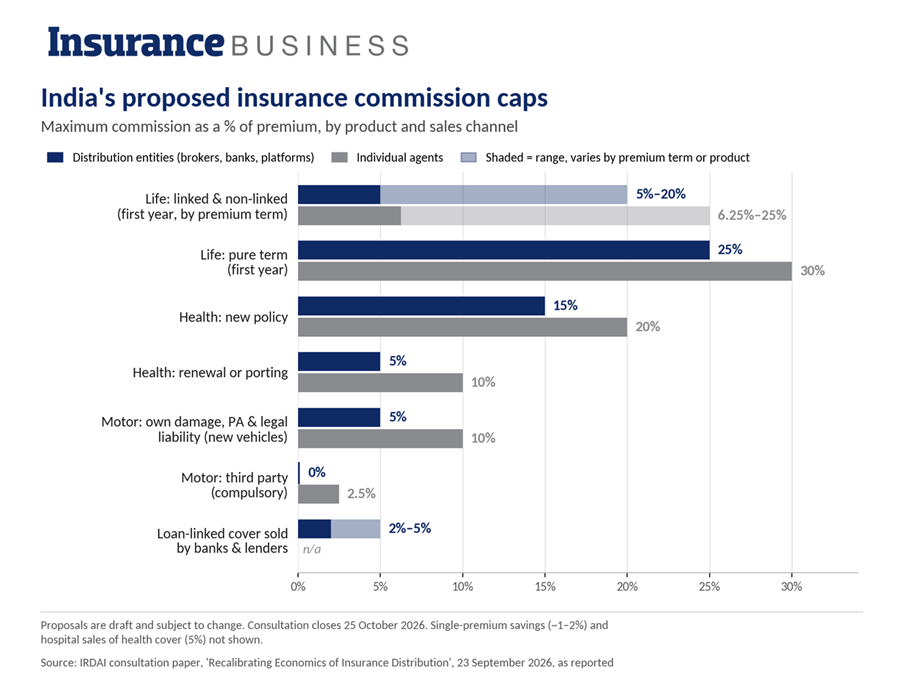
The biggest allowances are in life insurance. First-year commission on individual linked and non-linked policies would range from 5% to 20% for intermediaries and from 6.25% to 25% for agents, depending on the premium payment term. Pure term cover gets more room: 25% and 30% respectively.
Health distributors would be capped at about 15% on a new policy, with agents allowed 20%. Those figures fall to 5% and 10% on renewals and on policies ported to another insurer. Compulsory motor third-party cover would pay distributors nothing at all.
Read next: India regulator challenges insurers on costs and mis-selling
The toughest measures are aimed at lenders. Banks and non-bank lenders selling insurance alongside loans would face caps of 2% to 5%. Making insurance a condition of credit would be banned outright, and bank staff could no longer receive volume-linked bonuses or perks such as sponsored contest trips.
Insurers' own costs are also in the frame. Life insurers would have to cut total management expenses to 15% of gross direct premium income within two years and to 12.5% within five, with 10% as the long-term goal. For general insurers, the limit would fall from 30% to 20% over five years.
The paper also sets out a much stronger accountability regime. The individual seller's identity would be linked to every policy they sell. Mis-selling incidents would be made public, and commission could be clawed back where mis-selling is proved. Cost audits would become mandatory for insurers and for large distributors. Websites would be barred from using "dark patterns", such as demanding personal details before showing product information.
The regulator has been hinting at this for months. At a Confederation of Indian Industry conference in February, IRDAI non-life member Deepak Sood said: "Selling correctly is an imperative for every salesperson, distributor, and insurance company."
Read next: Joint liability ruling puts India's bancassurance distribution under scrutiny
The timing is awkward for foreign groups that have just been told they can go it alone. The Sabka Bima Sabki Raksha amendments, passed by Parliament last December, removed the 74% cap on foreign ownership of Indian insurers.
In July, Aviva signed an agreement to buy the remaining 26% of Aviva India from Dabur Invest Corp, ending a partnership that dates back to 2001. The insurer said the financial impact was not material to the group. Aviva India wants to roughly triple annualised new business premium, from about 350 crore rupees to 1,000 crore rupees over five years. It will now have to hit that target under a much tighter pay regime.
Bupa owns around 55% of listed health insurer Niva Bupa. In July, Niva Bupa's deputy chief executive said the parent was open to raising that stake further. Health is one of the lines where the new caps are most sharply defined.
Read next: Aviva takes full India ownership under new FDI regime
Bank distribution is the heart of the issue. Corporate agents, mostly banks, brought in nearly 53% of private life insurers' individual new business premium in 2024-25. Online channels accounted for less than 1%. Any foreign insurer building a wholly owned Indian operation will almost certainly lean on bank partners, and those partners are about to earn a lot less per sale.
Not everyone reads this as bad news for insurers. Some brokerage analysts argue that lower payouts should cut acquisition costs and support new business margins, even if sales growth cools for a while.
For UK readers, this will feel familiar. Forcing insurance onto people taking out loans was at the core of the PPI scandal. More recently, the Financial Conduct Authority found that only 6% of GAP insurance premiums were being paid out in claims, while some firms were paying up to 70% of premium in commission to motor dealers and others in the chain. Most of the market paused sales until commission was cut. FCA officials still point to the GAP intervention as proof that the Consumer Duty works.
Read next: FCA approves resumption of GAP insurance sales
The difference is in method used. The FCA uses fair value principles and supervisory pressure and says it would rather not write new rules. IRDAI is putting hard numbers into regulation. Meanwhile, the FCA's motor finance redress processshows what it costs when commission problems are fixed after the event rather than before.
Read next: FCA marks its own homework on insurance – and gives itself a six or seven
IRDAI is taking feedback until October 25. Expect a fierce lobbying campaign from distributors, and from India's banks in particular, before the numbers are set in stone.