NH NongHyup Life Insurance Co. has applied for patents covering an artificial intelligence system that automates insurance product recommendations for customers, the company disclosed, according to The Asia Business Daily. The insurer submitted applications for both a technology patent and a business model patent for the system, which it developed to handle the planning process that agents typically conduct when a customer considers purchasing an insurance policy.
The system pulls together a customer’s existing insurance coverage and premium budget, then generates a product recommendation based on that data. It also runs automatic checks against product structures and rider rules – a step that previously required manual verification by agents and added time to the planning process. Beyond the recommendation engine, the patent application covers eligibility condition analysis and error-reduction mechanisms built into the application process itself. NH NongHyup Life said the filing goes beyond a single AI feature, encompassing the operational model through which AI is applied across the sales workflow.
Byunghee Park, CEO of NH NongHyup Life Insurance, described the system in terms of its practical function in the field. “The AI Enrollment Planning System is more than just a digital adoption; it is an on-site, innovation-driven AI service optimized for the insurance sales environment of agricultural and livestock cooperatives. With this patent application as a stepping stone, we will further strengthen our competitiveness in AI-based personalized insurance services while enhancing both customer satisfaction and operational efficiency,” Park said, as reported by The Asia Business Daily.
Read next: Cyber’s most passionate advocates are gathering on a pier this July
NH NongHyup Life operates through South Korea’s agricultural and livestock cooperative network, where branch staff handle both banking and insurance products within the same customer-facing role. That setup creates time pressures that differ from those at standalone insurance agencies, as agents must shift between product categories within a single visit. The company said the system was developed with that environment in mind. It is also intended to help agents who are newer to the role handle complex protection products – including dementia and health insurance policies – that typically require more planning time due to the number of variables involved. The company said automating portions of that process is expected to reduce errors and improve output per agent.
Read next: Insurance is all in on AI, but the foundations are shaky
The filing arrives as insurers globally continue to work through questions about how far AI can be deployed across core business functions. A GlobalData poll conducted in the first and second quarters of 2026, covering 113 respondents, found that close to one in four participants identified AI's own maturity as the biggest obstacle to its adoption in insurance, according to a May 26 report from the firm. Ben Carey-Evans, senior insurance analyst at GlobalData, pointed to the narrow scope of current implementations as a likely driver of that scepticism. “This might be because use cases to date are largely around customer service and chatbots, rather than full-scale implementation. Regulation has not fully caught up yet, and there is concern around who is liable for mistakes made by AI,” Carey-Evans said.
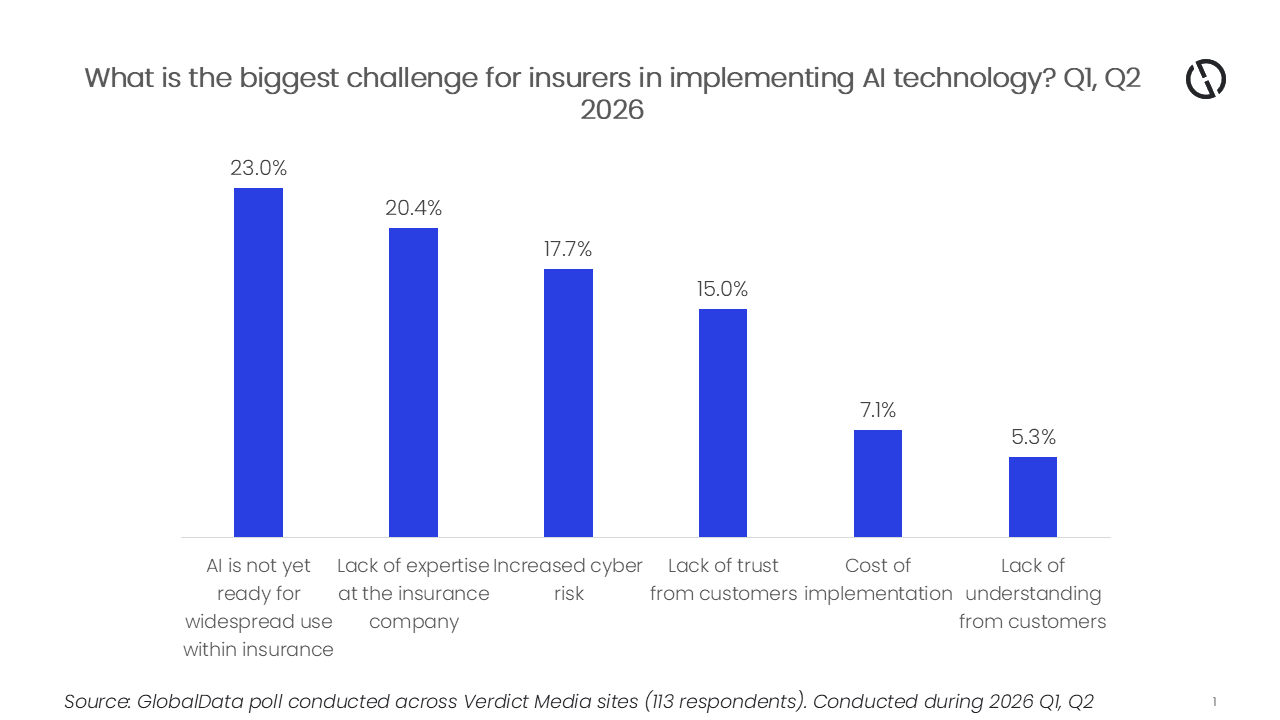
GlobalData’s job analytics data recorded 63,293 active AI-related insurance job postings in 2025 – approximately a 50.9% increase from the prior year and the highest annual figure in the data set – indicating that companies are responding to the expertise shortage through recruitment even as the technology continues to develop. NH NongHyup Life’s decision to seek patent protection for its system suggests it views the technology as a proprietary operational asset rather than a commodity tool, placing the insurer among a smaller group of carriers that have moved AI past the pilot stage and into the core sales process.