Asia absorbed US$65 billion in economic losses from natural catastrophes last year. Only 8% of that was covered by insurance. That figure, from Swiss Re Institute’s 2026 analysis of the region’s catastrophe landscape, is the market problem the Hong Kong Insurance Authority (IA) is now attempting to address through shared data infrastructure, regulatory guidance, and a formal product development framework.
At a Hong Kong Green Week event on September 8, 2026, the IA launched the Climate Insurance Lab (CIL) and unveiled its Climate Strategy, drawing more than 200 industry participants, including policymakers, academics, and insurers. For brokers placing risks in the region, the move has concrete implications – for how underwriters may assess climate-exposed assets in Hong Kong and what products may eventually reach the market.
Despite accounting for only about 5% of global insured losses, Asia contributed 30% of global economic losses from natural catastrophes in 2025, according to Swiss Re Institute. Just 8% of those losses were insured – well below the previous 10-year average of 17%.
Flood-related insured losses in Asia are rising at around 12% annually, approximately twice the global rate. Floods have historically represented 33% of total economic losses from natural perils in the region since 1970, yet account for only 20% of insured losses.
That gap between economic exposure and insurance coverage is not closing at a pace consistent with growing urban risk – and it is that structural shortfall the IA is seeking to address.
The CIL will operate across three areas: building shared data infrastructure, setting regulatory guidance for climate-related risks, and establishing a Product Innovation Platform.
The Product Innovation Platform carries the most direct commercial relevance. Its inclusion within a regulatory framework signals that the IA intends to shape how climate-linked products are designed in Hong Kong, rather than leaving product development entirely to individual carriers.
The practical question is what that means for the range of cover available for property, infrastructure, and construction risks – and when. The IA has not publicly disclosed a product timeline or which perils will be prioritized.
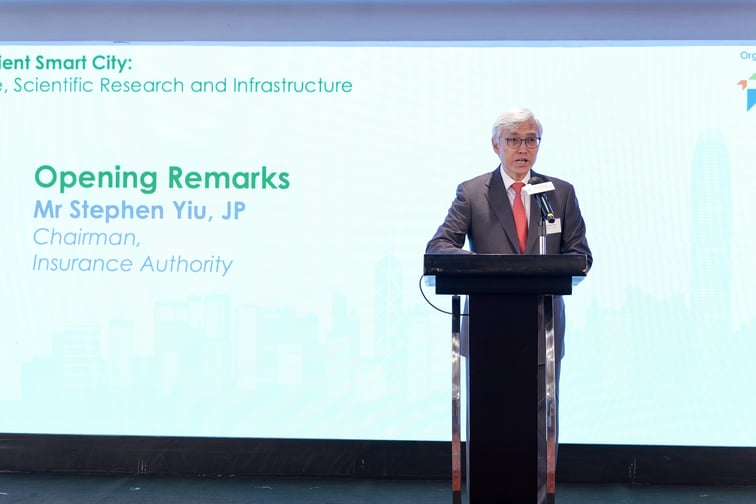
IA chairman Stephen Yiu (pictured) addressed the link between infrastructure design and risk transfer in his opening remarks. “Better-designed infrastructure and smarter risk transfer can work together so that the people building our city, and the families living in it, are genuinely protected, not just insured on paper. Regulators also have a critical role in ensuring insurance remains a source of confidence,” Yiu said.
The Climate Modelling Project – a joint initiative between the IA, the Hong Kong Federation of Insurers (HKFI), and the Hong Kong University of Science and Technology (HKUST) – sits alongside the CIL with direct underwriting implications.
The project draws on claims data shared by insurers and applies high-resolution climate models to assess risks at a spatial level. The IA has said the project is expected to give insurers insights for developing new product solutions and improving climate risk assessment capabilities.
HKUST’s professor Alexis Lau, head and chair professor of the Division of Environment and Sustainability, presented the latest project findings at the event.
If the models prove sufficiently granular, individual properties and infrastructure assets in Hong Kong could be assessed and priced differently from how they are today – with implications for both coverage availability and premium levels. The IA has not published technical detail on which perils the models cover or the geographic resolution used.
Ricky Lau, Permanent Secretary for Development (Works) and the event’s keynote speaker, made the case for broader coordination between government investment and insurance. “By combining government infrastructure investments that lower physical risks with insurance solutions that encourage resilience, we can build a stronger and more secure city together,” he said.
The Drainage Services Department also presented at the event, alongside a panel discussion with representatives from the Development Bureau, the insurance industry, academia, and the construction sector.
The CIL launch is one element of a broader regulatory shift affecting how climate risk is treated in Hong Kong’s insurance market. In May 2026, the Hong Kong government gazetted amendments to the Risk-Based Capital (RBC) regime – set to take effect December 31, 2026 – that include specific changes to how capital is calculated for natural catastrophe risks. According to the government’s May 22, 2026, gazette notice, the amendments reduce risk capital amounts for natural catastrophe and man-made non-systemic catastrophe risks and offer preferential capital treatment for eligible infrastructure investments in Hong Kong and mainland China.
For underwriters, that adjustment means the capital cost of writing certain catastrophe exposures changes from year-end. Combined with the CIL’s Product Innovation Platform, the regulatory direction in Hong Kong is linking capital incentives with product development – a pairing that could gradually alter the commercial case for writing climate-related risks.
The Monetary Authority of Singapore (MAS) moved in a parallel but distinct direction in March 2026, issuing guidelines that set supervisory expectations for banks, insurers, and asset managers to manage the transition and physical risks they face from climate change. Those guidelines take effect from September 2027 and include expectations that insurers will not indiscriminately withdraw coverage from clients with higher climate-related risk profiles – a measure designed to prevent protection gaps from widening further.
The two regulatory approaches differ in focus. Singapore’s guidelines address how firms govern and manage climate risk within their existing operations. Hong Kong’s CIL addresses the upstream problem: building the data infrastructure and product development capacity needed to extend coverage to risks that are currently uninsured or underinsured.
For brokers operating across both markets, the combined direction points toward a regional environment where climate risk is moving from a compliance consideration toward an underwriting and commercial one.
Swiss Re Institute has noted that under-insurance in Asia reflects three main constraints – affordability, access, and institutional capacity – and that insurers need to update underwriting models to reflect evolving exposure patterns and strengthen risk mitigation through broader cross-stakeholder collaboration.
The CIL directly addresses the institutional and data dimensions of that problem. Whether it translates into coverage that brokers can place, at what price points, and for which perils, will determine its practical value for the market. Those details have not yet been disclosed.