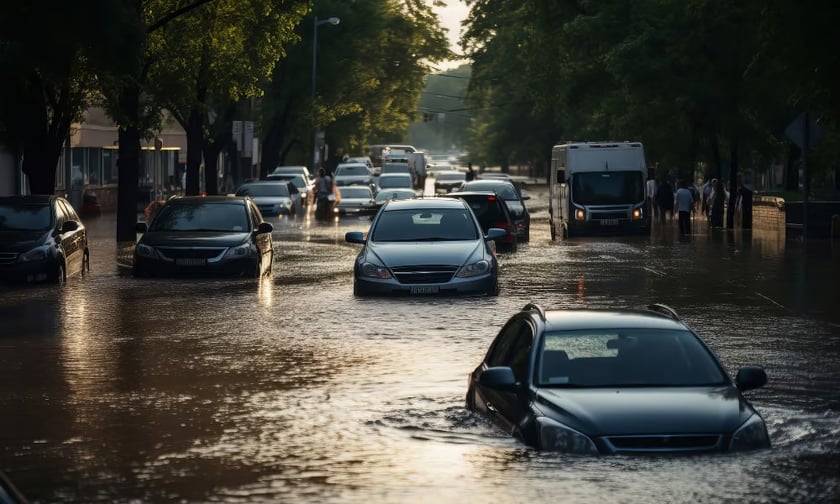
KB Insurance said on July 8 it has activated a five-stage “Emergency Response Process” for vehicle damage from summer rainfall and typhoons, the latest South Korean non-life insurer to institutionalize seasonal catastrophe operations as intensifying downpours and rising loss ratios press on motor underwriting, according to The Asia Business Daily.
The move follows a comparable step by market leader Samsung Fire & Marine Insurance, which said in late May it would run a “Flood Prevention Emergency Team” for the rainy season, inspecting flood-vulnerable sites and coordinating with local governments, The Asia Business Daily reported. Together the announcements indicate that pre-season flood response is becoming a standard operating function among Korea’s largest motor insurers rather than a point of differentiation.
The operational buildup tracks a documented shift in rainfall patterns. The Korea Meteorological Administration’s (KMA) 113-Year Climate Change Analysis Report, released in December 2025, found that annual precipitation has risen by an average of 17.83 millimetres per decade even as the number of rainy days has fallen, alongside increases in heavy-rain days and in the frequency of hourly rainfall above 50 millimetres – indicating shorter, more concentrated downpours, as reported by the Korea Times. Rainfall exceeding 100 millimetres per hour was recorded at 16 locations in 2024 and 15 in 2025, the Korea Times reported, citing the KMA report.
The exposure is not new. Typhoon Hinnamnor and concentrated rainfall centred on Seoul’s Gangnam district in 2022 produced what was then Korea’s largest-ever vehicle flood damage, with combined estimated losses exceeding 200 billion won, according to The Asia Business Daily. Catastrophe modeler Verisk said it updated its South Korea typhoon model in 2025, part of a wider refresh of its regional models.
The 2025 season produced a concentrated loss. Data from the General Insurance Association of Korea (GIAK) showed 3,131 flood-damaged vehicles reported to 12 non-life insurers between July 16 and 21, with estimated losses of about 29.6 billion won (US$22 million), as reported by the Korea Times, which cited industry officials expecting the figure to rise as further claims were filed before typhoon season.
The losses fed into deteriorating results at the four largest non-life insurers – Samsung Fire & Marine, Hyundai Marine & Fire, DB Insurance, and KB Insurance. Their average motor loss ratio reached 82.6% in the first half of 2025, above the roughly 80% breakeven level, and climbed to 92.1% in November, with the January-to-November cumulative figure at 86.2%, up 3.8 percentage points year on year, according to figures reported by the Korea Times. The pressure carried into 2026: the four insurers’ cumulative motor loss ratio stood at 85.9% in the first quarter, up 3.4 percentage points from a year earlier, the Seoul Economic Daily reported.
The claims burden has coincided with a pricing turn. Korean non-life insurers are raising auto premiums in 2026 for the first time since 2021, ending four consecutive years of cuts, with the increase in the low-1% range, the Korea Times reported. Insurance Business Asia reported that the average annual auto premium stood at about 692,000 won as of 2024, with the new pricing projected to add roughly 9,000 won per policyholder. Industry officials cited by the Korea Times said the increase is more likely to slow further deterioration than to restore profitability, given repair-cost inflation and the accumulated effect of prior cuts.
The segment also drew regulatory attention in October 2025, when the National Assembly summoned the chief executives of DB Insurance, KB Insurance, and NH NongHyup Property & Casualty Insurance over the pricing of flood and windstorm coverage, Insurance Business Asia reported.
KB Insurance’s process runs across five stages tied to damage severity: pre-preparation, prevention, initial control, on-site control, and emergency camp, The Asia Business Daily reported. Earlier stages cover weather analysis, coordination with dispatch partners, and securing personnel, vehicles, and equipment, followed by patrols of flood-prone areas and use of an “Emergency Evacuation Notification System” – built jointly by the Insurance Development Institute, the GIAK, and Korea Expressway Corporation – to direct owners to relocate vehicles. Later stages add real-time monitoring, extra tow trucks and staff, and “Emergency Camps” that manage the intake and release of flooded vehicles and support claims.
A KB Insurance representative said: “Recently, the risk of vehicle flooding has increased due to frequent localized heavy downpours occurring in a short period of time. KB Insurance will do its utmost to minimize customer damage through thorough pre-emptive measures and swift on-site response and will provide fast recovery and compensation services even after an incident occurs.”
For Korean carriers, the shared evacuation infrastructure and parallel emergency teams point to loss mitigation being managed as a coordinated response to an exposure that meteorological data suggest is becoming more frequent, even as pricing flexibility remains constrained.