More than 80% of adults surveyed across Asia say staying financially independent in old age matters more to them than transferring wealth to the next generation, according to the Manulife Asia Care Survey 2026, released June 11.
The findings point to a fundamental change in how people across the region think about retirement, caregiving, and long-term planning. The survey gathered responses from more than 9,000 adults aged 18 and above across the Chinese Mainland, Hong Kong, Taiwan, Japan, Singapore, Malaysia, Indonesia, the Philippines, and Vietnam. Fieldwork was conducted between February and March 2026.
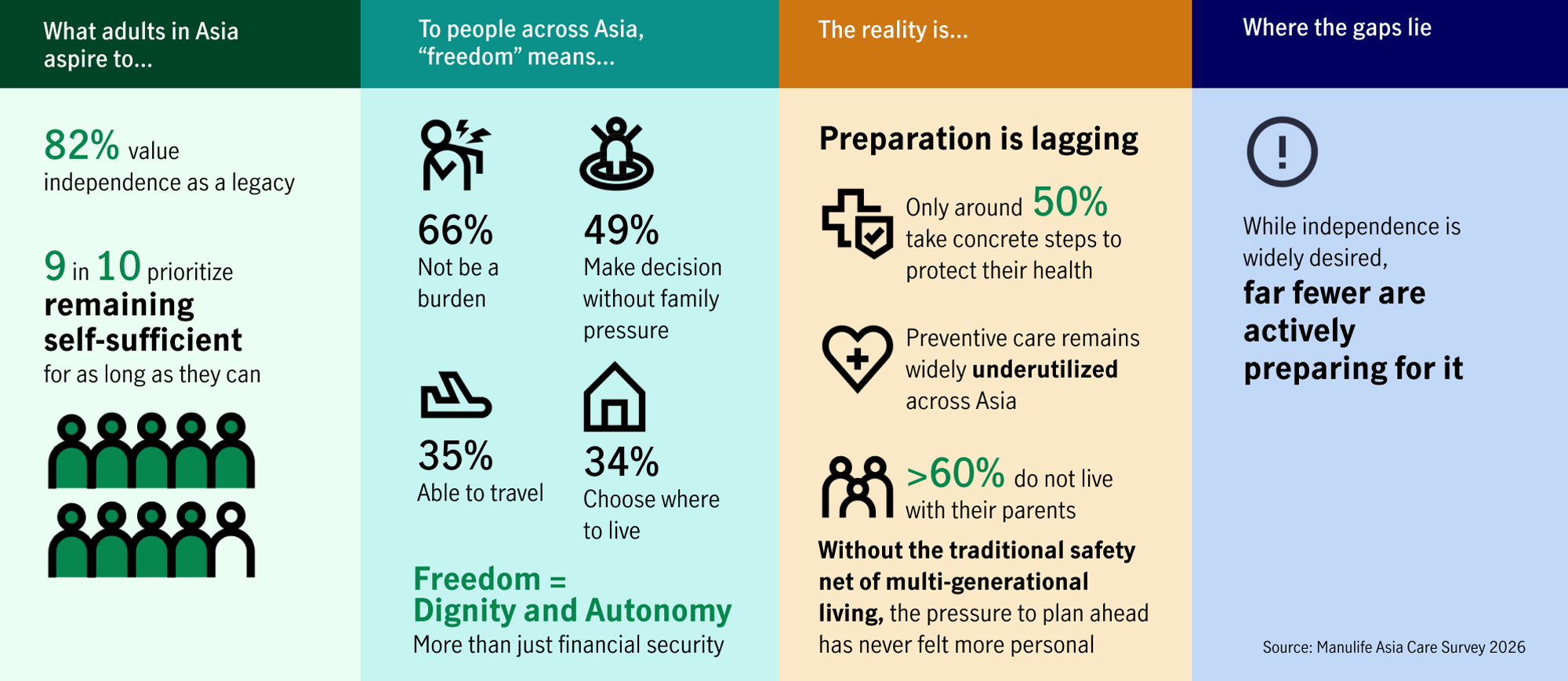
Nearly nine in 10 respondents identified remaining self-sufficient for as long as possible as their central goal for a longer life – a finding the survey links to a growing awareness of how many years in later life may require care or financial support. On average, respondents estimated that roughly 13 to 14 years toward the end of their lives could involve some degree of dependence, a span long enough to place considerable strain on both the individual and their immediate family.
The emphasis on independence as something to be passed on to the next generation was most pronounced in Indonesia at 93% and Vietnam at 89%, while Japan recorded the lowest proportion at 63%, though still a majority. “Across Asia, people are redefining what it means to leave something behind for the next generation. Independence has become the new and better legacy – because when people can take care of their own health and finances, they preserve their dignity while freeing their families to live their own lives,” said Steve Finch, CEO of Manulife Asia.
Read next: HUB’s top broker strategist has a message for everyone still playing it safe
Health emerged as the primary line of defence against care dependency, with two-thirds of respondents placing it at the top of their priorities. The survey found broad agreement – above 80% – that preventive screenings and early medical checks are effective tools for protecting long-term independence. In practice, however, fewer people act on this. Only about half of respondents said they undergo comprehensive health check-ups on a regular basis, and roughly 1 in 10 had never had one. A similar pattern held for lifestyle habits, with fewer than half reporting consistent exercise or a balanced diet. The data points to a persistent gap between what people recognize as necessary and what they actually do.
The survey’s financial data reveals a notable reorientation in how respondents are directing their money. On average, approximately 68% of total financial assets are allocated toward sustaining personal independence, leaving 32% designated for inheritance. Just 19% said they expect to rely on their children for financial support in retirement or during a period of care need. Despite this stated priority, only 51% of respondents said they are currently using investments to fund their retirement and care requirements. The figure is lower in specific markets: 30% in Japan, 40% in China, and 43% in Vietnam – suggesting that a substantial share of the population is not deploying capital in ways that would support the independence they say they want.
“There is a clear disconnect between what people want and how they are acting. Many are prioritizing independence, yet underutilizing investments that can help them achieve it. Too often, financial planning is approached as a choice between supporting one’s own independence and leaving a legacy – but that mindset can be limiting. When used effectively, investments can generate income, preserve capital, and grow wealth over time. Individuals don’t have to choose between living independently and creating a legacy – they can plan for both,” said Fabio Fontainha, chief executive officer of wealth and asset management, Asia, at Manulife. Among those who already hold investment, insurance, or savings products, 40% said they are moving toward income-generating instruments, while 38% are broadening their spread across asset classes – early signs that some households are beginning to align their portfolios with their longer-term goals.
Read next: Inflation erodes household financial resilience across Asia
Changing attitudes toward work in later life were also documented. Nearly three-quarters of respondents – 74% – said they intend to keep working past age 65, driven by both income considerations and the desire to remain active and financially independent. Part-time flexible arrangements were the most widely preferred option across the region. In the Chinese Mainland and Japan, however, a notable share – 39% and 32%, respectively – said they would prefer to continue in full-time employment, reflecting how people in different markets are adapting to longer working lives in different ways.
Care is already a present reality for many respondents, not just a future concern. Roughly half said they are currently providing care or financial assistance to a family member. Among this group, six in 10 said these demands are already limiting their ability to build their own long-term financial and health security – a dynamic that illustrates how caregiving obligations can create compounding pressure across generations.
Despite widespread recognition – at nearly 70% – that having early conversations with family about ageing, care expectations, and retirement leads to better outcomes later in life, more than 40% of respondents had not yet had those conversations, most commonly because they did not know how or where to start. Those who had engaged in such discussions, or had worked with a financial planner, consistently reported a higher quality of life.
The Manulife findings arrive alongside separate data from Sun Life Asia that points to deteriorating household finances across the region. Sun Life Asia’s third Financial Resilience Index, published June 9, found that 83% of respondents say rising costs have made it harder to meet monthly expenses, with groceries cited as the most widespread pressure point at 95%, followed by utilities at 94%, transport fuel at 92%, cooking fuel at 91%, and healthcare at 91%.
The proportion of households classified as highly resilient dropped from 32% in 2025 to 25% this year, while the share of people who feel fully secure about their financial situation fell from 19% to 13% over the same period. One in four respondents said they had drawn down savings, 10% had paused retirement contributions, and 55% either had no financial plan or were looking no further than 12 months ahead. The two surveys, taken together, describe a region where people are articulating longer-horizon goals around self-sufficiency while simultaneously facing the financial conditions that make those goals harder to reach – a tension the life and health insurance industry is positioned to address through advice, product design, and long-term planning support.