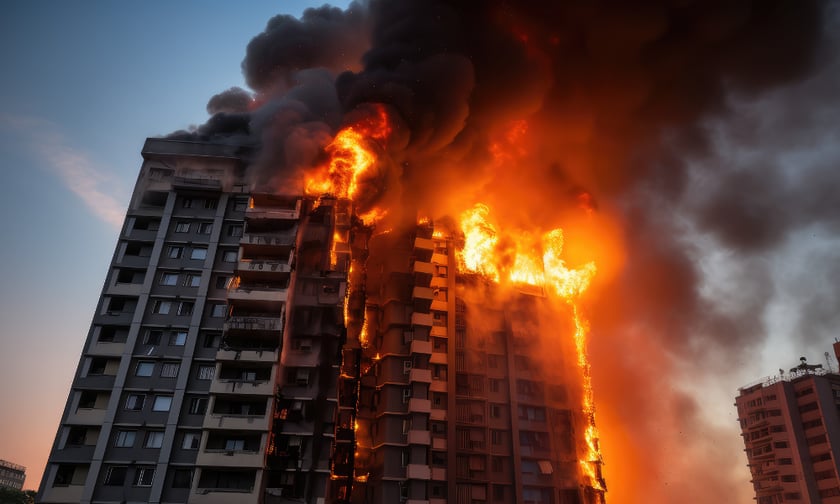
Eight months after the November 2025 Wang Fuk Court fire killed 168 people and displaced thousands of residents, a structural problem at the intersection of property law and insurance claims is pressing down on owners facing a government buyback deadline at the end of August.
Hong Kong Federation of Insurers (HKFI) CEO Selina Lau confirmed in February that if the government acquires ownership of Wang Fuk Court through its buyout scheme, it will also obtain the right to claim the fire insurance payout on the estate, with compensation capped at HK$2 billion, according to RTHK. Lau added: “Future claims will be negotiated by the government and the insurance company. Because it is not a rebuilding plan, it is unclear what the disbursement amount will be,” according to Hong Kong Free Press. That confirmation frames the central issue: owners must decide whether to transfer their titles – and with them their attached insurance claim rights – before those rights have been assessed, quantified, or paid out.
A representative of China Taiping Insurance (Hong Kong) told flat owners at the July 19 general meeting that the insurer cannot determine liability or begin the claims process until an independent committee investigating the fire releases its findings, according to Hong Kong Free Press. The government established the Independent Committee in December 2025, with a mandate to complete its work within nine months of commencing operations. The committee has since delayed its final report to late October – one month beyond the original September target – as more time is needed to review documents, according to the South China Morning Post. A source confirmed the judge-led panel’s report would be submitted to chief executive John Lee Ka-chiu in late October.
The inquiry’s terms of reference cover four areas: the causes of the fire and factors leading to the casualties, systemic problems in the building maintenance and renovation sector, the adequacy of existing regulations and penalties, and recommendations for the future, according to the Hong Kong government. The buyback deadline and the inquiry deadline are therefore separated by approximately two months – during which time owners who have sold their titles will have transferred their claim rights to the government, with no mechanism to reverse the decision.
According to minutes of the December 2024 owners’ board meeting, Wang Fuk Court is insured by China Taiping Insurance for mandatory insurance as well as fire insurance. The fire insurance coverage amounts to HK$2 billion, while public liability insurance is capped at HK$20 million per incident. Lau also clarified that home insurance policies held by individual residents – covering contents such as furniture and appliances – are separate from the structural fire policy and do not transfer to the government under the buyback, according to RTHK.
Under Hong Kong’s Building Management Ordinance (Cap. 344), fire insurance for building structures is not mandated by law. The only mandatory insurance under the ordinance is third-party risks insurance for common parts. The Deed of Mutual Covenant (DMC) may require the property management company to purchase fire insurance for the building’s structure or common parts, but no statutory obligation exists for owners or tenants absent a contractual or mortgage requirement. The HK$2 billion fire policy at Wang Fuk Court was therefore a discretionary arrangement, not a statutory minimum.
As of early February, approximately 85% of claims under individual insurance plans had been settled, totalling nearly HK$510 million in disbursements – comprising more than 1,000 general insurance claims and 169 life insurance claims, involving HK$450 million and HK$60 million, respectively. The HK$2 billion structural policy remains entirely unassessed. A Wang Chi House resident, identified only by the surname Wong, put the dilemma directly at the July 19 meeting. “We are being asked to sell our flats, but we do not yet have any information regarding the compensation of each insurance policy,” she told reporters in Cantonese, as reported by Hong Kong Free Press.
The government announced in February it would spend HK$6.8 billion to buy back all flats in the seven fire-affected blocks, offering between HK$8,000 and HK$10,500 per square foot depending on whether land premium has been paid, according to China Daily. Deputy Financial Secretary Michael Wong said the authorities would assume responsibility for all post-acquisition legal and insurance complications. As of July 10, more than 550 owners – approximately 28% of the total 1,984 households – had signed a formal sale and purchase agreement.
At the sector level, as of late 2025, S&P Global Ratings estimated that retained losses from the Tai Po incident could push Hong Kong’s property and casualty sector’s net combined ratio higher by approximately 2 to 3 percentage points in 2025, to roughly 97% to 98%, from 93.2% in 2024. Fitch Ratings anticipated a temporary rise in China Taiping Insurance Group’s combined ratio, though within the tolerance ranges for its A-/stable rating, citing state-linked backing, diversified earnings, and reinsurance protection. Fitch also projected tighter terms and conditions in property and construction-related business going forward, including higher premiums, deductibles, and exclusions for high-rise renovation risks.