AIA Life Insurance has deployed a new generative artificial intelligence platform for its consulting workforce, the South Korean insurer announced June 8, 2026, as questions about AI maturity and liability continue to circulate across the global insurance sector.
The system, called AICSR, sits within AIA Life Insurance’s smart AI messenger project and is built to support representatives handling customer inquiries in real time. Rather than replacing human consultants, the tool works alongside them – generating answer recommendations, categorizing inquiry types, and producing summaries of ongoing and past consultations as interactions unfold. The platform connects directly to Live Chat, a feature within AIA+, the company’s mobile application for customer insurance management. Through that connection, consultants receive both response suggestions and consultation summaries without leaving the interface they use during customer interactions.
Yoo Sinok, chief customer officer at AIA Life Insurance, framed the launch as an initial step in a longer-term effort. “We expect this service launch will enable us to provide the best customer experience with cutting-edge AI technology. We will continue to enhance our models to accelerate the digital transformation of consulting work and deliver differentiated customer experiences through customer-centric digital innovation,” Yoo said, as reported by The Asia Business Daily.
Read next: Cyber’s most passionate advocates are gathering on a pier this July
AIA Life Insurance said it will run a quality control system to assess the accuracy of AI-generated responses on an ongoing basis. Results from that process, combined with input gathered directly from consultants, will feed back into model refinement. The company also cited AI operational risk management as a standing priority alongside the platform’s rollout. The emphasis on oversight is notable given where the industry stands on AI governance.
A GlobalData poll of 113 insurance professionals conducted in the first two quarters of 2026 found that close to a quarter of respondents considered AI not yet ready for widespread deployment within the sector. Ben Carey-Evans, senior insurance analyst at GlobalData, pointed to the narrow scope of most current implementations as a contributing factor. “This might be because use cases to date are largely around customer service and chatbots, rather than full-scale implementation. Regulation has not fully caught up yet and there is concern around who is liable for mistakes made by AI,” Carey-Evans said.
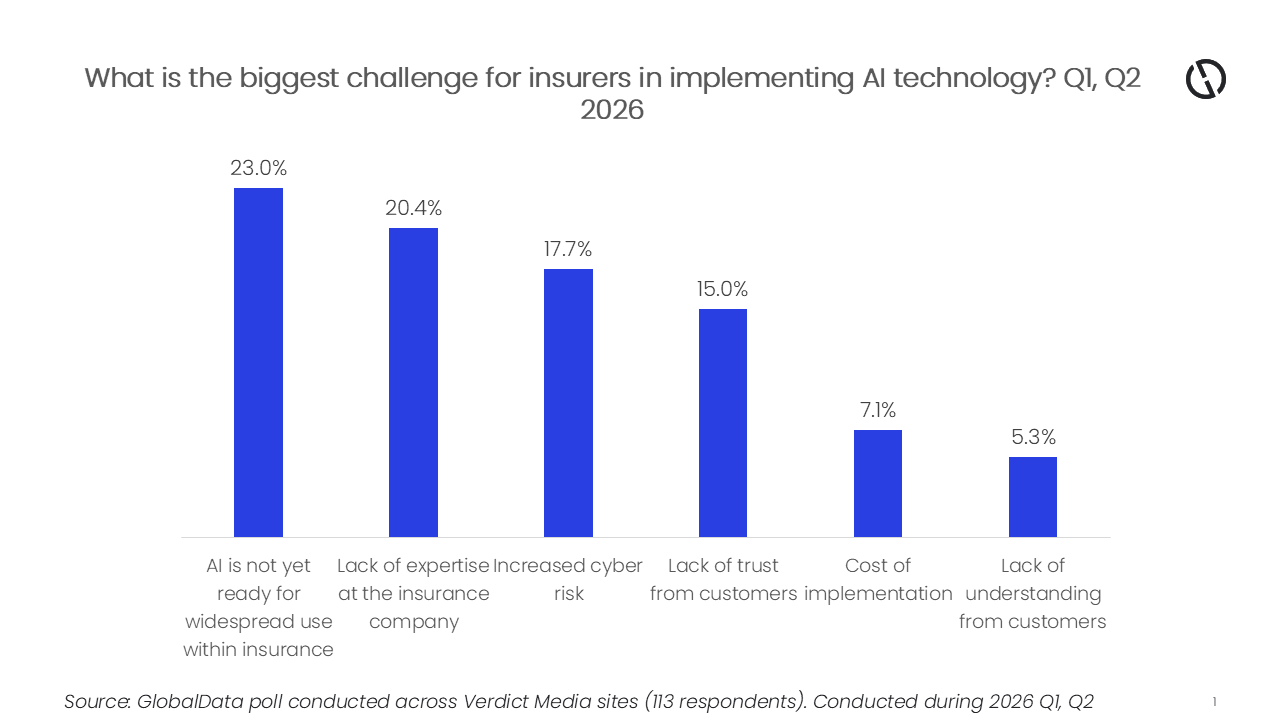
The same GlobalData research identified a shortage of in-house AI expertise as the second-most cited concern among respondents – a gap that insurers are attempting to address through recruitment. The firm’s job analytics data recorded 63,293 active AI-related job postings in insurance in 2025, a 50.9% increase from the prior year and the highest figure in the data set. Even so, Carey-Evans noted that hiring alone may not be sufficient given the pace at which the technology is evolving.
Read next: South Korea turns to AI as insurance fraud losses mount
For AIA Life Insurance, confining AICSR’s initial scope to the consultation layer – rather than deploying across multiple business functions simultaneously – positions the rollout in line with what analysts have described as a more sustainable approach to AI integration. “Targeting certain areas at a time, such as customer service, customer acquisition, or claims could help make the scale manageable,” Carey-Evans said. The company said it will continue assessing AICSR’s performance and refining its models as the platform moves beyond its launch phase.