A small San Diego haptics company has won what US legal commentators are calling the largest patent verdict in American history. If it holds, a big share of the money will flow to the investors who paid for the case.
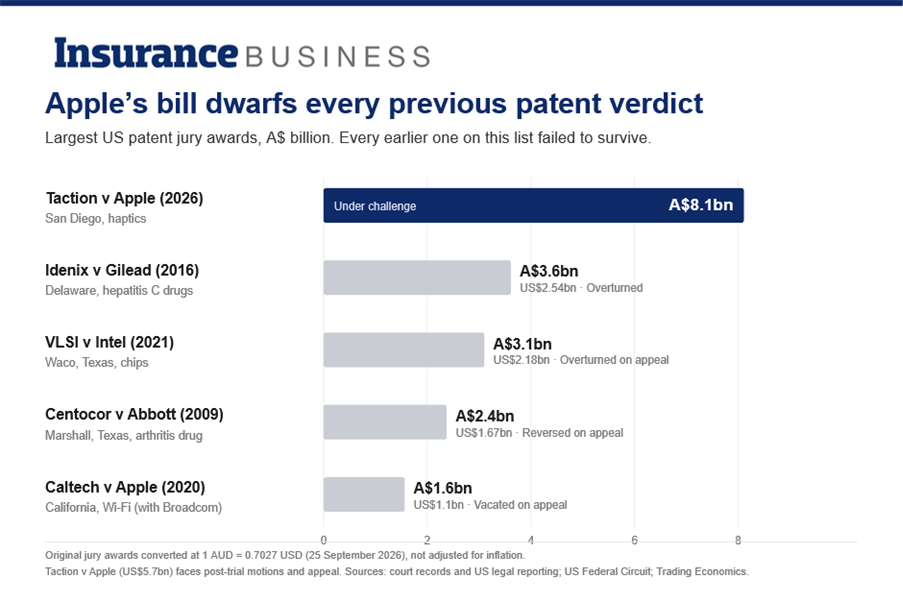
On Friday, US time, a federal jury in the Southern District of California found that Apple had infringed two patents owned by Taction Technology. It awarded more than US$5.7bn in damages, about A$8.1bn at current exchange rates.
The patents cover tactile transducers, the vibration hardware that makes a phone or watch buzz back when you touch it. Taction, which uses the technology in headphones and gaming headsets, told the court that Apple's Taptic Engine used its inventions without a licence. The Taptic Engine is built into iPhones and Apple Watches.
Apple denies it. The company said its Taptic Engine is "fundamentally different" from Taction's technology and that it will appeal. Taction's lawyers at Quinn Emanuel said the verdict vindicated patent rights their client had waited more than five years to have heard.
If at first you don’t succeed…
Taction filed suit in 2021. In 2023, Judge Robinson excluded testimony from Taction's technical expert and granted Apple summary judgment, ending the case before trial. The Federal Circuit then revived it. The trial began on 14 September, and seven jurors took parts of two days to find for Taction.
Anyone estimating Apple's final exposure should be aware of one important finding by the jurors. The jury decided the infringement was not wilful. Under US patent law, a judge can increase damages up to three times the jury's figure, but in practice that power is reserved for wilful or egregious conduct. Without a wilfulness finding, Taction has little prospect of enhanced damages.
Read next: Will US social inflation have a contagion effect worldwide?
Taction did not fund the litigation alone. US legal reporting on court disclosures shows the case was financed by Gronostaj Investments LLC and Kenosha Investments LP. In separate litigation, Kenosha has been identified as an indirect subsidiary of Burford Capital, one of the largest litigation funders in the world.
This is the model that liability insurers have been lobbying against. The American Property Casualty Insurance Association has backed a uniform federal rule requiring funders to be disclosed in US courts. Zurich's group chief claims officer has argued that funder involvement increases pressure to settle weak claims. The US National Association of Insurance Commissioners lists third-party funding and nuclear verdicts, generally awards above US$10m, among the main causes of social inflation.
The Taction award is 570 times that nuclear threshold.
Read next: Insurers hail first-in-the-nation ban against litigation funding
Insurers are not only on the defence side of cases like this. Over the past few years a market has grown up in judgment preservation insurance (JPI). These policies pay a winning claimant or its funder an agreed share of an award if the award is overturned on appeal. Patent verdicts are a core line for JPI because the Federal Circuit has a record of cutting down large awards.
The product has cost its underwriters before. In 2024 a US appeals court reversed a US$1.6bn judgment won by BMC Software against IBM, and insurers that had guaranteed part of that award had to pay. Brokers who placed that business say capacity has since become more expensive and more selective. Whether anyone has written cover on the Taction award is not public.
It would be easy to dismiss this as a US problem.
Australia is widely recognised as having one of the world's largest litigation funding markets, built largely on class actions. In 2022 the Full Federal Court ruled in LCM Funding v Stanwell that funding schemes are not managed investment schemes, and the federal government then exempted funders from those rules. Local D&O underwriters have already seen what well-funded claimants can do to premiums, retentions and limits. Marsh warned a parliamentary inquiry about this during the securities class action boom.
Patent cases are not shareholder class actions, but the pattern is similar. A well-capitalised backer makes long, expensive litigation affordable against a much wealthier defendant. When damages are calculated per unit sold across millions of devices, the result can far exceed any licence fee the parties might have agreed.
The exposure is direct for Australian manufacturers, med-tech developers and software exporters selling into the US. Dedicated IP insurance can pay for defending an infringement claim as well as for pursuing infringers.
Brokers should check whether a client's liability programme responds to a patent claim at all, and in many cases it won't. That conversation needs to happen before a demand letter arrives.
Read next: AI litigation, insolvencies among concerns threatening D&Os—Allianz
History is on Apple's side. The previous record was the US$2.54bn (about A$3.6bn) that a Delaware jury awarded Idenix against Gilead in 2016, which was later overturned. The next three largest awards, won by VLSI against Intel, Centocor against Abbott and Caltech against Apple, were all reversed or vacated on appeal.
Taction's award now goes to post-trial motions before Judge Robinson, where Apple will challenge both liability and damages. The appeal Apple has promised will follow. The final figure could be much smaller than the jury's, or nothing at all.
For insurers, what Apple eventually pays may matter less than the fact that a funded claimant, a revived case and a seven-person jury could produce an A$8bn award in the first place.