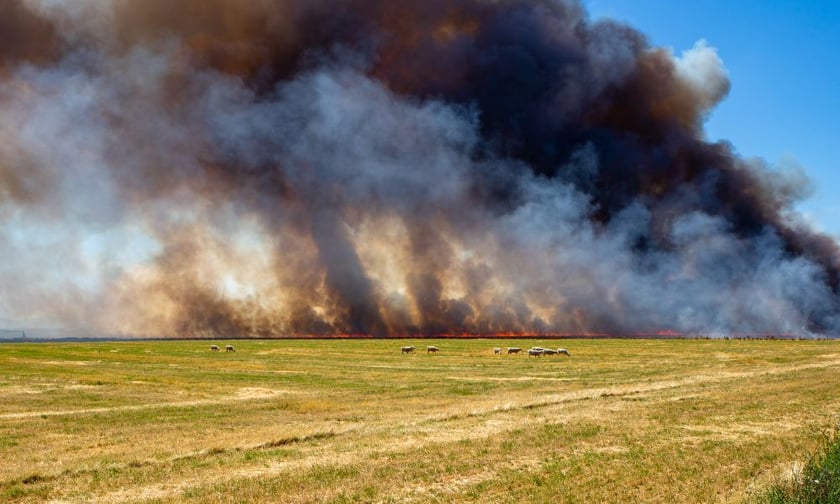
Multiple vegetation fires broke out across Canterbury on Sunday afternoon as strong winds spread flames through dry rural land and complicated firefighting efforts across the region.
The largest response centred on two fires in the Hurunui district. A vegetation fire on Karaka Road, south of the Hurunui River, was reported just before 1pm, burning through approximately 100 hectares of a rural property. Three helicopters were deployed alongside crews from six brigades - Culverden, Waikari, Hawarden, Hurunui, Waiau and Rangiora - but FENZ confirmed the terrain was too rough for ground operations, leaving ground crews on standby while the aerial attack continued.
Hurunui Mayor Marie Black said it appeared to be a large grass fire and she was not aware of housing or buildings at risk. "Of course it's concerning to the community to manage these crises," she said. "Given it had been relatively dry, the community had been careful about the fire risk."
Separately, a forestry fire broke out on O'Carrolls Road in Hawarden, also in the Hurunui district, with up to 16 firefighting crews backed by a helicopter deployed to the forestry block. Eight fire appliances were sent to a third fire at Mount Culverden, and firefighters from seven brigades responded to a hedge fire at Gebbies Valley near Christchurch.
FENZ assistant district commander Brian Keown urged residents to check any fires or burn-offs lit during the previous two weeks to ensure they had not reignited, and warned against lighting outdoor fires while strong winds persisted. FENZ said Canterbury remained extremely dry.
The afternoon's events present brokers with three distinct coverage scenarios developing in parallel across the same region.
The Karaka Road vegetation fire on rural grazing land, without structures currently at risk, is primarily a land and pasture loss question. Whether a rural policy responds to vegetation fire damage, and whether business interruption coverage extends to a grazing operation that loses pasture capacity, depends on how the policy defines the insured property and the covered perils. Many standard rural policies cover fire damage to structures and contents but treat pasture and standing vegetation as a separate question with its own coverage conditions and sub-limits.
The O'Carrolls Road forestry fire raises a different set of considerations. Forestry cover in New Zealand has been tightening - Insurance Business has previously reported that specialist forestry insurers have reduced capacity in fire-prone areas, pushing some risks toward the E&S market or leaving them partially uninsured. A fire in a commercial forestry block has an insured value that can extend to timber yield, replanting costs and the revenue lost during the years between replanting and the next commercial harvest. Whether all of those components are covered under the current policy wording, and at what limits, is not always as clear to the forest owner as it needs to be before a fire rather than after one.
The terrain factor at Karaka Road adds a practical dimension that rarely appears in policy reviews. Ground crews on standby while helicopters manage a fire in rough terrain means extended suppression time, higher firefighting costs, and greater uncertainty about containment. Where a policy includes a firefighting costs clause or a contribution to suppression expenses, the terrain-driven reliance on aerial resources rather than ground crews is exactly the kind of event that makes the scope and limit of that clause material.
Hurunui Mayor Marie Black's observation that the community had been careful about fire risk given the dry conditions is a meaningful signal for brokers with rural and forestry clients across Canterbury and the wider South Island. FENZ describing Canterbury as "extremely dry" in August - before the summer fire season has properly begun - indicates that the vegetation fire conditions currently active are likely to persist and intensify rather than ease.
FENZ recorded 4,873 vegetation fires nationwide in 2024/25, up from 4,339 the previous year. The trend has been rising gradually. An August fire day that requires simultaneous responses across multiple Hurunui district locations, deploys aerial resources due to terrain, and draws crews from as far as Rangiora is not a routine late-winter incident - it is the kind of event that, if it recurs through summer across the same dry landscape, produces the aggregate claims volume that tests rural portfolio performance across the Canterbury market.
For brokers reviewing rural and forestry client programmes ahead of the summer season, Sunday's Canterbury fires are a concrete prompt to confirm that forestry cover adequately addresses replanting and revenue loss, that rural liability sections respond to fire spread across boundaries, and that any firefighting costs provisions reflect the aerial-resource reality of suppression in rough Canterbury terrain.