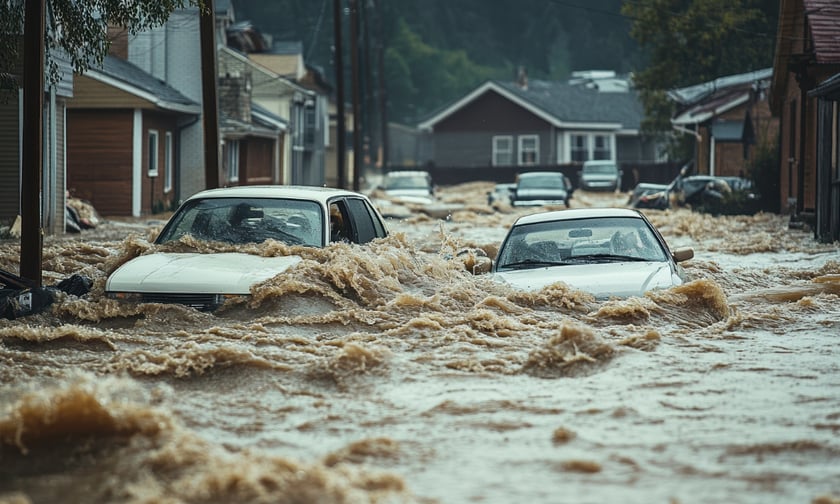
A record rainfall event in Chiba Prefecture is placing Japan’s voluntary motor insurance enrolment gap under scrutiny, as an unprecedented concentration of submerged vehicles overwhelms repair networks and exposes the financial position of the roughly half of drivers nationwide who hold no physical damage cover. Areas of Chiba recorded upwards of 360mm of rain in 24 hours from August 13 into August 14, 2026, flooding roads and rail lines and leaving more than 22,000 households without power. Among those killed was a 66-year-old woman found trapped in her submerged car, the Chiba Prefecture Disaster Management Office confirmed, as reported by Al Jazeera. On municipal roads in Chiba city alone, approximately 2,500 abandoned vehicles were reported, according to The Mainichi. Chiba Governor Toshihito Kumagai described the event as unlike anything he had encountered: “I have responded to many disasters in the past, but I have never experienced a case like this.”
Under Japan’s insurance framework, compulsory automobile liability insurance – which all drivers must hold – does not cover physical vehicle damage, according to the General Insurance Association of Japan (GIAJ). Recovery for flood-related vehicle losses requires voluntary physical damage insurance, a product that close to half of Japan’s drivers do not hold. Data from the General Insurance Rating Organization of Japan show that national enrolment in voluntary automobile physical damage insurance stood at 47.4% at the end of fiscal 2024, up from 45.7% at the end of fiscal 2019 – an increase of fewer than two percentage points over five years. Chiba Prefecture’s rate of 50.5% exceeds the national average but still leaves close to half of the prefecture’s drivers without protection.
The regional contrast is measurable. In South Korea, comprehensive motor coverage – which includes own-vehicle damage – accounts for 87.2% of the motor insurance portfolio by gross written premium, according to GlobalData, suggesting that Japan’s physical damage uptake is materially lower than that of a comparable northeast Asian market, even accounting for differences in how the two figures are measured.
A GIAJ official attributed part of the shortfall to cost. “As vehicle functions have advanced, repair costs and insurance premiums have also risen, so many people may be unable to decide to enrol,” the official told The Mainichi. Japan’s motor insurance market anticipated successive rounds of premium increases in 2025, with rates projected to rise by 6% to 8.5% in the fourth quarter, driven by inflation-related repair costs and higher payouts linked to natural disasters, according to GlobalData analysis.
The Chiba event is not an isolated occurrence. The GIAJ reported that August 2025 flooding across Kyushu and Yamaguchi generated nearly 17,000 auto claims totalling approximately $87 million. A hailstorm in Hyogo Prefecture in 2024 produced auto-related claims worth $590 million, according to the same report. No aggregate claims figure for the August 2026 Chiba event had been published by the GIAJ in English at the time of writing, though an official at a major nonlife insurer told The Mainichi that each carrier expects to handle thousands of cases and that payment timelines will exceed the standard two-to-three-week window.
The frequency of such events is projected to worsen. Data from the Japan Meteorological Agency (JMA), drawn from 1,300 ground observation locations across Japan, show that three-hourly precipitation of 150mm or more averaged 34 annual occurrences in the decade from 2013 to 2022 – an approximately 1.8-fold increase compared to the first decade of records from 1976 to 1985, when the average was 19. Separately, the annual frequency of hourly precipitation exceeding 100mm increased approximately 2.0 times over the same comparison period. The JMA and Japan’s Ministry of Education, Culture, Sports, Science, and Technology projected in their March 2025 national climate report that extreme daily precipitation events historically classified as once-in-a-century occurrences are projected to occur approximately 5.3 times more frequently under a 4°C warming scenario relative to pre-industrial conditions.
The Chiba event is arriving at a moment of explicit regulatory focus on both the protection gap and the role of brokers in closing it. In its Strategic Priorities for July 2025 to June 2026, Japan’s Financial Services Agency (JFSA) stated that it will lead international discussions, including within the G20, on insurance protection gaps that arise when existing insurance does not sufficiently cover risks, citing the growing frequency and severity of natural disasters as a factor requiring companies to manage risk more actively through non-life insurance.
The FSA’s distribution reform agenda runs in parallel. The revised Insurance Business Act – passed by Japan’s Diet in May 2025 and promulgated in June, with enforcement expected from June 2026 or later – is designed to strengthen the obligation for large-scale shared agents to establish appropriate systems and to promote the use of insurance brokers as part of restoring trust and ensuring customer-oriented sales practices, according to Chambers and Partners’ legal commentary on Japan’s 2026 insurance regulatory framework. The JFSA’s own Comprehensive Guidelines for the Supervision of Insurance Companies specify that brokers must “take into consideration the customer’s purpose and assets and should advise the customer of the insurance products that the insurance broker knows are most appropriate for the customer, clearly indicating the reasons for such recommendations,” as reproduced in the same Chambers and Partners commentary.
For brokers, that obligation intersects directly with the enrolment data. Independent brokers currently write less than 1% of Japan’s direct non-life premiums, yet the FSA is actively promoting their expansion precisely as disaster-driven claims make the cost of underinsurance visible to consumers. A motor client without physical damage cover, whose vehicle sits on an outstanding loan in a flood-prone urban area, represents both a compliance gap a broker is now required to address and a commercial conversation that the events of August 2026 have made considerably easier to have.