Chinese engagement in Belt and Road Initiative (BRI) countries hit its highest level on record in 2025, reaching US$213.5 billion in construction contracts and investments across around 350 deals – a 19% increase in deal numbers compared to 2024, according to the Griffith Asia Institute. The scale is significant. The composition is more so.
For the first time, BRI investments in 2025 were led by private sector companies – dominated by East Hope Group, Xinfa Group, and Longi Green Energy – while construction remained the domain of state-owned enterprises.
Private Chinese companies do not carry the institutional risk infrastructure of their state-backed predecessors. Many have no consolidated multi-territory coverage, no established broker relationships, and limited familiarity with the specialty products their exposures demand.
That gap is where Hong Kong’s Insurance Authority (IA) is positioning the city – and it is the commercial reality brokers should be assessing.
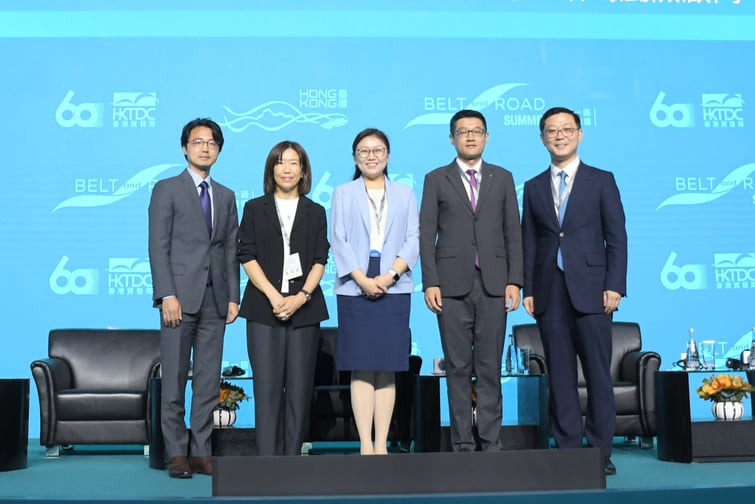
The IA hosted a panel session at the Belt and Road Summit on September 9, 2026, titled “Architecting a Global Risk Strategy: Hong Kong as the End-to-End Risk Advisor for Globalizing Enterprises.”
Clement Lau (pictured left), the IA’s executive director of policy and legislation and the panel’s moderator, framed the issue in terms of structural change in BRI itself. “The Belt and Road Initiative has evolved from the construction of standalone infrastructure projects to the operation of global business ecosystems, requiring enterprises to adopt proactive and consolidated risk management solutions to tackle the increasingly complex risks,” he said.
He added: “By leveraging Hong Kong’s unique strengths as a global risk management centre with a deep pool of insurance solutions and professional advisory services, we stand ready to support Chinese Mainland enterprises throughout their overseas expansion journey, from risk assessment to executing tailored mitigation strategies.”
The panel examined how Hong Kong’s cluster of maritime law, trade finance, and insurance expertise could serve as a coordinated advisory offering. It also addressed SMEs, which now represent a growing share of BRI participation but are typically the least equipped to manage cross-border risk.
The environments these companies are entering carry significant political risk exposure. Most are not covered for it. A Howden survey of around 500 senior risk and treasury executives found that 51% of multinational companies suffered a political risk loss to an international investment between 2020 and 2025. Companies holding political risk insurance (PRI) reported average losses at least US$1.4 million lower than those without it.
Demand for PRI is estimated to rise 33%, according to Howden’s 2025 survey of multinational corporates, driven by trading environment instability and tariff uncertainty. Yet 73% of non-buyers cited lack of awareness as the top reason for not purchasing cover. That is a distribution problem – and established insurers are already responding to it.
In March 2025, MSIG launched a collaboration between its Hong Kong, Singapore, and US operations to expand political risk and trade credit capacity across the two Asian hubs, citing growing regional demand. “By collaborating with MSIG Singapore and MSIG Hong Kong, we are strengthening our ability to serve global clients with tailored solutions that address the challenges of international trade,” said Peter McKenna, CEO of MSIG USA.
UNCTAD’s 2025 report on PRI notes that Asia accounts for the largest share of political risk coverage provided by export credit agencies and private insurers globally – reflecting China’s dual role as both a major recipient and a leading provider of PRI. The demand conditions exist. Penetration has not kept pace.
A week before the summit, IA chairman Stephen Yiu and CEO Clement Cheung travelled to Beijing on September 3 to meet Xiao Yuanqi, Vice Minister of China’s National Financial Regulatory Administration (NFRA), covering regulatory priorities and the integration of Hong Kong’s insurance industry into national development planning.
The meeting follows a run of concrete regulatory moves. In August 2026, the NFRA announced it will actively support Mainland insurance funds to participate in mutual access schemes between the Mainland and Hong Kong. Earlier, in February 2025, the NFRA lowered the asset threshold for Hong Kong and Macao financial institutions to invest in Mainland insurers, following CEPA revisions made in late 2024, per the Chinese central government.
Each step tightens the regulatory connection between the two markets. Whether that alignment extends to the placement and claims recognition side – making Hong Kong-placed covers more attractive to Mainland risk managers and their brokers – has not yet been confirmed.
Hong Kong is not the only hub making this argument. The Monetary Authority of Singapore (MAS) co-created a BRI Insurance Consortium, administered by the Singapore branch of China Reinsurance Group (China Re), covering construction and engineering, project cargo, and political violence and political risk for BRI projects across Asia-Pacific ex-China.
On reinsurance depth – which determines local retention capacity for large, complex risks – Singapore holds a 2.6% global market share, ranking seventh, against Hong Kong’s 1.4% at 12th, per International Association of Insurance Supervisors (IAIS) data.
Hong Kong’s full-year 2025 gross premiums reached HK$827 billion, up 29.7%, according to IA provisional statistics – growth that reflects a large and expanding market, though not yet matching Singapore’s specialty lines infrastructure.
Neither hub has yet claimed the private-sector BRI segment as its own. Both are building toward it.
The commercial logic is clear. Private Chinese companies are committing record capital to politically complex markets. Most lack adequate cover. The product most relevant to their exposure – PRI – is chronically underplaced, with awareness the documented primary barrier. Established insurers are visibly moving capacity into both Hong Kong and Singapore to meet demand that is already building.
Brokers with Chinese outbound clients do not need to wait for the regulatory picture to settle before acting. The client conversation – about what these companies face, what exists to cover it, and why they almost certainly do not have it – is overdue regardless of which hub processes the placement.