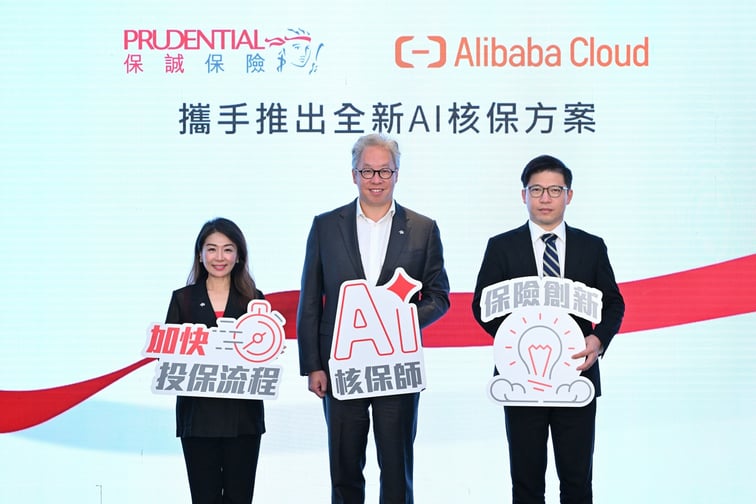
Prudential Hong Kong is not the only major insurer in the city putting AI tools into the hands of agents and consultants. But its September 9, 2026, deployment – a chatbot that returns preliminary underwriting indications at the point of sale, before any application is filed – makes the direction of travel in the Hong Kong market harder to ignore.
The broader pattern is this: large insurers are moving AI from back-office pilots into direct sales and underwriting support workflows. The broking community, for the most part, is not yet in the room when those systems are designed. The compliance obligations that follow apply to them anyway.
Prudential Hong Kong’s AI Underwriter gives financial consultants real-time preliminary indications on acceptance, exclusion, loading, or requests for additional information, based on a customer’s financial, medical, occupational, and residential profile. According to the companies’ joint press release, it delivers accuracy above 95%, with hallucination rates below 2%. It was built with Alibaba Cloud and deployed in under three months. Before the tool, a preliminary review could take days. It now takes minutes.
Manulife Hong Kong, which joined the Hong Kong Insurance Authority’s (IA) AI Cohort Programme in June 2026, has separately deployed what it describes in its own announcement as an AI-powered assistant for agents supporting new business and underwriting enquiries – alongside a sales enablement tool that provides agents with data-driven insights. Manulife has also announced a strategic partnership with Alibaba Cloud to develop further AI use cases.
Two of Hong Kong’s largest life insurers are running AI tools in agent-facing underwriting workflows simultaneously. That is the competitive context Prudential’s announcement sits within.
Hong Kong’s IA has been tracking this shift. In December 2025, Secretary for Financial Services and the Treasury Christopher Hui cited an IA survey at Insurtech Insights Asia showing that only 20% of Hong Kong insurers had formulated formal AI strategies and were actively implementing solutions. More than half remained in exploratory or pilot phases, while 40% planned to increase investment over the following two years.
A PwC survey of 201 financial services professionals in Hong Kong and mainland China, conducted between October 2025 and January 2026, found that 61% of firms are allocating 10% or less of their technology budget to AI – a gap of 30% to 40% against what PwC identifies as the global standard. In insurance specifically, PwC found customer service is the leading application. The report concluded that most firms view AI as a driver of strategic transformation rather than simply an efficiency tool.
The IA launched its AI Cohort Programme in August 2025, with seven founding insurer participants. By June 2026, that number had reached 10 – a list that now includes AIA, AXA Hong Kong, BOC Group Life, China Life, China Taiping, FWD, HSBC Life, Manulife, Prudential, and YF Life.
At the June 2026 AI Cohort Symposium, IA chairman Stephen Yiu said: “AI adoption does not happen in isolation. It depends on insurers, technology companies, and the broader ecosystem progressing together.”
Updated AI supervisory guidance from the IA, signalled for 2026, had not been published as of this article’s date.
Prudential’s AI Underwriter currently sits within its financial consultant channel. Brokers submitting to Prudential are not yet working inside the same AI-assisted pre-qualification process.
That changes in the next phase. Prudential has confirmed that future rollout stages will extend the tool into brokerage distribution channels. Manulife’s agent-facing AI assistant operates across its distribution network, which includes independent broker channels.
The practical implication is already forming. Candy Au Yeung (pictured left), chief customer operations and health officer at Prudential Hong Kong, stated that the tool helps consultants collect more complete information from customers upfront and reduce administrative back-and-forth. When that standard becomes the norm for insurer-aligned consultants – and then extends to broker-submitted business – the bar for pre-submission quality shifts with it.
The governance layer compounds this. In July 2025, the International Association of Insurance Supervisors (IAIS) published its Application Paper on the supervision of AI in insurance, covering both insurers and intermediaries. The paper does not create new standards, but confirms that existing conduct obligations – governance, accountability, transparency, and fairness – apply fully to AI-assisted workflows.
The implication for brokers is direct: AI deployment by a counterparty insurer does not reduce an intermediary’s conduct obligations. If a customer’s information has been processed through an AI triage system before submission, the broker remains responsible for demonstrating that pre-contract information was properly handled.
Against this backdrop, the PwC finding that most Hong Kong financial services firms – including insurers – are allocating less than 10% of their technology budget to AI is notable. The firms moving fastest are large insurers with the resources to close that gap quickly. Smaller broking operations face the same market shift without the same investment base.
The IA has acknowledged the disparity. Our reporting on the June 2026 AI Cohort Symposium noted that Yiu encouraged core participants to share practical experiences with brokers and smaller market participants, so the broader market can advance at a proportionate pace.
That is a regulatory signal, not a guarantee. The timeline for those learnings to reach the broking community remains open.
Lawrence Lam (pictured centre), CEO of Prudential Hong Kong, said: “For us, this is what AI leadership means – making insurance simpler, faster, and stronger for customers and our distribution channels.”
Future phases of AI Underwriter are expected to cover bancassurance and brokerage channels and to make the tool available to Prudential’s internal underwriting team.
For brokers, the question is no longer whether AI in underwriting affects them. It is how fast the standard moves, and whether their own processes are built to meet it.