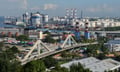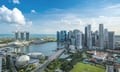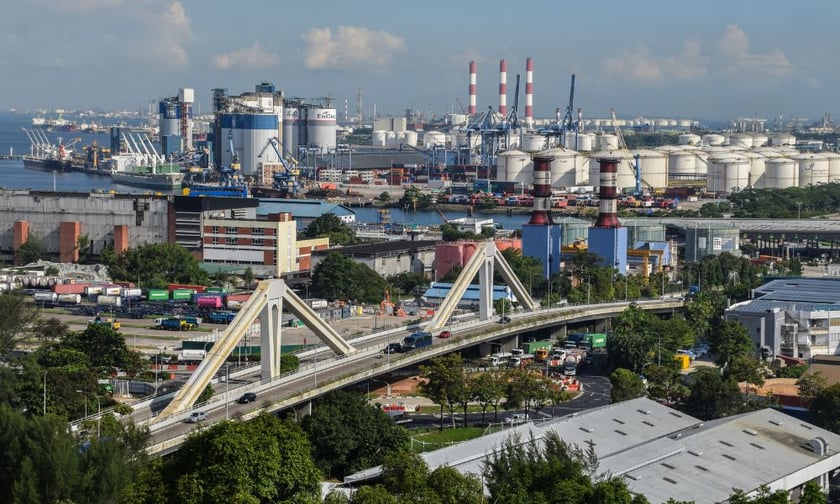
Prime Minister Lawrence Wong announced at the National Day Rally on August 23 that Singapore intends to merge Pulau Semakau, Pulau Bukom and Pulau Sudong - and potentially Pulau Hantu, Pulau Jong and Pulau Sebarok - into a single larger landmass south of Jurong Island over the coming decades, to be known as the Western Island. The new landmass will support advanced manufacturing, new power generation infrastructure and defence needs, modelled explicitly on Jurong Island's development as a global energy and chemicals hub.
Wong was direct about the timeline and the uncertainty: "These are long-term plans. We are studying them carefully." No reclamation tender has been issued, no engineering specifications are in the public domain, and no insurance placement timeline exists. What does exist is a policy direction - and a regulatory infrastructure that has been building in parallel, independent of any specific project, toward exactly the kind of large-scale, long-duration, technically complex risk this island would eventually generate.
The Western Island announcement follows a sequence of major reclamation announcements. Wong also revealed plans at the same rally to develop Pulau Brani - currently a container terminal - as a tourism and heritage site adjacent to Sentosa, and to extend Changi Airport with a new Terminal 5 and associated reclaimed land. Each of these creates insurance and infrastructure financing questions. The Western Island is the most complex by an order of magnitude.
Jurong Island, the closest comparable, was formed through the progressive reclamation and merger of seven offshore islands between the late 1980s and early 2000s. It now houses more than 100 global energy and chemicals companies on approximately 3,200 hectares. Its insurance program, built up incrementally as tenants arrived and industrial assets reached operational status, had the benefit of comparable industrial and marine reclamation projects elsewhere in the region to model against.
The Western Island would be designed from scratch for an energy mix that has not yet been determined. Matthew Chew, nuclear competency and strategy lead at HY M&E Consultancy Services, said that "Singapore could design the island as an integrated energy hub where gas, low-carbon fuels, electricity imports, storage, renewables and potentially nuclear eventually operate together." That breadth of potential energy use - from conventional gas to storage to potentially small modular reactors - means the eventual insurance program would need to span technologies whose risk profiles are structurally different from each other and from anything currently operating on Jurong Island.
The urgency of that energy diversification question has sharpened in 2026. The IEA's Southeast Asia Energy Outlook 2026 found that the Middle East accounts for 60% of Southeast Asia's crude oil imports, and that US-Iran conflict disruptions to Strait of Hormuz energy shipments have exposed the region's structural supply chain vulnerabilities. Singapore's plan to create new physical space for domestic energy generation is a direct response to that exposure - and the political risk and supply chain dimensions of the project's eventual energy mix will need to be addressed within whatever insurance architecture eventually covers it.
A coastal reclamation project with a multi-decade build timeline, no operational comparator in the Singapore market, and an undetermined final energy and industrial use presents the same challenge as any technically unconventional build - but in more acute form.
The data centre construction boom across Asia-Pacific offers a useful parallel. An HDI Global report found that standard approaches to site selection, construction and coverage placement have proven insufficient for large, technically unconventional builds in that sector. Data centre construction costs across the region rose 10% year-on-year in 2025, according to Cushman and Wakefield's Data Centre Construction Cost Guide 2026, meaning replacement values shift constantly and demand active review at every renewal stage. A reclaimed island designed for as-yet-undetermined energy infrastructure compounds that problem: there is no comparable Singapore asset to benchmark the risk against, and a coverage program modelled on standard industrial or utility wordings risks under-scoping the exposure from day one.
Megaproject and marine reclamation work of this scale typically draws on specialised large-scale engineering, environmental liability and construction all-risk cover. How public-private partnerships eventually structure long-duration catastrophe and climate adaptation covers for the resulting coastal assets - the operational phase question that follows a decade or more of construction - is exactly the kind of development the Singapore alternative risk transfer market has reason to be watching now, well before any formal placement process begins.
At the Singapore International Reinsurance Conference on November 3, 2025, MAS managing director Chia Der Jiun named infrastructure financing and climate risk coverage among three priority areas for regulatory collaboration with the industry, citing an Asian Development Bank estimate that developing economies in Asia-Pacific will need to invest US$1.7 trillion annually in infrastructure through 2030.
MAS has finalised proposals for differentiated capital treatment of qualifying infrastructure investments under its Risk-Based Capital 2 framework, intended to help insurers match long-duration assets against their own long-term liabilities. A separate time-bound pilot offers capital relief for infrastructure investments that do not yet meet those qualifying criteria - with renewable energy projects still in construction named as an example, and asset managers including BlackRock,
Brookfield, Clifford Capital and Macquarie Asset Management having indicated interest in participating.
For an intermediary tracking a reclaimed island with a multi-decade build timeline and an undecided energy mix, that pilot is a meaningful signal. Singapore's capital rules are already designed to accommodate assets that remain in construction for years before generating operational risk data - precisely the profile the Western Island would have throughout its development period.
"The alternative risk transfer market expands the overall capacity and strengthens resilience to large-scale shocks," Chia said at SIRC. MAS has supported the issuance of 29 catastrophe bonds covering storms, earthquakes and floods globally and in the region, and has refreshed its ILS Grant Scheme to offset issuance costs while extending support to non-APAC risks and renewals.
Asia's insurance-linked securities market remains comparatively underdeveloped against the US, where ILS has become a significant source of hurricane risk capacity. That gap is the context for a separate MAS consultation opened in July 2026, building out a protected cell company framework designed to help Singapore compete for captive insurance, ILS and sovereign risk-pooling business in a segment where Labuan has been the only established Asian domicile. MAS has framed the proposal against approximately US$65 billion in Asia disaster losses in 2025, more than 90% of it uninsured, and a global natural catastrophe protection gap the Swiss Re Institute put at US$424 billion in the same year.
A PCC structure would give the eventual participants in a project of the Western Island's scale a mechanism to pool and transfer catastrophe risk without each partner setting up a standalone captive - an architecture that fits the profile of a multi-decade, multi-phase, multi-tenant industrial development before any formal insurance program can be structured. It is the kind of tool that tends to matter most during exactly the long preparatory period between announcement and first reclamation contract.
The Western Island is decades from operation. The regulatory infrastructure Singapore is building around it is already taking shape.