Monday’s offer for Challenger left the industry asking one question: who’s next?
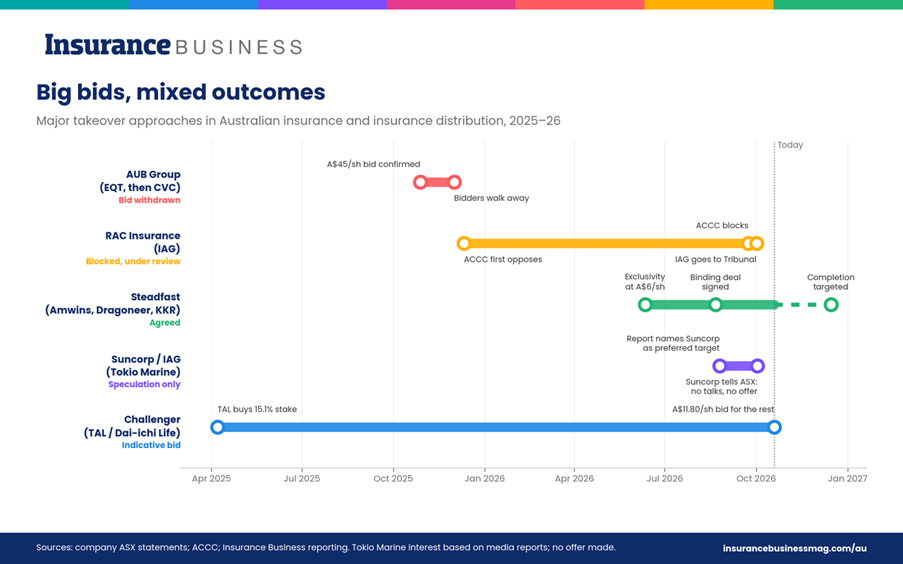
It’s a fair thing to wonder. Within a few months, Australia’s largest broker network has agreed to a foreign takeover, the country’s biggest annuity provider has received a bid from a Japanese-owned life insurer, and Suncorp and IAG have spent weeks fielding questions about Tokio Marine.
The short answer is that more deals look likely. The longer answer is that plenty of approaches never make it to the finish line, and the ones that do tend to arrive in bursts.
The buyers have deep pockets and a reason to spend
Start with Japan. Its big insurers have been shopping abroad for years, and the reasons they’re on a buying spree haven’t changed. Ratings agency AM Best has said a mature home market, held back by a shrinking and ageing population, is pushing Japanese insurers into overseas markets including the US and Australia. Swiss Re’s latest outlook for Japan makes the same point: the major life insurers are still diversifying through acquisitions and partnerships, with Australia named alongside the US and Europe.
They have plenty of cash to deploy, too. For the larger non-life groups, selling down strategic shareholdings through to 2030 is expected to free up capital for overseas activity. Tokio Marine is the obvious example. It was reported to be preparing to spend more than US$10 billion on overseas deals, funded partly by unwinding its cross-shareholdings in Japanese companies. Berkshire Hathaway’s 2.49% stake, taken in March, came with an agreement to jointly pursue large international acquisitions.
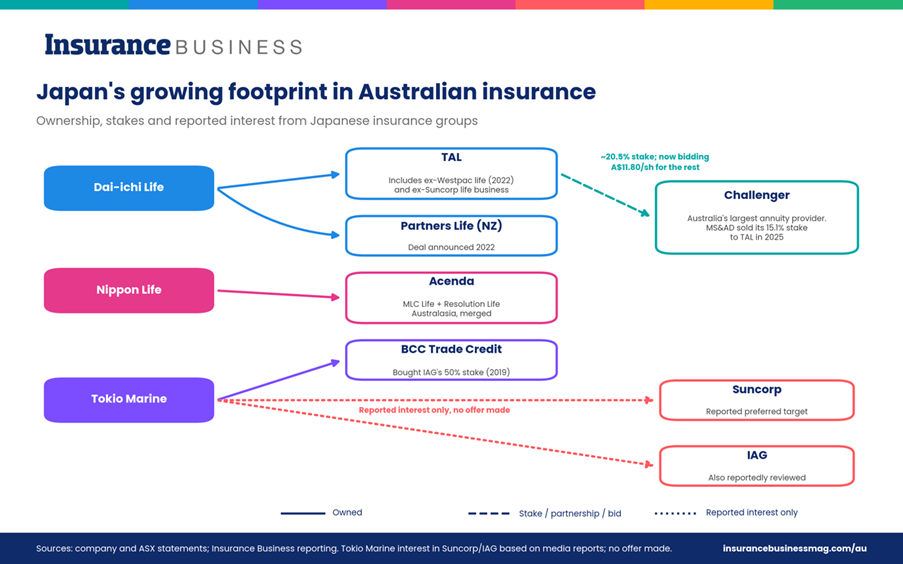
Japanese money is already deeply embedded in Australian life insurance. TAL, owned by Dai-ichi, has grown largely by acquisition. It bought Westpac’s life insurance business in 2022 and earlier paid $725m for Suncorp’s Australian life arm, while Nippon Life has merged MLC Life and Resolution Life Australasia into the Acenda Group. If the Challenger deal goes through, Dai-ichi would own both Australia’s largest protection insurer and its largest annuity provider.
Read next: Japanese owned insurer makes bid to take over Aussie financial company
Then there’s private capital. Going into the year, law firm MinterEllison predicted private capital would pounce on ASX-listed targets, noting sponsors still had plenty of money and were concentrating on fewer, larger and more complex deals. In insurance specifically, US law firm Debevoise has called private capital a primary driver of activity in broker, MGA and MGU markets. The Amwins, Dragoneer and KKR deal for Steadfast is the clearest local example. According to Mergermarket, it was the largest Australian deal of the first half of 2026, a period in which the country’s total M&A volume reached US$52 billion across 451 deals, up 23% on a year earlier.
Headline bids make it feel like insurance M&A is booming. The deal count tells a choppier story. S&P Global Market Intelligence data shows Australia and New Zealand, historically the region’s busiest insurance M&A market, fell to 16 deals in 2025 from 26 in 2024. The first quarter of this year brought a rebound, led by mid-sized transactions such as Zurich’s pending acquisition of ClearView, the region’s largest insurance deal of the quarter. Then activity dropped away again. In the second quarter, the ANZ deal count fell to two from nine in the first quarter.
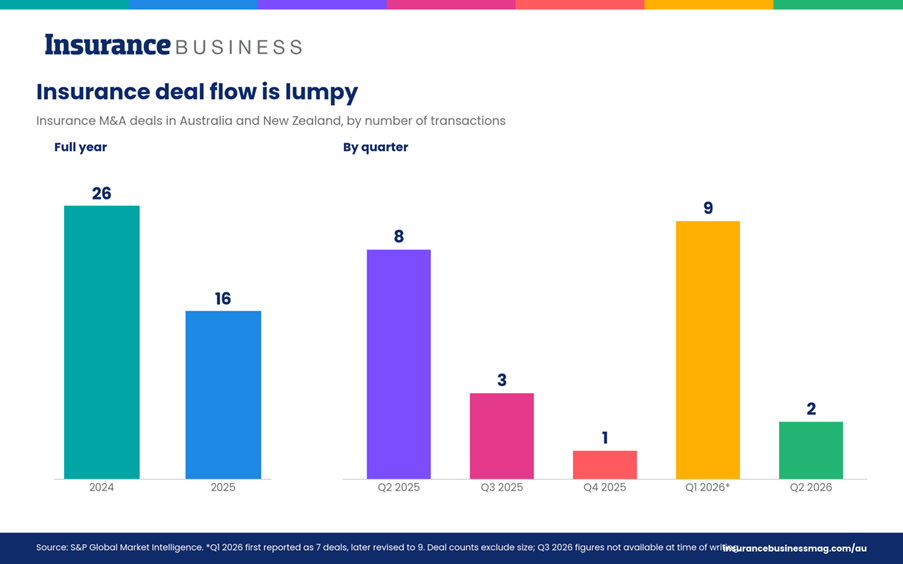
That pattern matters for anyone trying to read the market. A quiet quarter doesn’t mean buyers have lost interest, and a busy one doesn’t mean the floodgates are open.
The Suncorp story hasn’t gone away, even after the insurer told the ASX it was not in takeover discussions and had not received an offer. We broke the news yesterday of the latest bid for it.
Size is a constraint for any buyer. When Tokio Marine was weighing up its options, Canada’s Intact was reportedly considered too large. At roughly A$20 billion each, Suncorp and IAG sit within range, but beyond the two majors the pool of large listed insurers is shallow. The recent run of mid-sized deals suggests specialist insurers, agencies and portfolios are more likely to change hands than another blockbuster. In the second quarter, nib agreed to sell a large part of its travel insurance business, including the Travel Insurance Direct brand, to Allianz Partners.
Read next: Tokio Marine takeover talk returns as bankers reportedly ready for a Suncorp bid
AUB Group is the cautionary tale. Late last year, EQT, later joined by CVC, offered $45 a share for the broker. After exclusive due diligence, the pair told AUB they wouldn’t make a binding offer at that price, and AUB’s shares fell 16.7% to $31.02. AUB has since moved on with its own UK expansion, but the episode showed how quickly a headline premium can vanish once buyers see inside the books.
Regulation is the other hurdle, and it’s higher than it used to be. A mandatory merger control regime has applied since 1 January 2026, and it’s expected to raise execution risk and costs because approvals may take longer.
Insurers have already felt the effects. On 23 September the ACCC ruled that IAG’s acquisition of RAC Insurance must not go ahead, finding it would likely substantially lessen competition in Western Australia. In its decision, ACCC chair Gina Cass-Gottlieb said the deal “would eliminate the significant competition between IAG and RACI.” IAG isn’t giving up. It filed a challenge on 1 October, an early test of the new regime before the Tribunal.
Foreign bidders face extra checkpoints. Offers like Dai-ichi’s for Challenger need clearance from the Foreign Investment Review Board, and anything involving a regulated insurer also goes past APRA. That doesn’t mean deals get blocked, but it adds months.
Read next: $1.35b on ice: IAG takes RAC Insurance block to 12-day hearing
Probably, though in fits and starts rather than a steady stream. The buyers are motivated, the capital is there, and Australian insurance offers what offshore groups want: steady premium growth and an ageing population that needs retirement products. Against that, AUB and RAC show that price discipline and competition law can stop a deal cold, and the quarterly numbers show how quickly activity can stall.
For brokers and advisers, ownership changes are now a live business risk. Distribution agreements, capacity relationships and product shelves can all shift when a parent company changes hands. It’s worth knowing what your key partners’ change-of-control clauses say before you need to.