Catholic Church Insurance has just reached the point it spent three years preparing for. On Monday (23 November) the board of the run-off insurer determined that the financial conditions for a "Trigger Event" under its court-sanctioned scheme of arrangement had been met. Its remaining policyholders will now be paid a percentage of their claims rather than the full amount. Most of them are dioceses, religious orders, parishes and schools.
Church leaders moved quickly to reassure survivors. Archbishop Timothy Costelloe, president of the Australian Catholic Bishops Conference, said the final stages of CCI's wind-down would "not impose a moratorium on civil claims". He also said Catholic entities would remain liable for abuse claims regardless of the insurer's fate, and that they continued to meet their obligations under the National Redress Scheme.
That commitment is the part brokers should read closely. CCI's announcement says the reduced rate applies to what the insurer pays its policyholder, not to what a claimant receives. Agreed settlements and compensation are still owed in full, and the defendant entity is responsible for paying them. Whatever CCI doesn't pay, its policyholders must.
The scheme sets the trigger as the point where the board concludes that, without the scheme, CCI would be insolvent or likely to become insolvent. It is also met if the board concludes CCI's liabilities would exceed its assets once contingent and prospective claims are included.
Independent Scheme Advisers now have up to 90 days to set the payment percentage. They must consult a creditors' committee, but the committee has no veto. Payments on scheme liabilities are frozen in the meantime, and anything held back is paid within 60 days once the rate is set.
The terms leave policyholders few options. CCI's published scheme documents state the percentage cannot be disputed and there is no hardship exemption. Policyholders may also have to cover scheme liabilities that fall due during the freeze. Payments made before the trigger stand. Workers' compensation policies are outside the scheme and continue to be paid in full, and new claims can still be lodged under existing policy terms.
Chief executive Tim Farren said the change was expected. "The Trigger Event moves CCI into the next phase of that process," he said, adding that claims would continue to be handled in the ordinary course.
Read next: Catholic Church Insurance refuses bailout, closes down
CCI was founded in 1911 to insure church property. It stopped writing new business in May 2023 after its shareholders, mostly dioceses and religious institutes, declined to provide more capital, and the prudential regulator confirmed it would monitor the run-off. Policyholders voted unanimously for the scheme, and the Federal Court approved it on 2 November 2023. It was designed to stay dormant unless the company's position worsened.
The pressure came from professional standards claims, most relating to historical child sexual abuse. Claim numbers rose sharply after the Royal Commission into Institutional Responses to Child Sexual Abuse and after states and territories removed limitation periods for abuse claims.
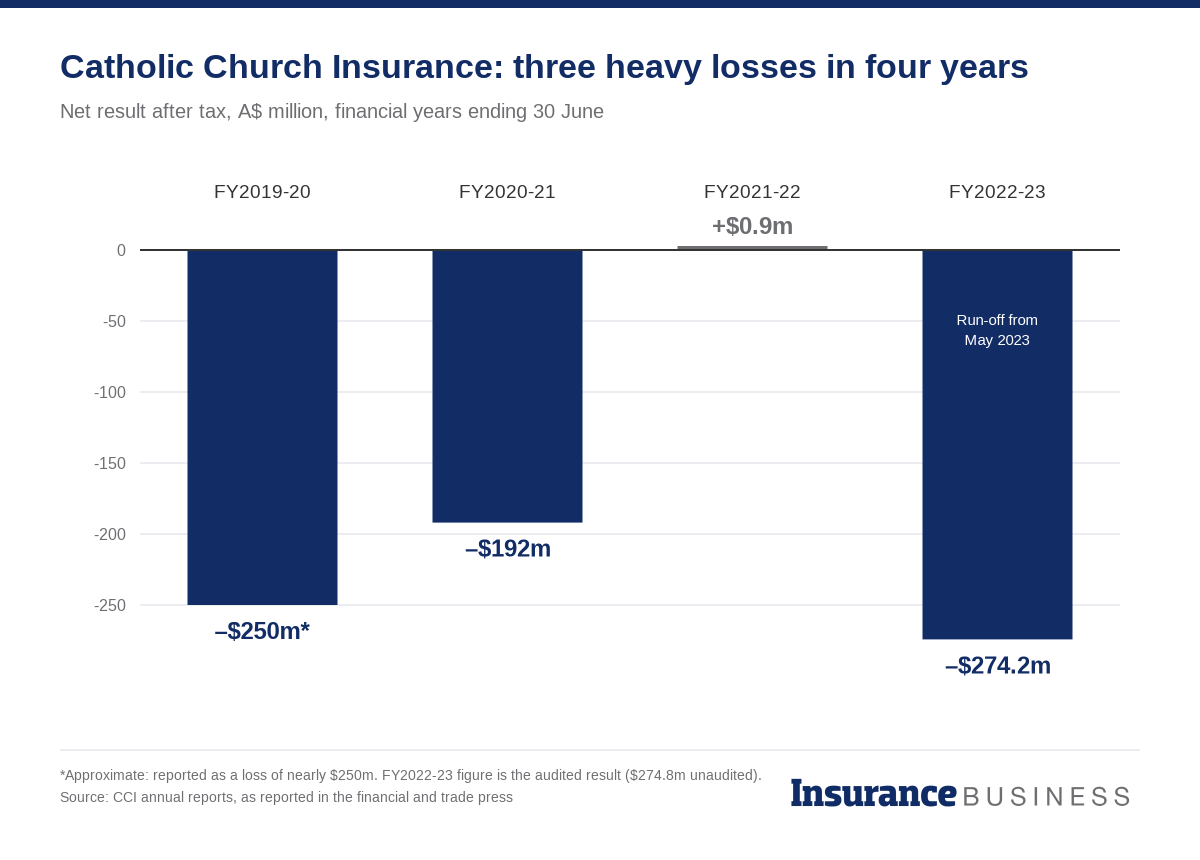
CCI lost close to $250 million in 2019-20 and $192 million in 2020-21, prompting 18 shareholders to inject fresh capital in 2021. A profit of $866,000 in 2021-22 was followed by a $274.2 million loss in 2022-23.
When policyholders voted on the scheme, CCI estimated its abuse-related liabilities at $381.3 million. Its book had fallen from more than 16,000 policies to about 7,000, as Insurance Business has reported. A subsequent annual report showed its prescribed capital amount coverage ratio had turned negative.
Read next: What's next for insurers and sexual abuse claims?
The organisations most exposed are those still relying on old CCI liability policies to respond to historical abuse allegations. These are occurrence-based covers, some written decades ago, now responding to claims lodged today. Those entities will fund the difference between CCI's payment percentage and the settlement, and may need cash on hand during the freeze.
Archbishop Costelloe said Catholic entities had used the past three years to place their general cover with new insurers. That protects them against future losses. It does nothing for abuse alleged to have occurred decades ago, which no current policy will pick up. A large archdiocese can probably absorb its share. A small religious congregation that owns buildings but holds little cash will find it harder.
Brokers advising these clients will want to check that finance teams have provisioned for lower recoveries and that boards understand the size of the exposure. They should also consider whether closer scrutiny of trustees and directors could test management liability programmes.
Sparke Helmore's Gillian Davidson predicted in 2023 that insurers would ring-fence legacy abuse portfolios, as the industry did with asbestos. Some state governments have already provided indemnities to service providers that could not find cover.
Read next: Insurer exodus results in 'confidential' state abuse claim indemnities – report
New business is a different picture. Insurer appetite for faith-based risks has picked up since CCI's exit, although abuse and molestation cover is still written selectively (see our guide to non-profit insurance).
The payment percentage is due within 90 days of the trigger, which puts the deadline around late February. Until it is published, CCI's former policyholders cannot accurately calculate what the shortfall will cost them.