The administrators arrived at David Jones yesterday. Trade credit underwriters had made their call long before the final nail was hammered in.
The directors of the 188-year-old department store chain appointed McGrathNicol as voluntary administrators. Within hours, secured lender Hilco called in FTI Consulting as receivers and managers of parent company ACP Riley Street Midco. David Jones’ 38 stores across Australia and New Zealand, and its online business, are still trading while the receivers review operations. Hilco says it will keep supporting the business until new owners are found. The ramifications for employees could be huge as the group employs more than 6,000 people.
The immediate trigger was rent. David Jones stopped paying after 30 September, and talks with Westfield owner Scentre Group broke down. Scentre is landlord at 17 of the chain’s sites, and its proposed lifeline was rejected by David Jones’ private equity owner, Anchorage Capital Partners.
For anyone who places trade credit cover, though, this was one of the most clearly signposted collapses in recent memory.
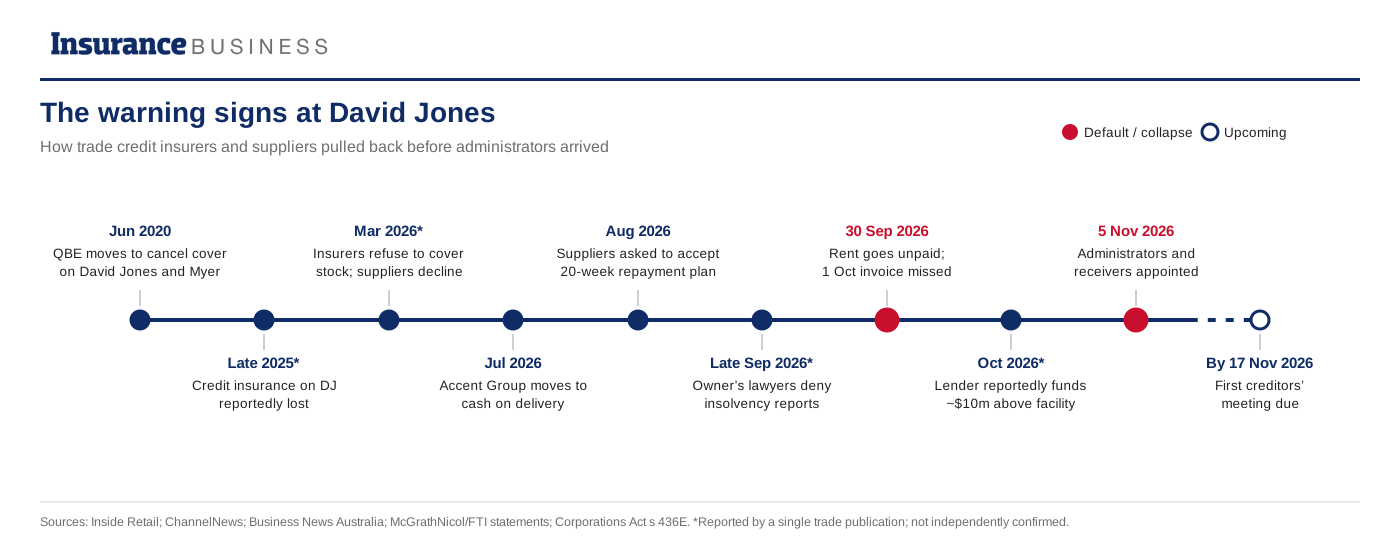
The warning signs built up over a year:
Read next: Insurers tighten terms as insolvencies rise – Lockton
Credit insurers have doubted David Jones before. In 2020, QBE told suppliers it would cancel cover on both David Jones and Myer, while Atradius, the Bond & Credit Co, Coface and Euler Hermes were all reported to be reviewing their limits on the department stores. David Jones got through that scare under its previous owner, Woolworths, which sold the business to Anchorage in 2023.
This time the retreat lasted longer, and the company pushed back harder. In late September, lawyers acting for David Jones’ ultimate owner wrote to one trade publication. They said reports questioning the retailer’s finances were false and were damaging its relationships with suppliers and trade credit insurers. Five weeks later, administrators were appointed.
When insurers cut or cancel a buyer limit, the policy is doing exactly what it is meant to do. The underwriter is telling the supplier something about the buyer that the buyer won’t. A supplier who acts on that has had an early warning. A supplier who keeps shipping on credit anyway is carrying the risk alone.
Some suppliers are now in exactly that position. Since the appointment, suppliers have been stripping stock from stores. Many could not get insurance on goods already sitting on David Jones shelves, which leaves them fully exposed if that stock is caught up in the administration. The timing makes it worse. The holiday season has traditionally accounted for about half of David Jones’ full-year sales, so many suppliers had shipped heavily for Christmas.
The administrators say they will immediately seek either a recapitalisation or a sale of the business as a going concern. Anchorage is reportedly weighing a bid to take back a slimmed-down David Jones, free of its current debts.
Hilco has been here before. Almost exactly two years ago, Mosaic Brands entered voluntary administration, and Hilco, as its lender, appointed KPMG as receivers and managers the same day.
Ranking matters a great deal here. Hilco is the secured lender. In October it reportedly lent about $10m beyond its agreed facility so David Jones could buy Christmas stock. Suppliers and concession partners will generally be unsecured creditors unless they hold a properly registered retention-of-title interest on the Personal Property Securities Register, and unsecured creditors rank behind the secured lender. How much any individual supplier recovers will depend on its terms and registrations, so suppliers should get insolvency advice specific to their position.
The first deadline is close. Under the Corporations Act, administrators must hold a first creditors’ meeting within eight business days of being appointed, which puts it on or before about 17 November.
Suppliers who do hold cover have practical steps to take now. Trade credit policies typically set strict deadlines for notifying overdue debts and lodging claims, and they often require the insured to help with stock recovery. Brokers should be checking the wording with those clients this week, not at month-end.
Read next: Unity Trade Credit begins underwriting for Australian SME insurance
Suppliers aren’t the only ones caught. Country Road Group had already planned to pull close to 100 of its 283 David Jones concessions next year. The retail workers’ union, the SDA, says its focus is on keeping jobs and protecting entitlements. It has also pointed to the federal government’s payday super changes, which it says will stop workers losing up to three months of unpaid superannuation when an employer collapses.
The backdrop isn’t improving. According to ASIC’s insolvency statistics, 14,152 companies entered external administration for the first time in 2025–26, and retail remains one of the most affected sectors. Yet trade credit cover is still under-used in Australia compared with Europe, a gap specialists have long pointed out.
For brokers with wholesale, fashion, homewares or beauty clients, David Jones is a case study worth taking into renewal conversations. Three questions are worth asking:
Read next: Business credit demand loses momentum in early 2026
A cut buyer limit is information. David Jones’ owners spent part of this year insisting the market had it wrong. The underwriters, it turns out, had read the situation correctly.