On their own, a teacher's suspended registration in Geelong and a law firm signing up former students in Bendigo make a regional news story. For liability underwriters, and for the brokers who place cover for independent schools, they look more like a live case study in how historical abuse exposure resurfaces, and how quickly the insurance questions arrive behind it.
The Victorian Institute of Teaching now lists the registration of a Geelong High School teacher as suspended on an interim basis. The teacher previously worked at Girton Grammar School in Bendigo, where the school says his employment ended in 2013. Victoria Police has confirmed that its Central Victoria Sexual Offences and Child Abuse Investigation Team received a referral in June about a possible incident in the Bendigo area, although police say no formal statement has yet been given. No charges have been laid, and the teacher has not publicly responded.
Victoria's Department of Education says he cannot work in any Victorian school while police inquiries continue.
Running in parallel is a potential civilaction. Shine Lawyers, which says it represents the person whose report led to the suspension, began calling for witnesses from Girton's 2000 to 2010 cohorts earlier this year and has since widened that window. The firm now reports more than 60 witness contacts and 12 signed clients. Girton has previously said it had received three legal letters, and that it is a participant in the National Redress Scheme.
Principal Dr Emma O'Rielly said the school's policies are built to deliver prompt and proportionate responses when concerns are raised, working with affected people and regulators.
Read next: Faith-based organisations find insurer appetite has returned
Twelve claimants is a modest book by the standards of Australia's biggest institutional abuse dockets, but the legal settings in Victoria make every file expensive to defend and hard to close.
Victoria became the first jurisdiction to scrap the limitation period for child abuse claims entirely, from 1 July 2015. Since 2017, the Wrongs Act has made organisations liable for abuse in their care unless they can prove they took reasonable precautions to prevent it. And since 2019, courts have had the power to set aside earlier settlements where that is just and reasonable, which means a file closed years ago can reopen.
This year has tilted the field further. In February, the High Court's decision in AA v Trustees of the Roman Catholic Church for the Diocese of Maitland-Newcastle confirmed that an institution that takes on the care of children can owe a non-delegable duty that extends to intentional wrongdoing such as sexual abuse, overturning earlier authority. Defendants relying on "standards of the day" arguments have lost much of that ground. Later the same month, Victoria's parliament passed legislation reversing the High Court's 2024 ruling in Bird v DP, so that vicarious liability once again reaches relationships "akin to employment", retrospectively.
For schools, where the people accused were usually salaried staff, the AA ruling arguably matters more than the vicarious liability fix. Either way, the defences available to a Victorian school facing historical claims are thinner now than at any point since the Royal Commission.
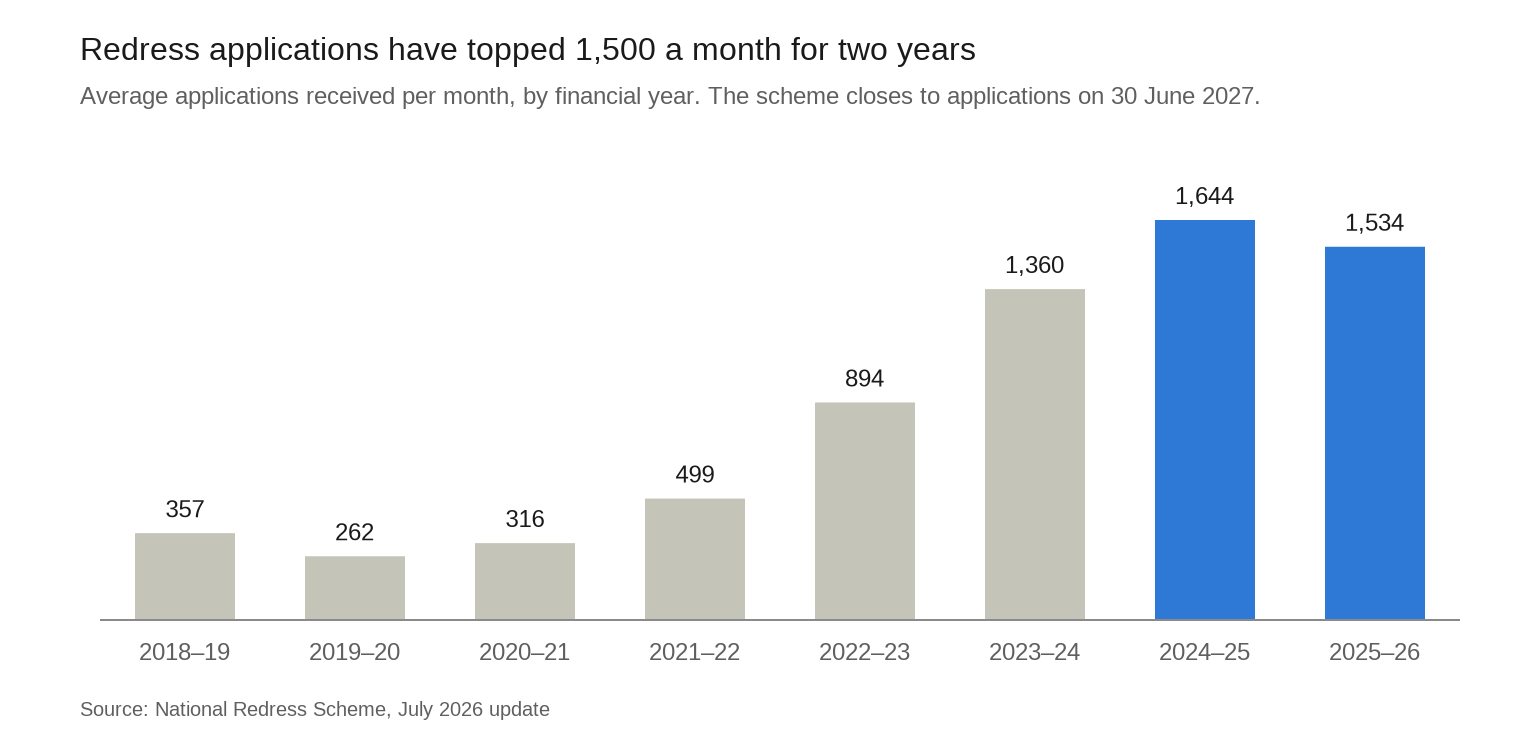
The National Redress Scheme adds a deadline. As at 31 July 2026 it had received 84,299 applications and made 23,705 payments worth about $2.1 billion, and applications close on 30 June 2027. Redress payments are capped at $150,000, and a survivor who accepts an offer releases the institution from civil liability for that abuse. Once the window shuts, anyone who has not applied has one route left: the courts.
For participating schools and their insurers, the next seven months may go a long way to deciding how much of the remaining exposure settles through capped redress, and how much turns into litigated claims assessed on common law damages.
Read next: How claims farming is increasing insurers' risks from sexual abuse cases
The more immediate question for the market is timing. The Knox Grammar coverage dispute, which Insurance Business unpacked in October, turned on when the insured knew enough to tell its insurer. A private investigator's report reached the school's headmaster in 2004, but bulk notifications did not reach Allianz until 2009. In February 2025, the Full Federal Court held that the Uniting Church's property trust was fixed with the school's knowledge, so the later notifications were too late to engage section 40(3) of the Insurance Contracts Act 1984. The High Court refused special leave in June 2025.
A police referral, a regulator's interim suspension and a law firm publicly recruiting claimants are each, on any reasonable view, facts that might give rise to a claim. Any school or school operator holding claims-made management liability, professional indemnity or association cover should already be talking to its broker about a circumstances notification, rather than waiting for a statement of claim.
For the older occurrence-based liability policies that would respond to conduct in the 2000s, the fight is different: which insurers were on risk in which years, whether the wordings survive, and how contribution is split. The Western Australian case of BB v Helena College Council, in which three successive insurers were held liable to indemnify one school, is a reminder that these files rarely sit with a single carrier.
Read next: Insurer exodus results in 'confidential' state abuse claim indemnities – report
Insurers pulled back from abuse cover after the post-Royal Commission reforms, prompting calls for government to step in, and Catholic Church Insurance went into run-off in 2023 carrying an estimated $381.3 million in abuse-related liabilities.
Appetite has since returned for well-run organisations. Charlotte Jolly, who leads Gallagher's faith specialty practice, told Insurance Business in September that "the biggest challenge today is ensuring organisations can provide the quality information insurers need to assess risk effectively". Safeguarding frameworks and governance records now sit at the centre of that conversation.
Clients that can show strong current safeguarding will find markets. Clients that cannot reconstruct who insured them in 2004, or that sat on a complaint for a renewal cycle too long, may find that the cover they paid for decades ago never responds.
The practical to-do list is not complicated: an audit of historical policy schedules, a check on whether any former carriers are now in run-off, written circumstances notifications as soon as police or a regulator are involved, and a hard look at abuse sublimits and aggregates on current programs. The Girton matter is at an early stage, and the allegations remain untested. The insurance lesson, however, is already clear: the time to notify is usually earlier than anyone thinks.