Australia's travel insurers have spent most of 2026 watching one indicator: the Smartraveller advice level sitting beside the Gulf's big transit hubs. On 8 October it turned in their favour. Within days, next door in Saudi Arabia, it swung hard the other way.
The Department of Foreign Affairs and Trade has lowered its advice for the United Arab Emirates and Qatar from Level 3, "reconsider your need to travel", to Level 2, "exercise a high degree of caution". DFAT cited an unpredictable security situation in Qatar, and the threat of terrorism on top of that unpredictability in the UAE.
That same day, the first in a run of Houthi missile and drone strikes hit King Khalid International Airport in Riyadh. By the end of the weekend, DFAT was telling Australians not to travel to the airport at all, while the rest of Saudi Arabia remained at Level 3.
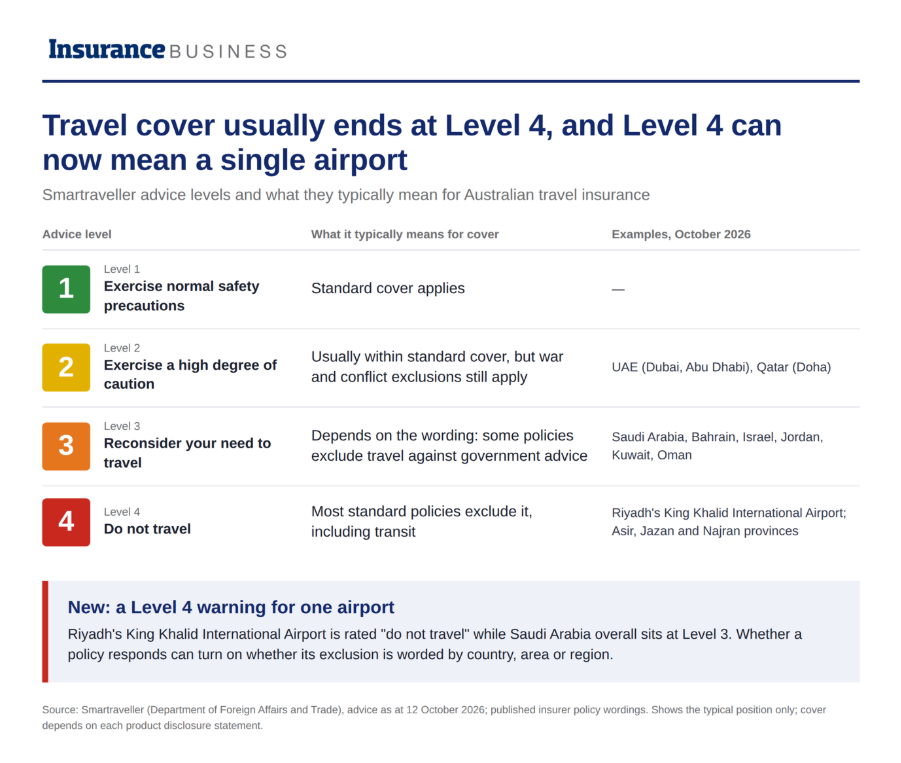
For underwriters and brokers, that combination matters more than the headline. Cover through the Gulf hubs was never at risk at Level 3, because the line that counts sits between Level 3 and Level 4. What's new is a Level 4 that applies to one airport rather than a whole country.
Read next: Middle East tensions refocus travel insurance coverage threshold
The hubs have come a long way since the opening weeks of the war involving the US, Israel and Iran, which began in late February and pushed Bahrain, Israel, Kuwait, Qatar and the UAE to "do not travel". That rating knocked out cover even for passengers who never left the transit lounge. The Insurance Council of Australia (ICA) declared the conflict a Significant Event on 3 March, setting up an industry taskforce and pooling claims data.
The Australian Travel Industry Association then led a sustained push for change, arguing that more than 150,000 Australians had passed through the hubs safely while technically uninsured. DFAT relented on 17 June, moving the five countries to Level 3 after a US–Iran ceasefire, as Insurance Business reported at the time. Before the war, Gulf carriers flew more than half of all passengers between Europe and Australia, New Zealand and the Pacific, according to aviation data firm Cirium.
The reprieve looked shaky in July, when fresh strikes, some aimed at targets in Qatar, led DFAT to harden its wording and prompted at least one former DFAT official to float a return to Level 4. That never came. Now the dial has moved the other way.
For most policyholders, not much, and that is partly the point. Shaun McGowan, chief executive of TravelInsurance.com.au, told The Canberra Times the test under his company's policy is whether a destination sits at "do not travel". Cover for Doha, Dubai and Abu Dhabi has been available since the June change, and last week's move doesn't alter that.
Tourism risk researchers see the shift mainly as a signal. Dr Garth Lean of Western Sydney University said Level 2 destinations generally fall within standard travel policies, but customers should still check exclusions for conflict and known events, and what happens to their cover if the level rises again.
Professor Brent Ritchie of the University of Queensland Business School said a lower rating may make cover easier to buy, though "travellers shouldn't assume they're automatically covered."
The ICA's position is that standard travel policies exclude losses caused directly by war and conflict, and the Australian Financial Complaints Authority has sided with insurers in most of the Middle East cancellation disputes it has determined, amid growing scrutiny of how war exclusions are explained to Gulf stopover customers. A lower advice level leaves the war exclusion untouched. Cancellations caused by a fresh round of strikes would still run into it, whatever colour the map shows.
Read next: Australia eases Middle East travel advice
Riyadh is where the harder underwriting questions now sit. Two attacks on the airport on 8 October killed three Saudi nationals, according to Saudi authorities. A far larger Houthi strike on King Khalid International on Saturday 10 October killed 13 people and injured more than 300, the deadliest attack in the kingdom in more than a decade, according to Saudi authorities and Reuters.
Another projectile hit Terminal 4 the next day, killing one person and injuring 11. Saudi aviation authorities have since extended the airport's closure through 17 October, a shutdown that flight tracker Flightradar24 says affects close to 700 flights a day.
Smartraveller now tells Australians not to travel to the airport, and anyone who must use it to reconfirm flights first and spend as little time there as possible. It also asks travellers to reconsider using other Saudi airports, and keeps a separate do-not-travel warning for the southern provinces of Asir, Jazan and Najran near the Yemen border.
Other governments have gone further. The UK has advised against all but essential travel to every Saudi airport except Medina's, and the US Federal Aviation Administration has warned American carriers of risks at all altitudes in Saudi airspace until 10 December.
McGowan expects only a small number of his customers to be caught, as Riyadh is not a main stopover for Australians bound for Europe. Those exposed are people connecting on Saudia or Riyadh Air, plus anyone visiting the city. For them, he said, the impact is significant: Smartraveller treats "do not travel" as "do not transit", and his policy's exclusion applies to regions within a country, not only whole countries.
Published wordings show why the answer depends on the insurer. One Allianz Partners-administered PDS says cover may be affected or declined where a claim arises because the traveller didn't follow government advice, and names both "reconsider your need to travel" and "do not travel" alerts. Under a clause like that, a Riyadh connection could stay exposed even after the airport warning lifts, because Saudi Arabia as a whole sits at Level 3.
Another Australian wording is narrower. It excludes travel to an "area" rated do not travel, while its cancellation trigger refers to advice against travel to or through a country that forms a major part of the itinerary.
That mix of country, area and region language worked well enough when advice moved whole nations at once. It is messier when DFAT can isolate a single airport, and brokers handling corporate travellers, including delegates to the energy conferences that went ahead near the airport last week, should expect clients to ask which word applies to them.
Read next: ICA declares Significant Event on Middle East travel disruption
The new settings may not last. The Houthis have threatened further attacks on Saudi airports and oil facilities, and US President Donald Trump has said Washington is considering joining Saudi strikes on the group. Smartraveller has already shown, in June and again in July, that it will revisit Gulf advice quickly when conditions change.
For insurers, the lesson from the past week is that advice now shifts city by city and airport by airport, not just country by country. That puts more weight on how PDS wordings define transit, and on what customers are told at the point of sale before the next change lands.