Insurers may have underwritten the policies, but when the bill for one of the messiest trade credit sagas in living memory finally arrived, it was one of the world’s largest brokers that reportedly dug deepest.
Credit Suisse has secured about US$800m (roughly A$1.2bn) to settle its Greensill-related claim, according to the Financial Times, which cited people familiar with the matter. Global broker Marsh is understood to be covering the largest portion, with IAG and Tokio Marine also contributing. None of the parties has confirmed the figure or how it was split, although Marsh’s figures show hundreds of millions booked against this very eventuality.
The deal ends the claim brought by two Credit Suisse supply chain finance funds in the Federal Court, which carried a face value of about A$2.8bn plus interest. On 25 September, IAG told the ASX that its subsidiary Insurance Australia Limited (IAL) had agreed to settle the Credit Suisse proceedings on confidential terms. The insurer said the settlement wouldn’t have a material impact on its financial position or FY27 results, pointing to expected recoveries from insurance, reinsurance and other indemnities.
That confirmation came four days after IAG told the market no settlement had been finalised, following press reports that the dispute had been resolved on the eve of trial.
Read next: IAG could be dodging $3 billion Federal Court showdown with Credit Suisse, AFR reports
Brokers arrange cover; they don’t put up capital to pay claims. So how did Marsh end up with the biggest cheque? The answer lies in what was alleged to have said about the policies, not in the policies themselves.
Marsh had been Greensill’s broker since 2014 and placed its trade credit cover with Bond & Credit Co (BCC). That put it in the middle of the arrangement, between the insurers and the investors buying Greensill’s notes. The Credit Suisse funds were named loss payees on the policies, so the value of their investments depended on that cover holding up.
When the funds added Marsh Ltd to the Australian proceedings in November 2023, they alleged the broker had failed to make sure representations about the cover were complete and accurate, and had made misleading statements and omissions. Greensill Bank’s administrators made similar claims, alleging Marsh hadn’t arranged suitable cover and had misrepresented the insurance placed for the German lender. In a separate London case, White Oak alleged Marsh knew in May 2020 that Tokio Marine wouldn’t renew the policies but didn’t pass that on.
The Australian forum mattered too. Marsh tried to pursue proceedings in London that could have cut across the Greensill Bank claims here, but the Federal Court shut that down in October 2025. Justice Thawley found the Australian cases had been validly brought and included statutory misleading conduct claims that couldn’t be run in England.
That left Marsh facing those statutory claims in Australia, where the case was set to go to trial. Marsh hasn’t admitted liability, and because every claim has now settled, none of the allegations will be tested in court.
The cost now shows up clearly in Marsh’s accounts. In its latest quarterly filing with the US Securities and Exchange Commission, the broker booked a US$144m charge for the Greensill litigation in the three months to 30 September, net of insurance recoveries. That brings its total Greensill charge for the first nine months of 2026 to US$569m, covering both the Credit Suisse deal and an earlier settlement with Greensill Bank, plus legal costs.
Marsh had already set aside a US$425m gross liability in the first quarter. It now says the settlements with White Oak, Greensill Bank and Credit Suisse end its involvement in the Australian proceedings, and it doesn’t expect any further charges.
Read next: Marsh reports strong Q1 2026 growth despite litigation hit
When Greensill Capital collapsed in March 2021, it took billions of dollars of investor money with it and dragged in backers including SoftBank and former UK prime minister David Cameron, who had lobbied on the firm’s behalf. Its pitch was simple: buy companies’ unpaid invoices, bundle them into notes and sell them to investors as low-risk products backed by insurance. Credit Suisse’s funds alone held roughly US$10bn of that paper.
Much of the cover came through BCC, a Sydney underwriting agency that IAG half-owned until it sold its stake to Tokio Marine in April 2019. In July 2020, Tokio Marine moved to stop the cover after finding that a BCC underwriter, Greg Brereton, had written policies beyond his delegated authority. He was dismissed, and the withdrawal of cover helped push Greensill over the edge.
When the claims arrived, the insurers argued the policies should never have stood. IAL’s defence, as recorded in a June 2026 Federal Court ruling on expert evidence, was that the policies weren’t valid and BCC had no authority to issue them.
Read next: Tokio Marine addresses speculation surrounding Greensill exposure
Trade credit insurance pays out if a business’s customers fail to pay their invoices. Greensill used it differently. Rather than protecting a single supplier, the cover sat behind the invoice-backed notes it sold to investors, and that cover was a large part of why the products were marketed as safe. When the cover went, so did the investors’ safety net.
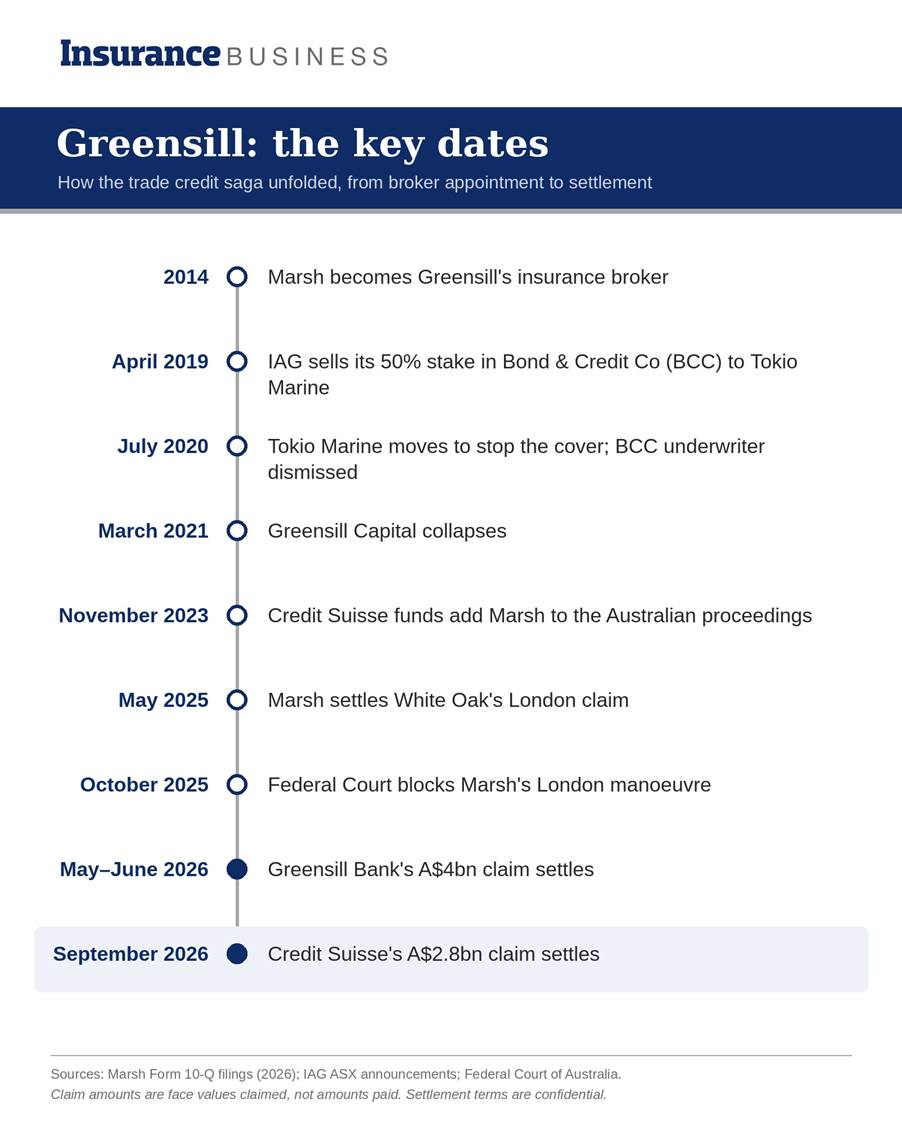
The Credit Suisse deal follows IAG’s settlement in May of a separate claim by Greensill Bank AG and its insolvency administrator, which had a face value of about A$4bn plus interest. Marsh dates its own settlement with Greensill Bank to June.
That leaves US lender White Oak as the last claimant in the Federal Court proceedings, which at their peak ran to 11 interlinked cases. White Oak is pursuing IAL over a claim with a face value of about A$170m plus interest, and IAG says it continues to defend it. Marsh settled White Oak’s separate London claim in May 2025 and recovered the cost through its errors and omissions insurance.
Read next: Insurer IAG settles one front of the Greensill legal war, but the hardest fight lies ahead
Neither insurer expects a hit to its bottom line. According to the FT, Berkshire Hathaway, which reinsures a large slice of IAG’s business, is expected to cover part of the settlement. Tokio Marine says it doesn’t expect a material impact. Even so, it disclosed earlier this year that Greensill-related reserves accounted for most of a ¥47.6bn (about US$301m) fall in profit at its Asia and Oceania operations last financial year, the paper reported.
Marsh, IAG, Credit Suisse and Berkshire Hathaway declined to comment on the reported figure. Tokio Marine said it wouldn’t disclose details of the settlement.
For Australian brokers, the case shows that placing the risk doesn’t keep you out of the courtroom. What a broker tells the people relying on a policy can matter as much as the policy itself.