Key numbers
Allianz has overtaken the country’s motoring clubs to become the insurance brand Australians are most likely to consider. The lead is narrow enough that “winner” may be too strong a word.
YouGov’s BrandIndex consideration rankings were published on 4 November and cover a full year of tracking to the end of September 2026. They put Allianz on 16.0%. The motoring club brands (RACV, RACQ, RAA, RAC and RACT) are tracked as a single entry and score 15.5%. AAMI is third on 14.9%. A gap of 1.1 points from first to third is about as close as brand tracking gets.
Budget Direct (13.0%) and NRMA Insurance (12.7%) complete the top five. Youi (11.0%) and Suncorp (10.8%) come next. Three private health funds make up the rest of the list: Medibank (10.5%), Bupa (9.5%) and HCF (7.6%).
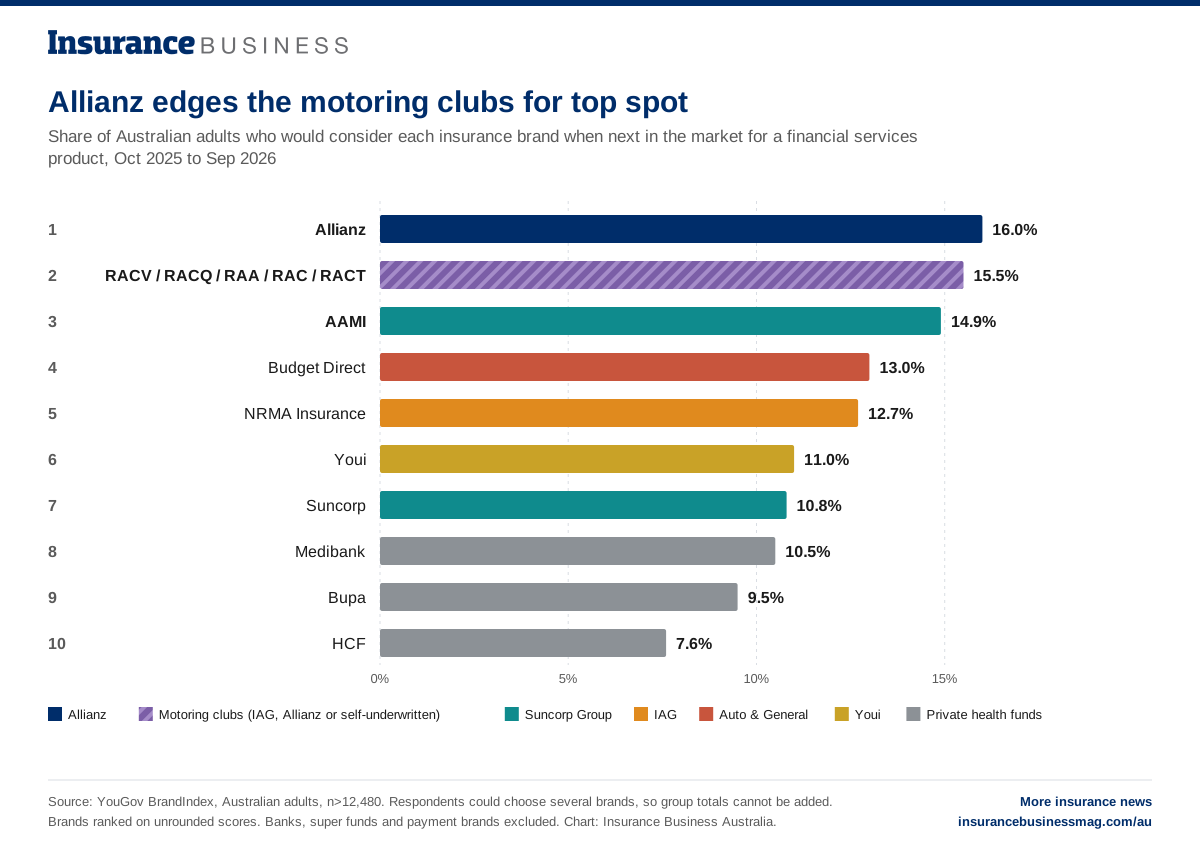
More than 12,480 adults took part. Each was asked which brands they would consider the next time they were in the market for a financial services product. Banks, super funds and payment brands were excluded from the insurance list, and positions were decided on unrounded scores.
The rankings come out while most households are still paying more for cover. The ACCC’s final insurance monitoring report, released in June, found that the cyclone reinsurance pool had lowered premiums in the highest-risk areas. Those areas account for only about 2% of policies. In the rest of the country, the average home and contents premium rose 10% to $2,310 in 2024-25. About half of the households surveyed for the report said their cover was unaffordable or barely affordable, as Insurance Business reported at the time.
When renewal notices hurt, people shop around. Brands that are already on the shortlist when they do so have an obvious advantage.
Read next: Australia’s cyclone pool keeps home insurance within reach in storm zones
The second-placed entry needs a caveat. The motoring club line combines five state-based brands. That gives it an advantage in a national survey, because a Queenslander who would consider RACQ and a Victorian who would consider RACV both count towards the same score.
The underwriting behind those badges has also shifted. In Victoria, IAG underwrites RACV-branded home and motor cover through a long-running joint venture, while RACV handles distribution and member relationships, according to the ACCC’s description of the arrangement. RACQ’s insurance business moved to IAG in September 2025, at the start of a 25-year partnership. In South Australia, Allianz paid $642 million for RAA’s insurance business, which gives it control of the home and motor book for 20 years.
That makes Allianz’s first place more significant than it first appears. It leads in its own right and also writes the risk behind part of the line in second place.
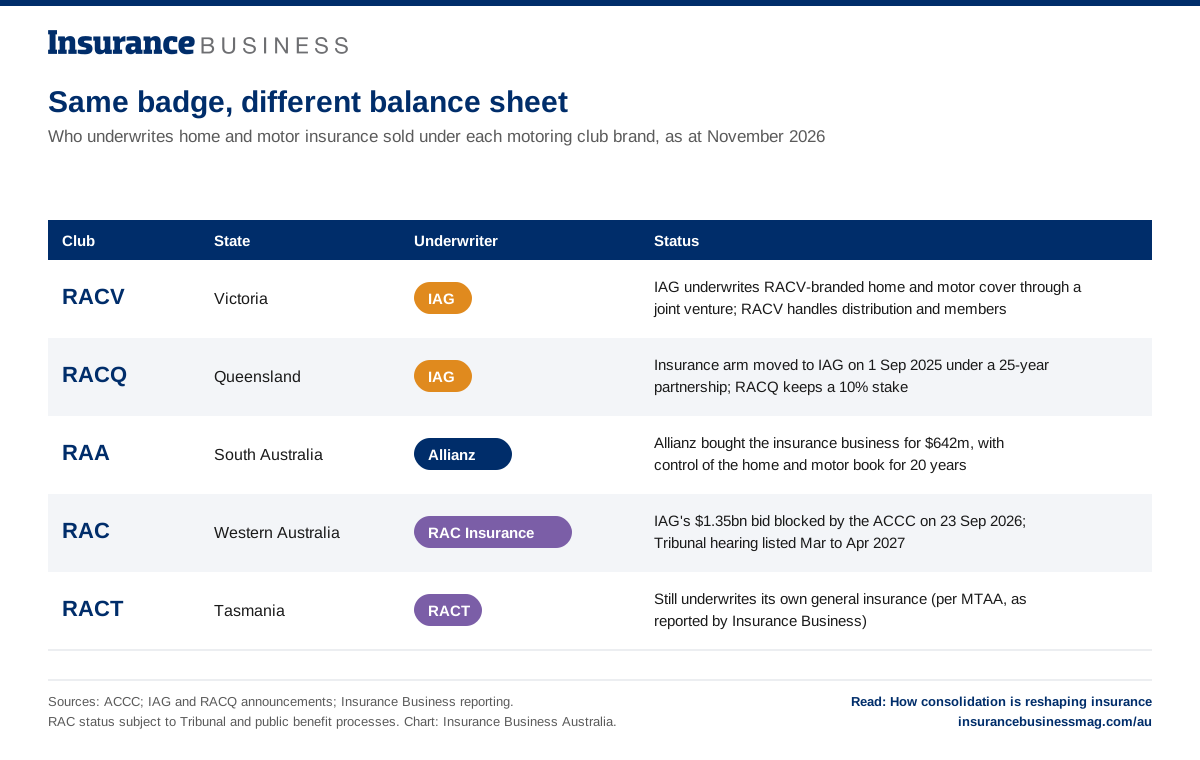
Western Australia is the exception. On 23 September the ACCC blocked IAG’s $1.35 billion bid for RAC Insurance for the second time. The regulator found that RAC Insurance leads the WA market in both motor and home cover, and that the deal would have given IAG between 55% and 65% of the state’s motor market. ACCC chair Gina Cass-Gottlieb said IAG was likely to be “a stronger competitor than it is presently” if the deal did not go ahead.
IAG and RAC’s parent have both taken the decision to the Australian Competition Tribunal, which has set aside 12 days for a hearing between March and April 2027. They are also pursuing a public benefit route with the ACCC. Until that is decided, RAC in WA and RACT in Tasmania remain the clubs that still underwrite their own general insurance.
Read next: $1.35b on ice: IAG takes RAC Insurance block to 12-day hearing
The rankings unsurprisingly line up closely with advertising budgets. Nielsen Ad Intel figures for the year to August 2025 named Youi, Allianz, Budget Direct, AAMI and HCF as Australia’s five biggest insurance advertisers, in that order. All five are in YouGov’s top 10. Nielsen’s later full-year 2025 rankings showed Youi moving up to 11th among all Australian advertisers, with Budget Direct and Allianz entering the overall top 20.
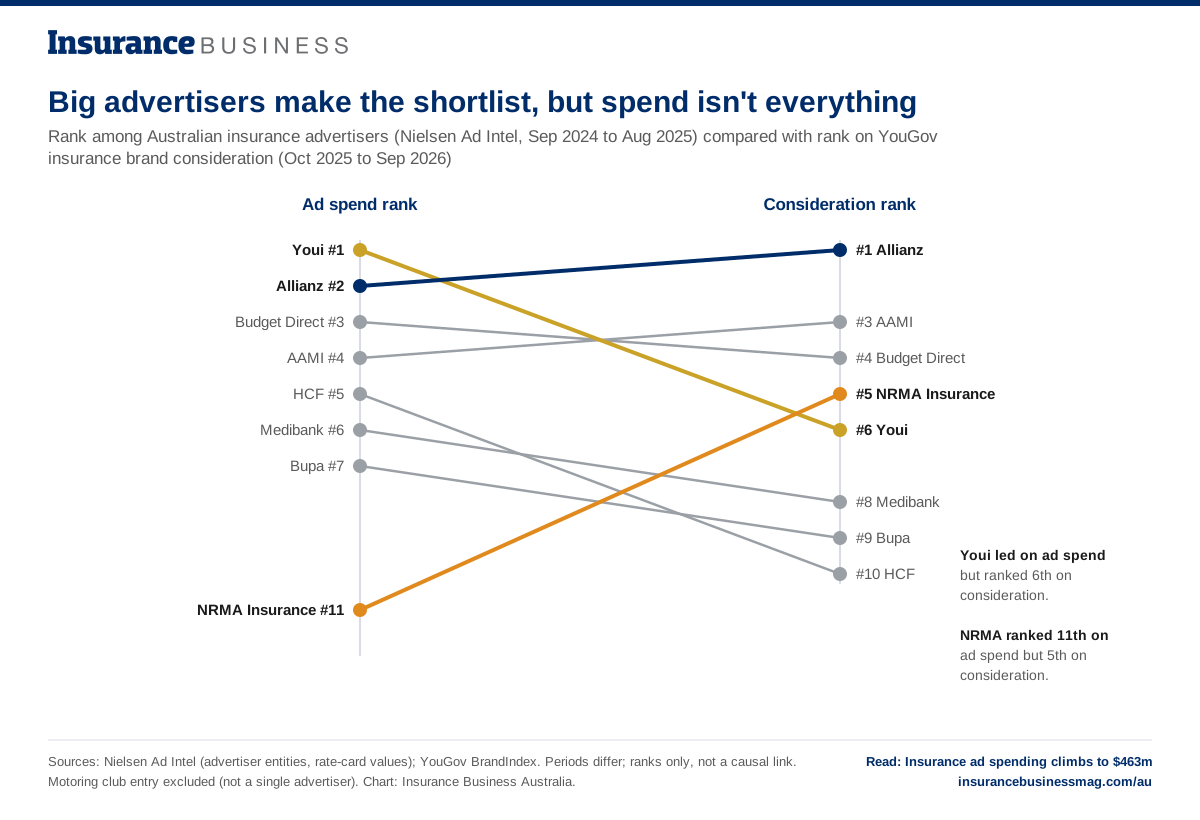
The relationship is not one-to-one though - Youi led on advertising but finished sixth on consideration. Still, it is hard to look at the two lists side by side and conclude that marketing spend makes no difference to which brands people shortlist.
Read next: Insurance ad spending climbs to $463 million amid rising competition
Viewed by parent group, Suncorp owns two of the top seven brands, AAMI and Suncorp. IAG has NRMA Insurance in fifth place, plus much of the motoring club line. The percentages should not be added together, though. Respondents could choose more than one brand, and many people who would consider AAMI would also consider Suncorp.
Challenger brands also did well. Budget Direct, which is owned by Auto & General, finished fourth, and Youi was sixth. Both sell direct and rely heavily on advertising rather than a branch network, and both finished ahead of Suncorp’s own namesake brand.
Health funds hold up despite a steep price rise
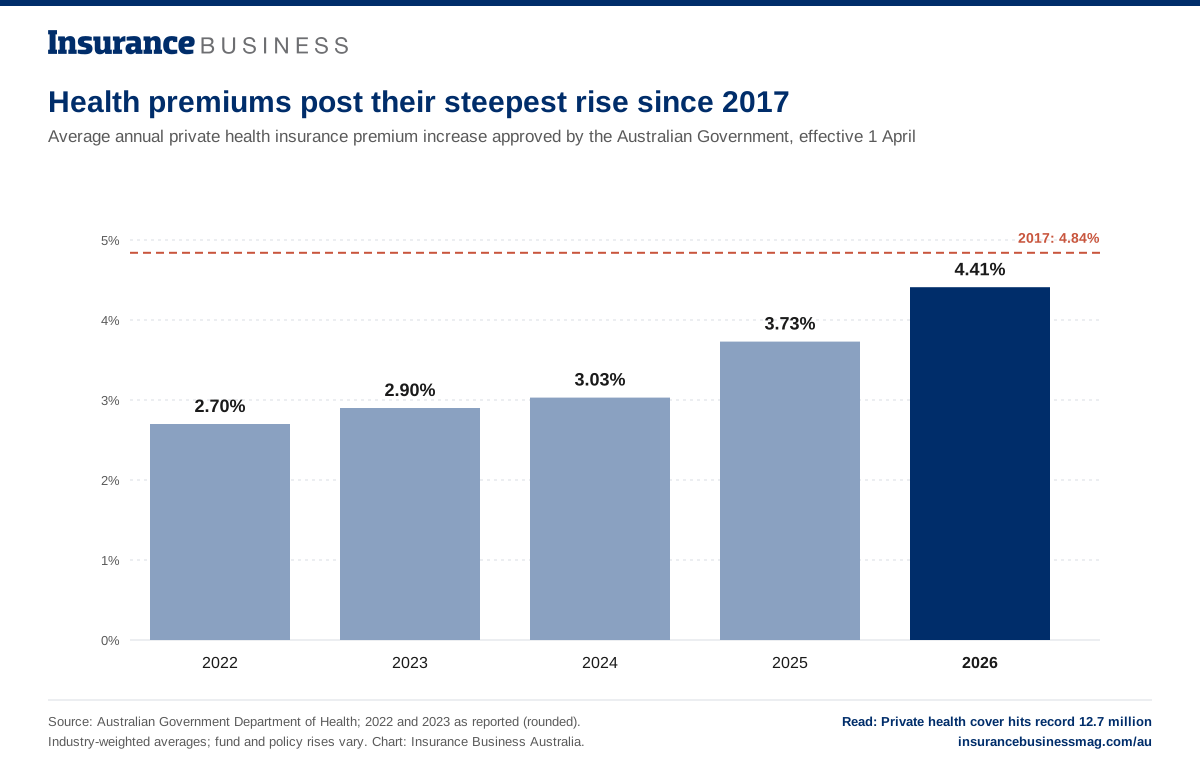
The three health funds reached the top 10 in a year when cover became noticeably more expensive. The federal government approved an average premium increase of 4.41% from 1 April, up from 3.73% the year before. It was the largest annual rise since 2017.
The increases varied by fund. Members Health Fund Alliance said its not-for-profit funds averaged 3.62%, compared with 5.12% for the three largest for-profit insurers. Even so, the number of people with private health cover reached a record.
Read next: Private health cover hits record 12.7 million
It’s worth remembering that being on a shortlist does not mean winning the sale – we brokers play the most important part of telling clients whether that advert they saw is, in fact, the best carrier for them. Consideration says nothing about price, claims handling or how an insurer performs after a catastrophe. What the rankings do show is which names clients will raise before a broker has said anything.
The more useful point for larger brokerages concerns brand and balance sheet. In personal lines, the brands consumers know best increasingly sit on top of a few national groups. Some of those groups also write intermediated business under different names; IAG, for example, trades through brokers as CGU and WFI.
A client who is attached to a local club badge may not know who carries the risk. A client who has never heard of a particular underwriter may be more comfortable once a broker explains that it is part of the same group as a brand they already trust.