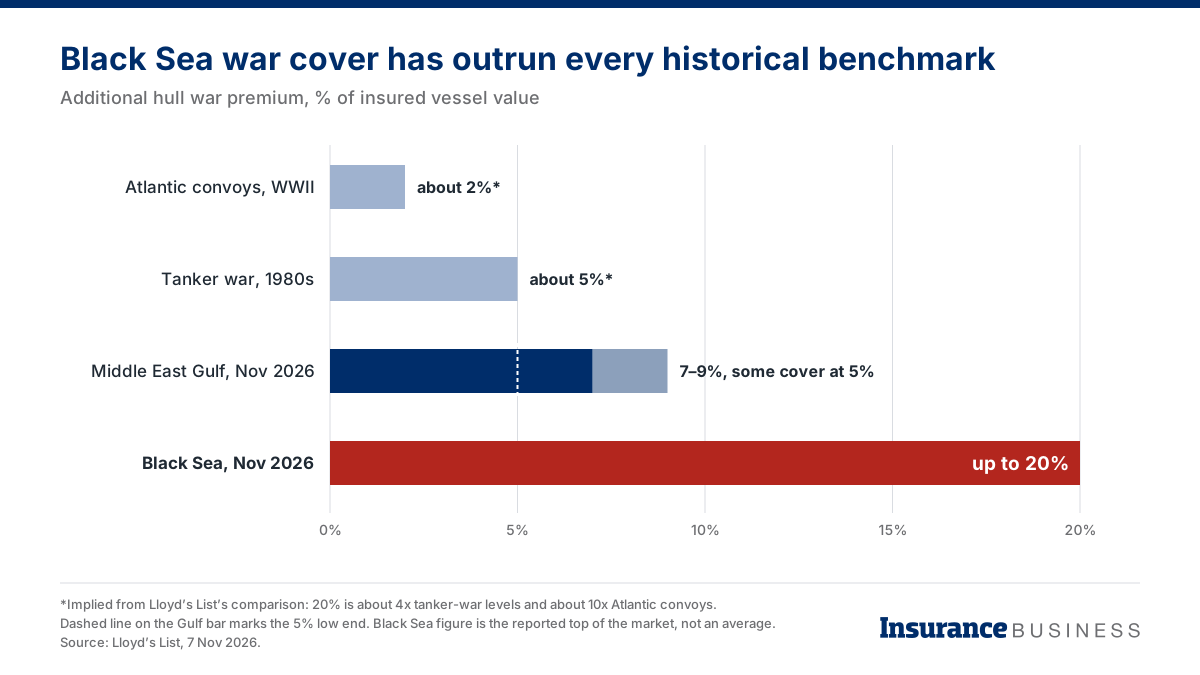
Insuring a ship against war in the Black Sea has never been cheap, but even with that in mind, it is now historically expensive. Lloyd’s List reports that Ukraine-related hull war premiums have climbed as high as 20%, roughly four times the levels seen during the 1980s tanker war and well above anything charged in the Second World War. The publication puts the figure at about ten times what Atlantic convoys paid in WWII.
Run that nrate through a mid-sized vessel and the arithmetic is brutal. At 20%, a ship insured for US$50 million would carry around US$10 million in additional premium for a single exposure. The cost would hit owners, charterers and, eventually, cargo interests.
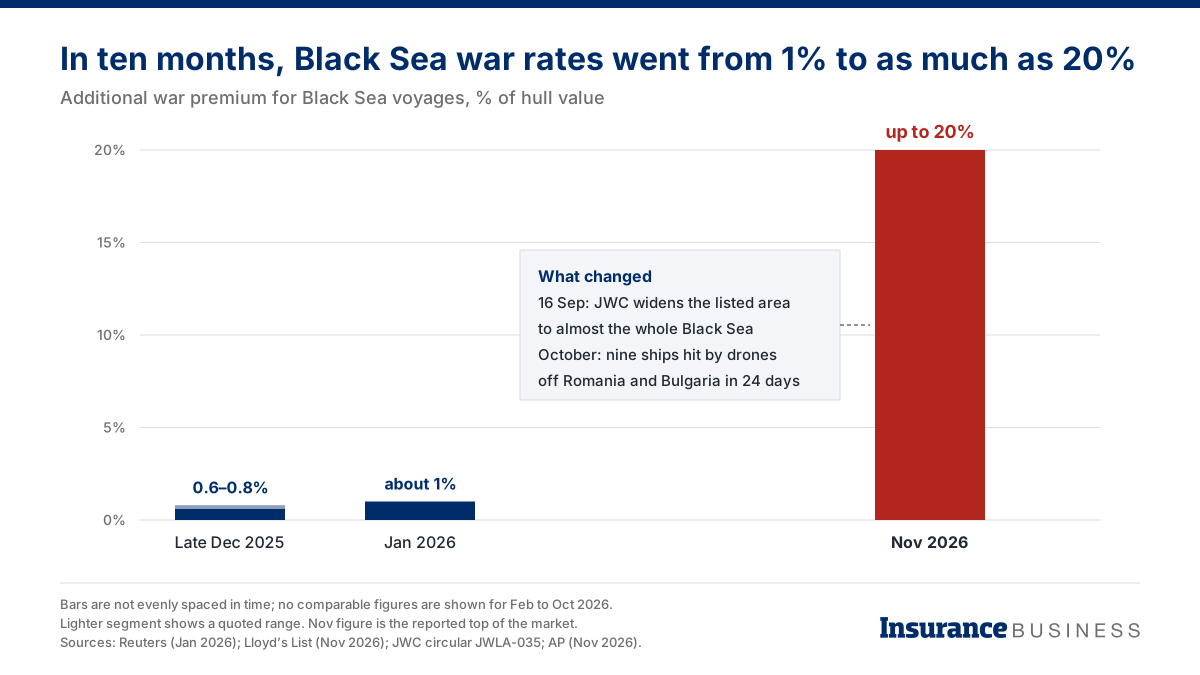
It’s a long way from the start of the year. In January, war cover for Black Sea port calls rose to about 1% of hull value, up from 0.6–0.8% in late December.
The London market had already redrawn the map before the latest surge. The Joint War Committee’s circular JWLA-035, issued on 16 September, extended the listed area across most of the Black Sea. Only the territorial waters of Turkey, Bulgaria, Romania and Georgia were left out.
Then the war at sea moved west. In a 24-day stretch of October, drones struck nine cargo ships and tankers near the Bulgarian and Romanian coasts, and at least 30 seafarers were confirmed dead or reported missing. On 23 October the Comoros-flagged carrier Khoryv capsized and sank around 13 nautical miles off Constanta, Romania’s main Black Sea port. Security firm Ambrey has logged 696 security events in the Western Black Sea alone, about 537 of them in Ukrainian waters.
Read next: Hormuz sinking hands marine war underwriters another total loss as attacks surge
Price is now only a part of the larger problem. Two analysts told Lloyd’s List, off the record, that they had been approached over possible charterparty disputes in which owners want to refuse charterers’ orders to call at Romanian and Bulgarian ports. Ambrey also says some crew members and masters are now reluctant to sail to either country. For brokers, that pushes attention onto the war risk clauses in charterparties, including those drafted by BIMCO. These clauses determine whether an owner can decline a port that has become dangerous and who carries the extra premium.
The trade damage is already visible. Ukraine halted operations at its Black Sea ports in late July because of Russian attacks, diverting cargo to Danube river ports and out through Romania’s Sulina Canal. On the Russian side, grain exports through the Black Sea and Sea of Azov fell to 0.3 million tonnes in September, against 4.74 million tonnes a year earlier. NATO has said it will send maritime patrol aircraft, radars and drones to reinforce its eastern flank in the Black Sea.
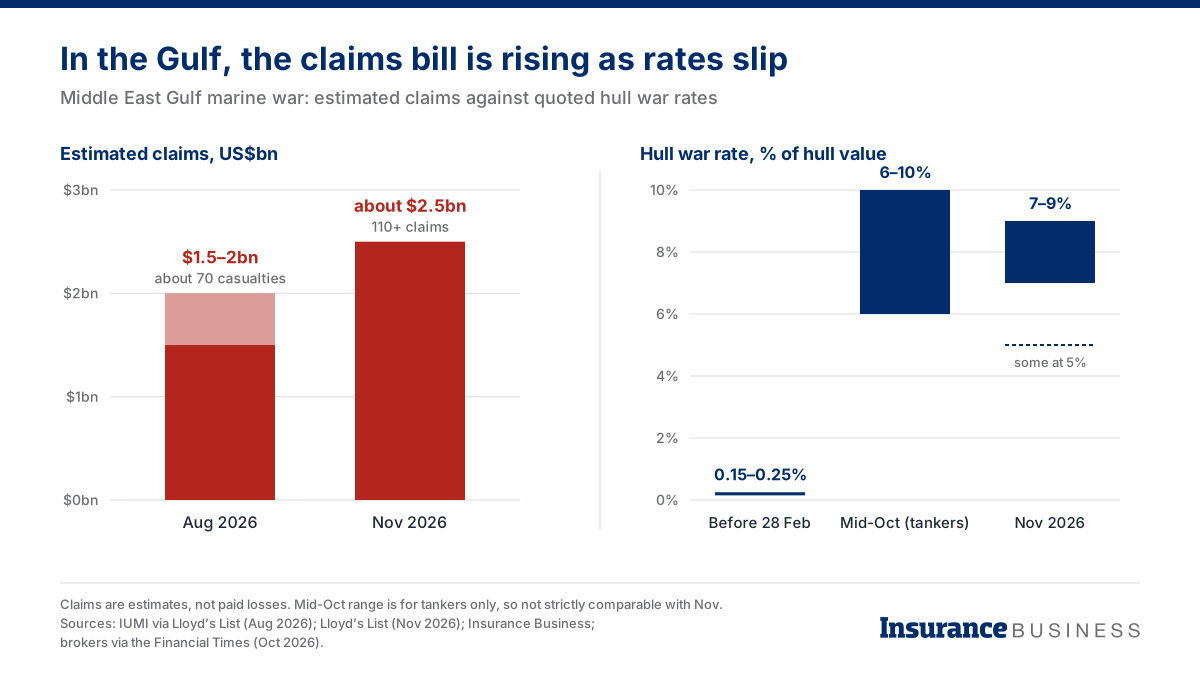
The picture in the Middle East Gulf looks almost backwards in comparison. Rates there have eased to 7–9%, and some cover is being written as low as 5%. This is despite more than 110 claims and estimated payouts of around US$2.5 billion.
That claims tally has grown quickly. In August, IUMI director general Lars Lange estimated claims of US$1.5–2 billion from about 70 casualties linked to the conflict. Rates have also come a long way from where they started. Before hostilities began on 28 February, hull war rates for Hormuz transits sat at around 0.15–0.25% of vessel value. As recently as mid-October, brokers were quoting additional premiums for Gulf tankers at 6–10% of hull value.
Read next: Washington’s $40 billion Hormuz insurance fix: zero takers
Capacity is the likeliest explanation. Plenty of new money has entered the market. Beazley set up a US$1 billion marine war consortium at Lloyd’s, split evenly between hull war and cargo war. In June, Lloyd’s announced a separate facility offering up to US$200 million each for hull and P&I risks, plus US$200 million of dedicated cargo capacity for Hormuz transits. Earlier in the conflict there was already signs of softening driven by competition from surplus capacity in the hull market.
Not everyone is comfortable with the trend. Lange has warned that keeping war risk insurable depends on pricing it well above peacetime levels. The strain is also showing further up the chain, in the wider war, terrorism and political violence class. Marsh Re’s Global Specialties 2026 Market Update puts Middle East losses in that class above US$2 billion, against an annual gross premium base of roughly US$2.5 billion. That could make 2026 the first loss-making year for the class. IB has examined how the conflict is sharpening accumulation concerns across terrorism and political violence books. None of this makes the 1 January renewals any easier.
Read next: War risk reinsurance posts first loss since 9/11
[EDITOR: insert quote from an Australian marine broker or underwriter here on how local clients are budgeting war premiums.]
For Australian brokers with clients in commodities, energy or chartering, the practical lesson is about speed. Black Sea war cover is a short-dated product that can change overnight. Calls into Russian or Ukrainian ports need additional war cover, usually written for seven days, and its terms are now reviewed every 24 hours. Clients trading into either region need budgets, and charterparty wording, that assume pricing can move sharply within a single voyage.
The two regions are now sending opposite signals. In the Gulf, the market has decided it can price the risk and is competing for the business. In the Black Sea, owners are starting to ask whether any price is enough.