By now most of the industry has seen the big numbers. AFCA received 119,949 complaints in 2025-26, up 19%, and secured $834.2 million in compensation and refunds. General insurance complaints rose a modest-sounding 5% to 36,022.
Modest is actually the wrong word. Read past the summary pages of the 200-page review and a sharper picture emerges. Claims disputes are surging. Life cover inside super is causing more grief than retail life. The code committees have been handing out sanctions. Here are nine stories the headlines missed, and what each one means for the industry.
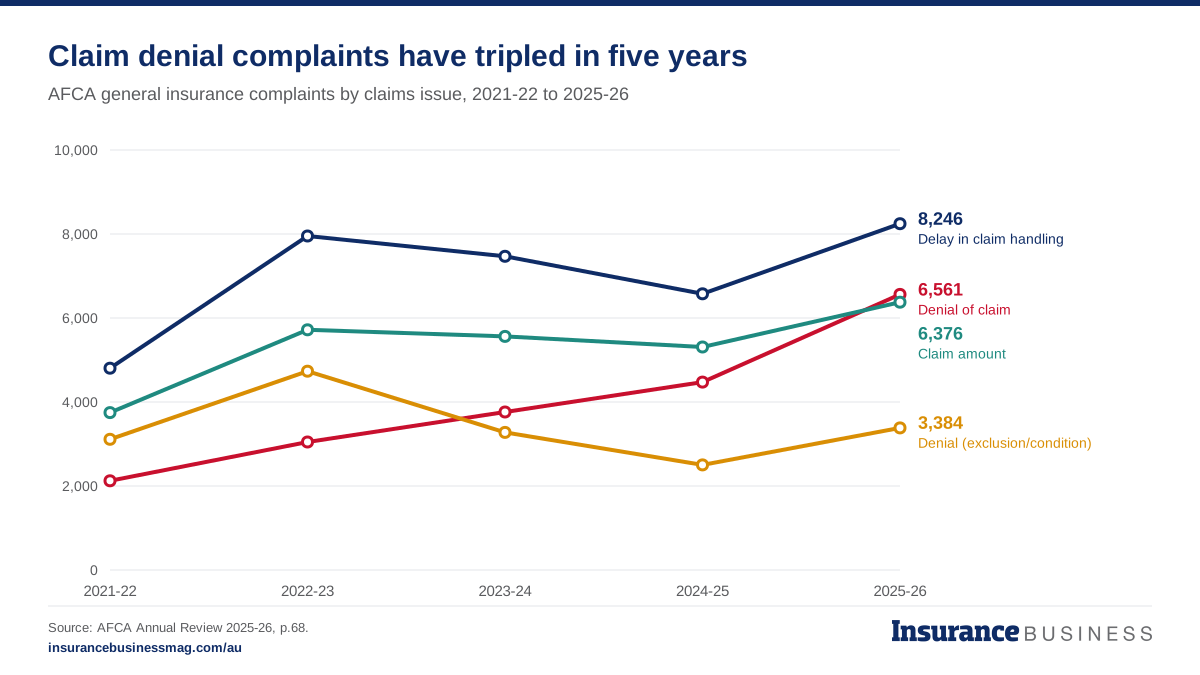
The 5% figure flatters the industry. Complaints about claims, the moment of truth for any insurer, rose about 30%. The four claims issues AFCA tracks went from 18,862 to 24,567 combined (p.68).
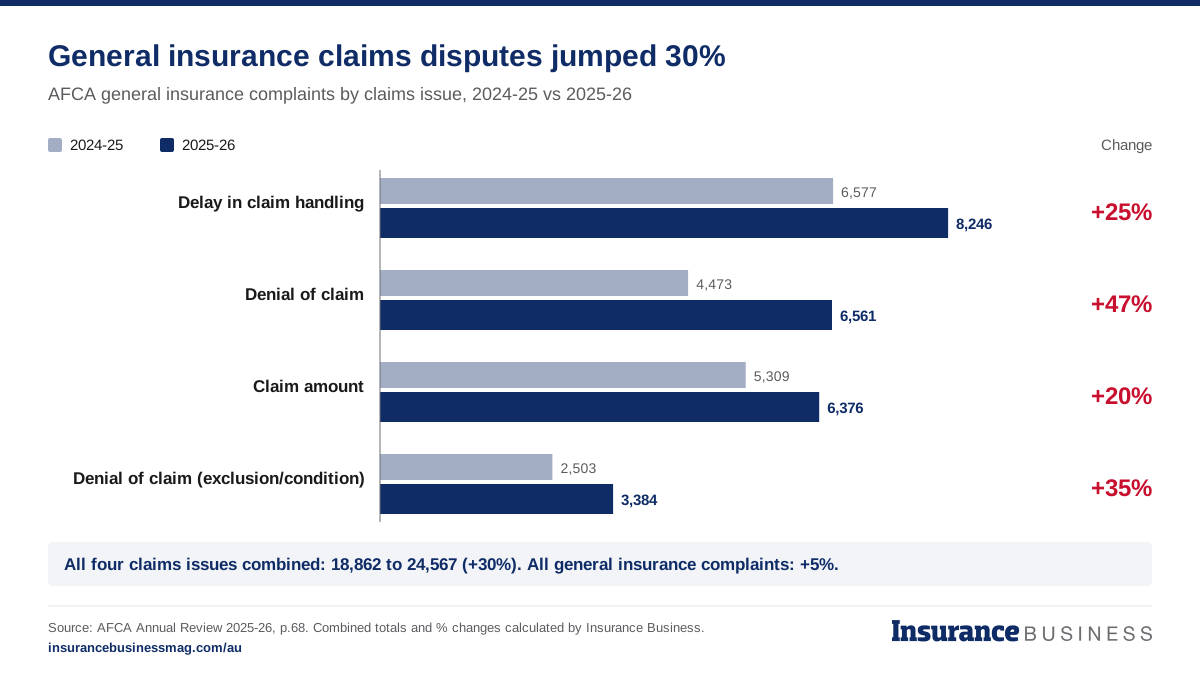
Denial of claim complaints led the charge, up 47% to 6,561. Delay complaints rose 25% to 8,246, claim amount disputes 20% to 6,376, and denials based on an exclusion or condition 35% to 3,384.
So why only 5% overall? Consumer credit insurance. CCI complaints collapsed from 7,880 to 2,636 as a claims-firm campaign ran its course (pp.68, 104). Take CCI out and general insurance complaints grew by roughly a quarter. That is an approximate IB estimate, as AFCA does not print the 2024-25 total directly.
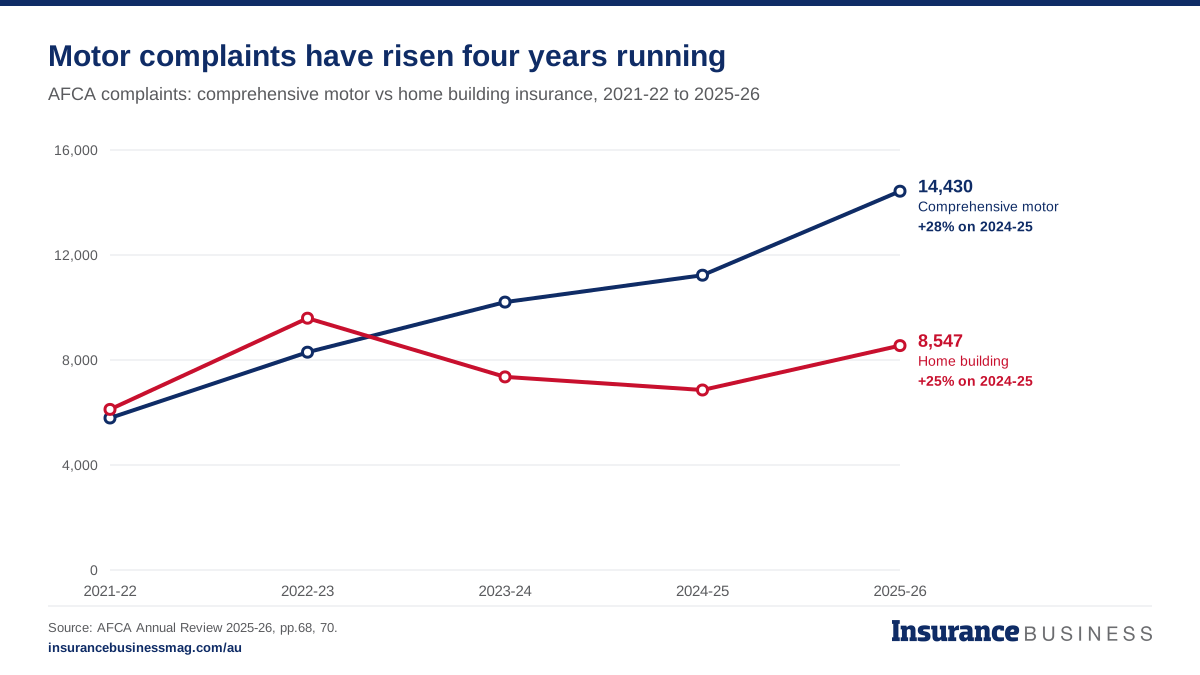
Motor led the products. Comprehensive motor complaints jumped 28% to 14,430, and home building rose 25% to 8,547 after two years of decline (p.70). AFCA put part of the delay problem down to scarce trades, repair capacity and parts. It was blunt, though, that insurers still own the communication with customers and the oversight of their repair networks (p.71).
Why it matters: Watch the denials. Delay complaints can be blamed on supply chains and tradie shortages. A 47% jump in denial disputes points at decisions insurers make themselves: wordings, exclusions and how a decline is explained. AFCA is also closing more general insurance cases at Decision stage, and it published 6,140 determinations naming the firm involved last year. A weak decline is now more likely to be tested, and more likely to be tested in public.
Here is the strange paradox – insurers appear to be really good with really big problems. The Insurance Council of Australia declared seven significant events in 2025-26, from the South-East Queensland hailstorms to the Victorian bushfires. Together they produced just 417 AFCA complaints, and the two hailstorms accounted for 377 of them
AFCA credited insurers with robust event systems built on hard experience. Then it told them to bring the same discipline to everyday claims.
Why it matters: The industry has shown it can do this well. Catastrophe response gets surge staffing, dedicated support for vulnerable customers and executive attention. The numbers suggest ordinary motor and home claims, where complaints are rising by a quarter or more, do not get the same treatment. That makes the gap look like an operational choice rather than a capability problem, which is a harder criticism for insurers to push back on.
General insurance made up about 30% of complaints received, but 34% of AFCA's open cases at 30 June 2026: that’s 10,761 matters still waiting. These cases took 84 days to close on average. That is down from 96 days, but well behind the 69-day average across AFCA.
More are going the distance, too. Decision-stage closures rose 31%, from 2,475 to 3,239.
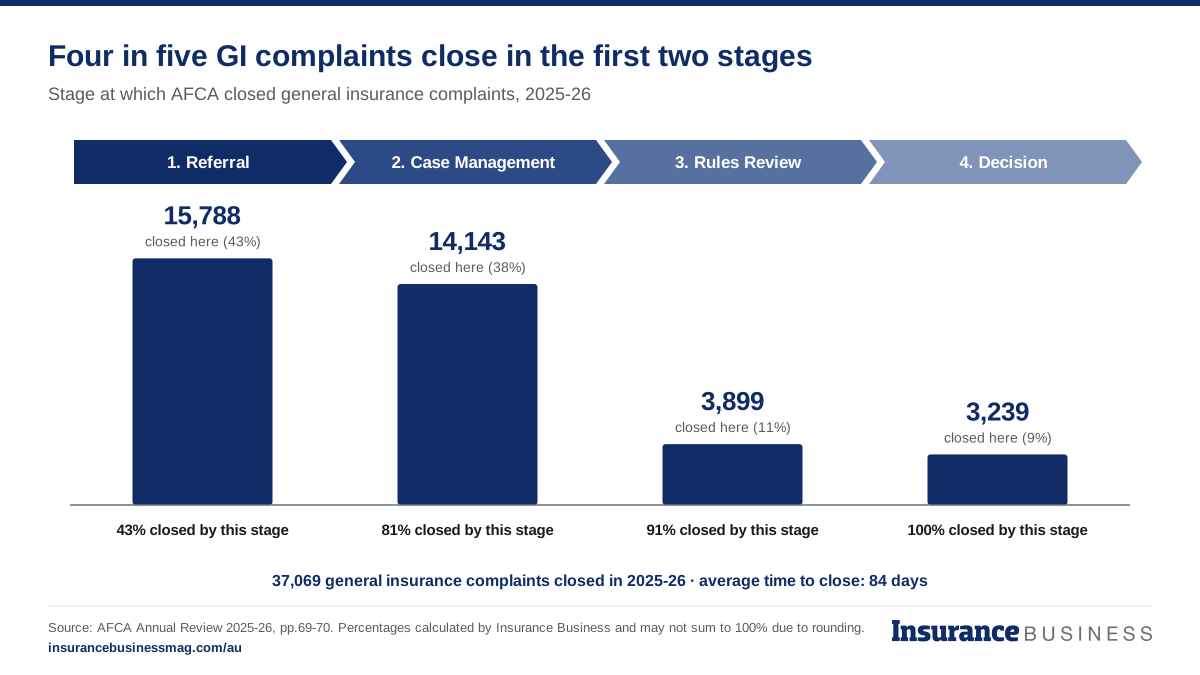
The scoreboard has also shifted. Across all product lines, determinations in favour of complainants rose from 31% to 41% (p.108). AFCA does not split that by product, so how much reflects insurance rather than investment collapses such as Shield and First Guardian is a question worth putting to AFCA.
Why it matters: Every open file costs money. Members pay nothing for their first five complaints closed in a year, but complaint fees after that brought AFCA $135.7 million in 2025-26, up from $111.5 million, and fees rose 3.5% from 1 July 2025 (pp.31, 183). Add claims staff time and reserving uncertainty, and a backlog weighted towards insurers is one insurers are paying for. If more determinations are also going the customer's way, settling earlier starts to look like the cheaper option.
Retail life insurance complaints barely moved, up 3% to 1,561 but cover held through superannuation is a whole different matter. TPD complaints in super rose 44% to 1,328, income protection 51% to 1,044 and death benefits 7% to 518. Across super, denial of claim complaints jumped 82% and delay complaints 36% (p.82).
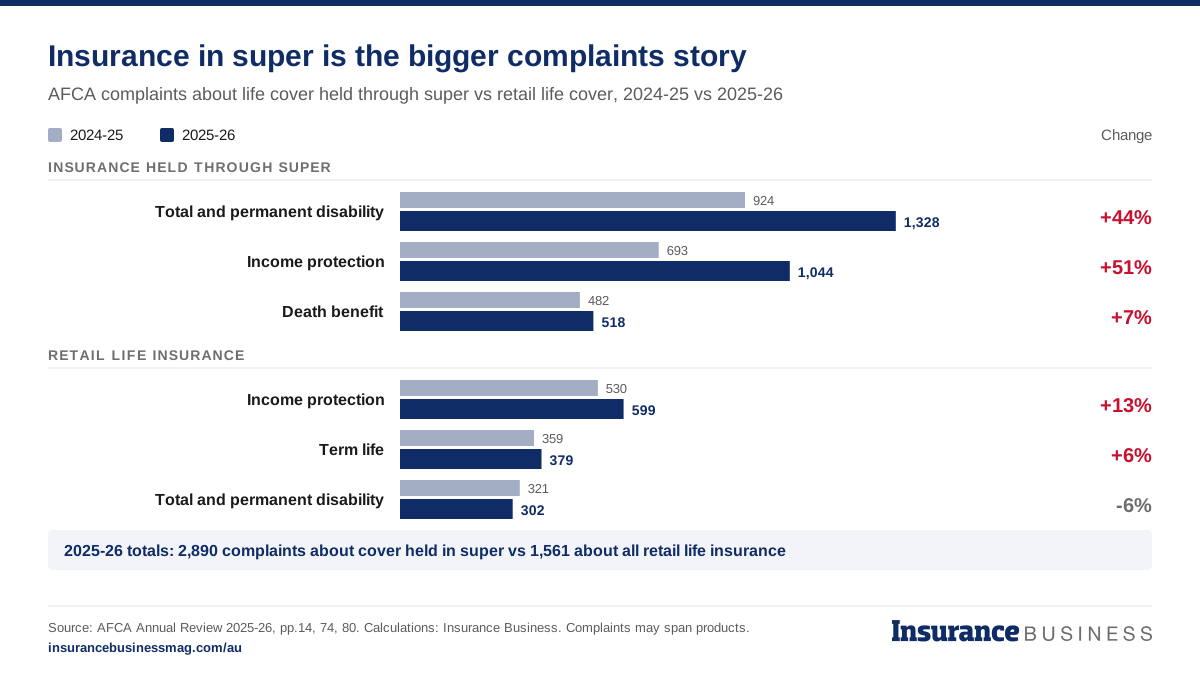
On the retail side, income protection remains the sore point at 599 complaints, or 38% of the total. Life complaints also took the longest to close of AFCA's five main product lines, at 124 days on average, just ahead of investments and advice at 122.
Why it matters: In AFCA's figures, these complaints sit under superannuation, not life insurance, so the trend is easy for life insurers to miss. Yet much of that cover is underwritten by life insurers under group policies. AFCA addressed trustees and insurers together: tell members what a claim needs, keep them updated, give reasoned decisions. An insurer that treats a disputed group claim as the trustee's problem may find the fallout lands on it anyway.
Underwriting agencies drew 5,497 AFCA complaints in 2025-26. That ranks them fifth of all member types, behind banks, general insurers, credit providers and super trustees. General insurers drew 26,949.
The review gives no prior-year figure, so whether that number is climbing is unclear. AFCA's Data Cube, which publishes member-level complaint data, is the place to find out (p.4).
Why it matters: To a policyholder, the underwriting agency is the insurer. A complaint against an agency reflects on the capacity provider behind it and the broker who placed the business. Capacity providers reviewing their delegated authorities now have a public data set to check how their agencies handle disputes, and so do brokers choosing where to place clients.
While the complaint totals drew the attention, AFCA's Code Compliance and Monitoring Group was busy.
The review does not name the firms involved. The code committees' own reports may say more.
Why it matters: For brokers, the strata findings are a warning shot. Conflicts, disclosure and oversight of agent arrangements have moved from best-practice talk to enforcement and regulator referrals. The renewal benchmarks also give clients, and AFCA, a yardstick for judging a broker who leaves renewals to the last minute. For life insurers, a sanction over medical data shows that consent failures in claims are a Code breach, not a paperwork slip.
The candle and the exclusion. During a severe mental health crisis, a woman threw household items, including a lit candle, and her home caught fire. The insurer declined under the intentional acts exclusion. AFCA accepted she threw the items deliberately, but found no evidence she meant to start a fire. The insurer had read the exclusion too broadly, AFCA ruled, and it ordered the claim settled plus $6,300 for non-financial loss.
The goodwill offer that wasn't enough. A woman fled family violence, and a family member then badly damaged her home. The policy excluded intentional acts by family members, and the insurer offered a modest goodwill payment. After AFCA pointed it to its published approach to family violence, the insurer paid in full. It also said it would apply the same approach to similar claims in future.
Why it matters: In both cases the policy wording arguably favoured the insurer, and in both cases the insurer paid. AFCA is reading exclusions narrowly and expects insurers to weigh the human context, particularly mental illness and family violence. It has named vulnerability support and poor explanations of decisions among the recurring problems it wants fixed in 2026-27. Claims teams relying on intentional acts exclusions should expect that reliance to be tested.
Complaints lodged by paid representatives fell 38%, from 9,429 to 5,878, as the CCI campaign faded. Their CCI complaints dropped from 7,188 to 2,468.
The firms have pivoted to banking. Paid-representative complaints about home loans rose 201%, credit cards 140% and personal loans 70%. AFCA says it is pressing paid representatives on submission quality, fee transparency and professional conduct (p.104).
Why it matters: One of the biggest drivers of insurance complaint volumes has largely dried up, and that flatters this year's numbers (see story 1). The bigger lesson is how fast paid representatives can move. Their CCI complaints went from 2,258 to 7,188 in a single year (p.102). Whatever insurance product they target next could see the same surge.
Funeral insurance complaints edged up from 105 to 127. Volumes are far below earlier years, but the complaints AFCA does see are pointed. Customers are paying more in premiums than the benefit, or can no longer afford premiums that rise with age.
AFCA backed recommendations from Peter Kell's independent review of the Life Insurance Code of Practice. These include a premium guarantee paying the greater of the insured amount or total premiums paid, and refunds in some cases where a policy ends after at least two years .
Old sales can still bite. AFCA ordered a full premium refund plus interest, and $4,500 for non-financial loss, on a funeral policy sold by phone in 2013. It found the sale breached anti-hawking laws, applying principles from the Federal Court's ASIC v Select AFSL (No 2) decision.
Why it matters: A premium guarantee would cap one of the sector's most criticised outcomes, customers paying more than they will ever get back. If it makes it into the revised Code, funeral product pricing and design will need rethinking. And the 2013 case shows legacy books carry live risk: a sale made more than a decade ago still ended in a full refund with interest.
AFCA has spelled out what it wants from insurers in 2026-27: fix the recurring causes, not just the complaints. It named claims delays, poor communication, inadequate explanations of decisions and inconsistent support for vulnerable customers. The hidden headlines say the same thing in numbers. The insurers that act on them now will be the ones missing from next year's tables.