Ask any broker what the hardest part of their job has become in the last few years and many will not say claims, or underwriting appetite, or even compliance paperwork. They will say the premium conversation.
Watching a client's face when the renewal notice lands and then explaining that a chunk of that number has nothing to do with risk, reinsurance or claims history – it is tax.
For brokers who spend their days trying to keep clients insured rather than watching them walk away uncovered, that conversation has become a recurring headache. And it raises a question that has been kicking around Australian insurance circles for the better part of two decades: why does buying protection attract a tax bill in the first place?
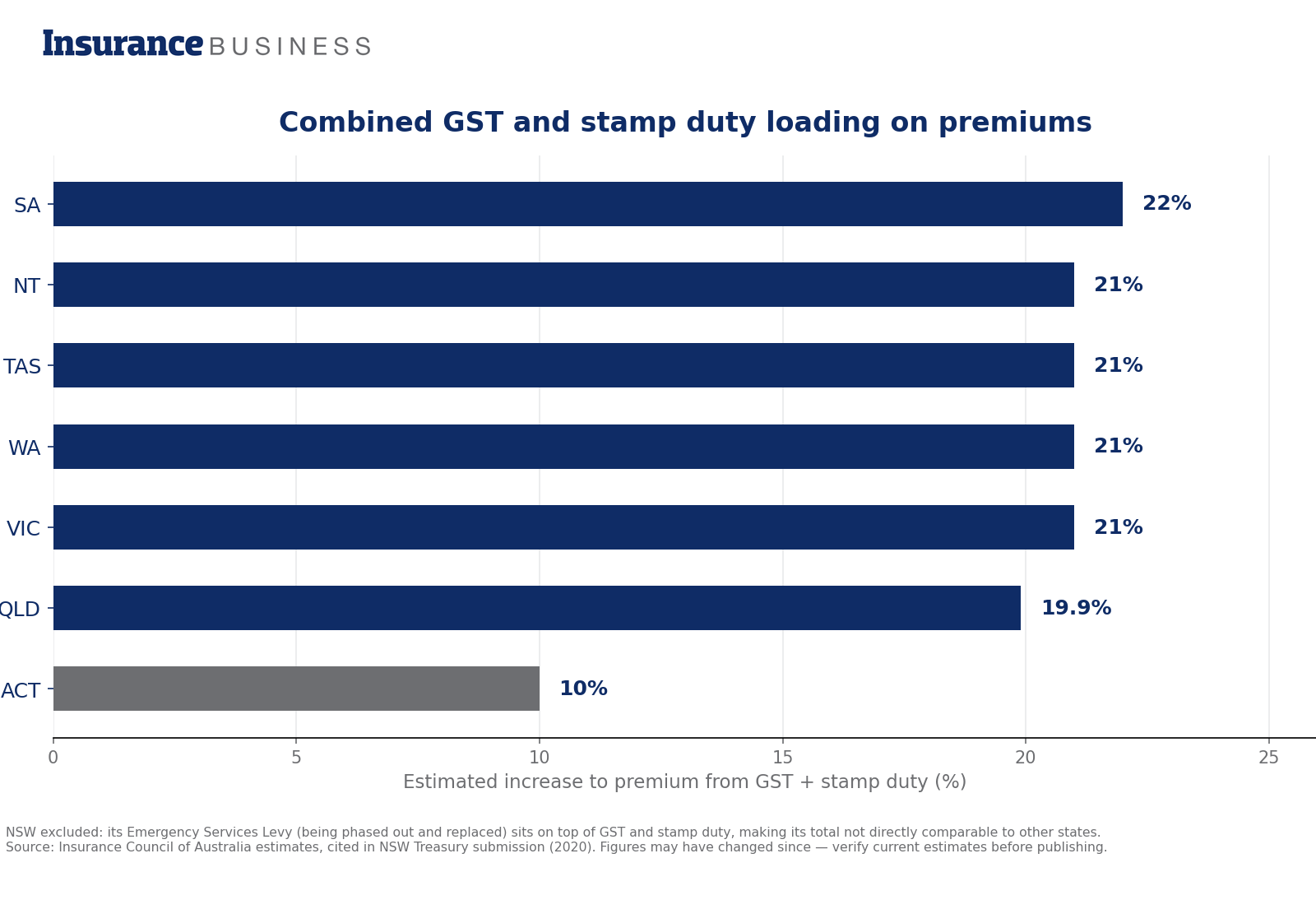
Strip a typical home, contents or business premium back to its components and there are, in most of the country, three things stacked on top of the actual cost of cover: the base premium, built from risk, reinsurance costs and insurer margin; the goods and services tax (GST); and then, in every state and territory except the Australian Capital Territory, stamp duty, calculated on top of the GST-inclusive figure. In Queensland, that stamp duty currently sits at nine per cent, layered onto a premium that is already carrying GST – which is effectively, as brokers and consumer advocates have long pointed out, a tax on a tax.
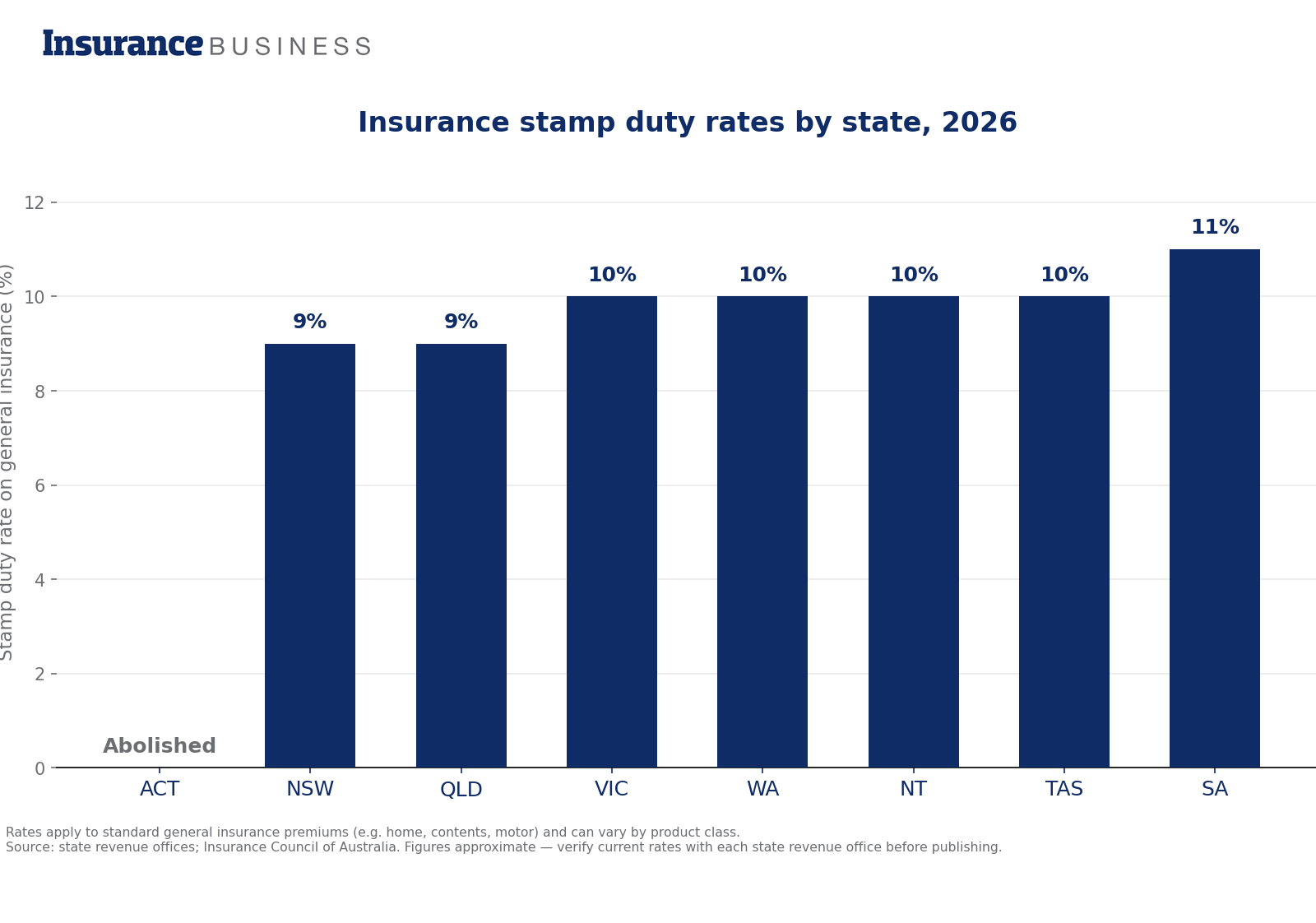 The Insurance Council of Australia puts the combined effect of these state charges at anywhere between 20 per cent and 40 per cent on top of the underlying premium, depending on where a client lives. And because the tax is calculated as a percentage of the premium, it hits hardest exactly where premiums are already highest: cyclone-exposed Queensland, flood-prone parts of northern New South Wales (NSW), bushfire country in the southeast. In other words, the people paying the most for risk are also paying the most tax on that risk.
Read next: ICA urges Queensland to cut insurance stamp duty as premiums soar
In NSW, the Emergency Services Levy (ESL) sits underneath all of it. The levy is applied as a percentage against the premium, GST is calculated on the premium-plus-levy figure, and stamp duty is then calculated on the lot. NSW is the only mainland jurisdiction still funding fire and emergency services primarily through a levy on insurance policyholders.
"It is probably the bane of most underwriters," said Richard Hardy, global head of property at Agile Underwriting Services in Sydney. "Due to the fact that it is not set in stone, it is too variable and it creates an awful lot of confusion and angst amongst people."
Hardy said he could not understand why NSW has not reviewed how other states removed the levy and what they replaced it with.
“I think it's a rather antiquated method, a bit too clunky and difficult to administer," he said. "I'm not a real fan of it."
The variability he described is structural. The NSW government sets the total amount insurers must contribute each year but each insurer decides how to recover its share across its own book, so two insurers quoting the same risk can load it differently. Chubb, for example, applies a rate of 29.5 per cent for commercial non-small-and-medium-enterprise business in NSW, effective May 1 2026.
Queensland removed this problem for itself more than four decades ago, abolishing its insurance-based emergency levy in 1984 and replacing it with a property-based levy collected through council rates. Stamp duty alone, however, is enough to cause real broker headaches there.
Tyrone Shandiman, a broker who chairs the Australian Consumers Insurance Lobby (ACIL) in Brisbane, has been clear about where this leaves Queensland property owners. Shandiman has described Queensland as the most unaffordable state for insurance in the country, a claim backed by the numbers: the state is projected to collect more than $10 billion in insurance stamp duty over the next five years, with an estimated $912 million of that coming purely from duty applied to the GST component of premiums.
For a broker sitting across the desk from a small business owner or a young family, that is a substantial sum the taxman is taking. It is the difference between a client renewing full cover, trimming their sums insured to make the premium fit the budget, or walking away from insurance altogether. Underinsurance and non-insurance are the failure point of a tax-heavy premium. Nobody notices until a flood or a fire hits and the shortfall becomes very real, very fast.
Read next: ACIL calls for some QLD stamp duty to fund disaster resilience
There is a reasonable case on both sides here, rather than a simple villain-and-victim story.
The argument against taxing insurance so heavily is compelling. Insurance is broadly accepted as a social good. It spreads risk, keeps households and businesses solvent after disaster, and reduces the bill governments themselves pick up through post-disaster relief payments. Taxing it at a rate comparable to gambling, as the Insurance Council has pointed out, sits oddly next to that logic. The point of taxing gambling or smoking is to dissuade people from doing it. That is surely not the desired result here.
And because state stamp duty on insurance is one of the least efficient taxes in the country – modelling cited by the industry has put the economic drag from these charges at the equivalent of 1.1 per cent to 1.8 per cent of household consumption if removed – even economists who do not work in insurance tend to agree it is not a well-designed tax.
 The counterargument is more about political reality than logic or principle. State governments have a genuinely narrow tax base once GST revenue is pooled and redistributed federally, and insurance duty is a reliable, low-cost-to-collect revenue line.
Queensland's insurance stamp duty take grew from just over $1 billion in 2019-20 to approximately $1.7 billion by 2023-24. Money that has been budgeted for is hard for any treasurer to simply walk away from, however inefficient the tax might be on paper.
Read next: Rising stamp duty fuels insurance reform calls in Queensland
It is not all deadlock. The Australian Capital Territory abolished insurance stamp duty entirely, completing a five-year phase-out to zero by mid-2016 – proof that a jurisdiction can walk away from the revenue without the sky falling in.
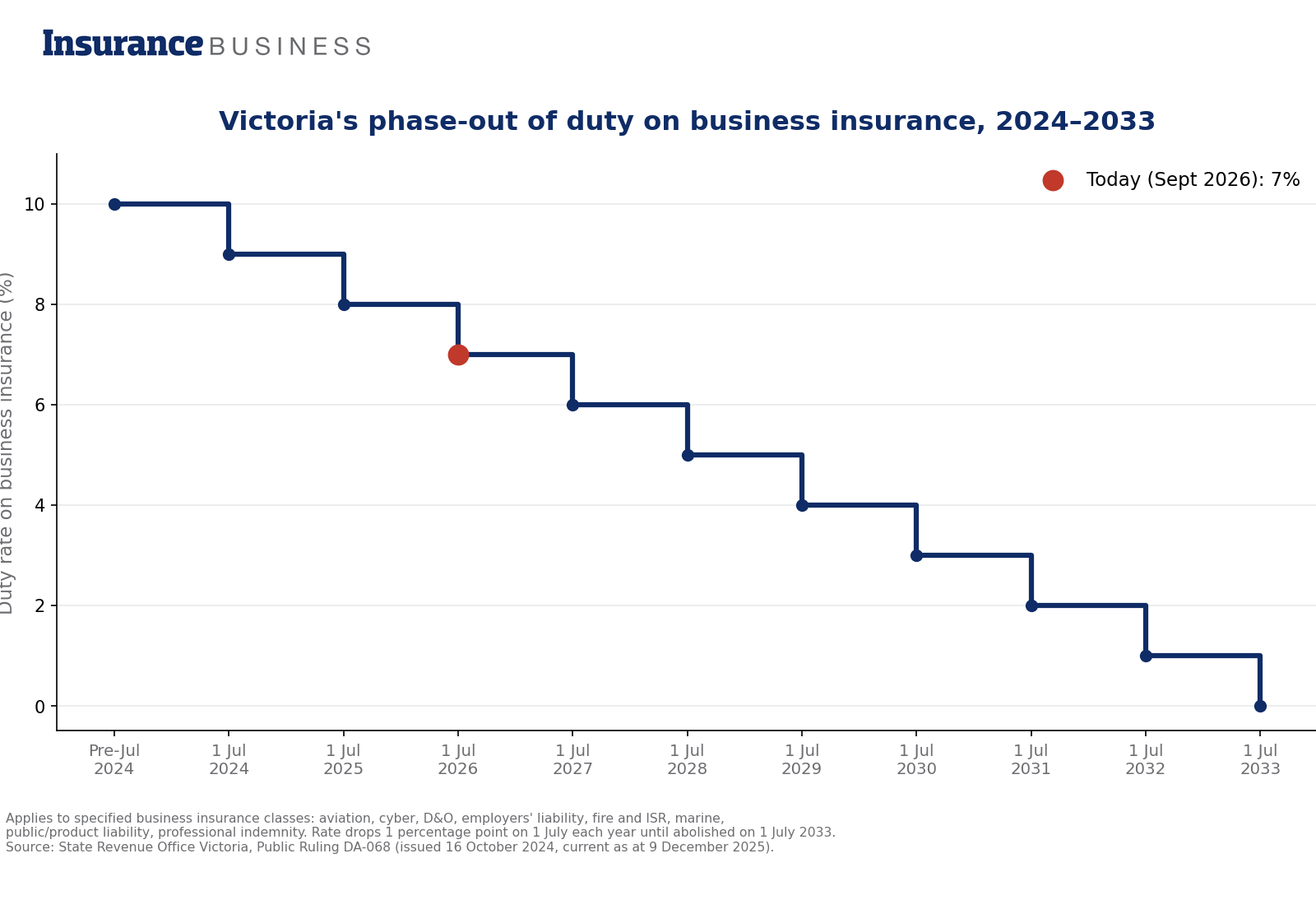
Victoria has taken two separate steps. It removed the fire services levy from insurance premiums in 2013, following a recommendation of the 2009 Victorian Bushfires Royal Commission, shifting it to a property-based charge collected through council rates. That charge was replaced on 1 July 2025 by the Emergency Services and Volunteers Fund. Separately, since 1 July 2024, Victoria has been phasing out stamp duty on business insurance. Duty on classes including fire and industrial special risks (ISR), public and product liability, professional indemnity, marine, aviation, cyber, and directors and officers (D&O) has been dropping by one percentage point every 1 July, on a schedule running from 10 per cent down to zero by 2033. It currently sits at seven per cent. It is a slow burn, but it is real money back in commercial clients' pockets each renewal, and one of the only concrete, scheduled wins brokers can point to in this whole debate.
 NSW, meanwhile, has been here before. Parliament passed the Fire and Emergency Services Levy Act in 2017 to abolish the insurance-based ESL and replace it with a property-based charge, appointing an insurance monitor with power to seek penalties of up to $10 million from insurers charging excessively during the transition. More than $900 million of taxes were to be removed from premiums by July 1 2017. The reform was shelved before it commenced.
The current process sits with the NSW Legislative Assembly's Select Committee on Emergency Services Funding Reform, chaired by independent MP Jacqui Scruby, member for Pittwater, which is due to report by November 18 2026 - months before the March 2027 state election. NSW Treasury released an options paper in April 2026 setting out five possible levy models, each built on fixed charges applied to a revenue base of land values.
Read next: IAG calls for 'immediate taxation relief' to lower prices
Queensland and South Australia (SA) remain the two jurisdictions where the broker community argues the case for stamp duty reform is loudest. Queensland because of the sheer scale of exposure to cyclones and floods, and SA because it carries the highest standard duty rate in the country at 11 per cent.
Insurance Australia Group (IAG) made the industry's position plain in a submission to the Australian Competition and Consumer Commission's Northern Australia Insurance Inquiry, arguing that removing state government taxes and duties on general insurance is a necessary first step toward fixing affordability, not a nice-to-have.
From where many brokers sit, this is not really a debate about whether tax reform is a good idea in the abstract. Most agree it is. It is a debate about political will.
Every review, parliamentary inquiry and industry submission for the past fifteen years has landed in roughly the same place: insurance stamp duty is inefficient, regressive by risk exposure and actively works against the outcome governments say they want, which is more Australians adequately insured.
Until a state government decides the political cost of giving up that revenue is worth the affordability win, brokers will keep having the same renewal conversation - explaining to clients why protecting what they own comes with its own tax bill attached.