Getting into management is no longer where women fall behind in Australian insurance. In financial and insurance services, promotions from non-manager to manager now split 50:50, according to Workplace Gender Equality Agency (WGEA) figures reported by Insurance Business in March. The gap opens after that.
Women make up 53% of the industry's workforce and 43% of its managers. They hold 34% of key management personnel roles and 13% of CEO jobs. Boards are closer to balance, with women holding 33% of seats, but only 21% of chairs.
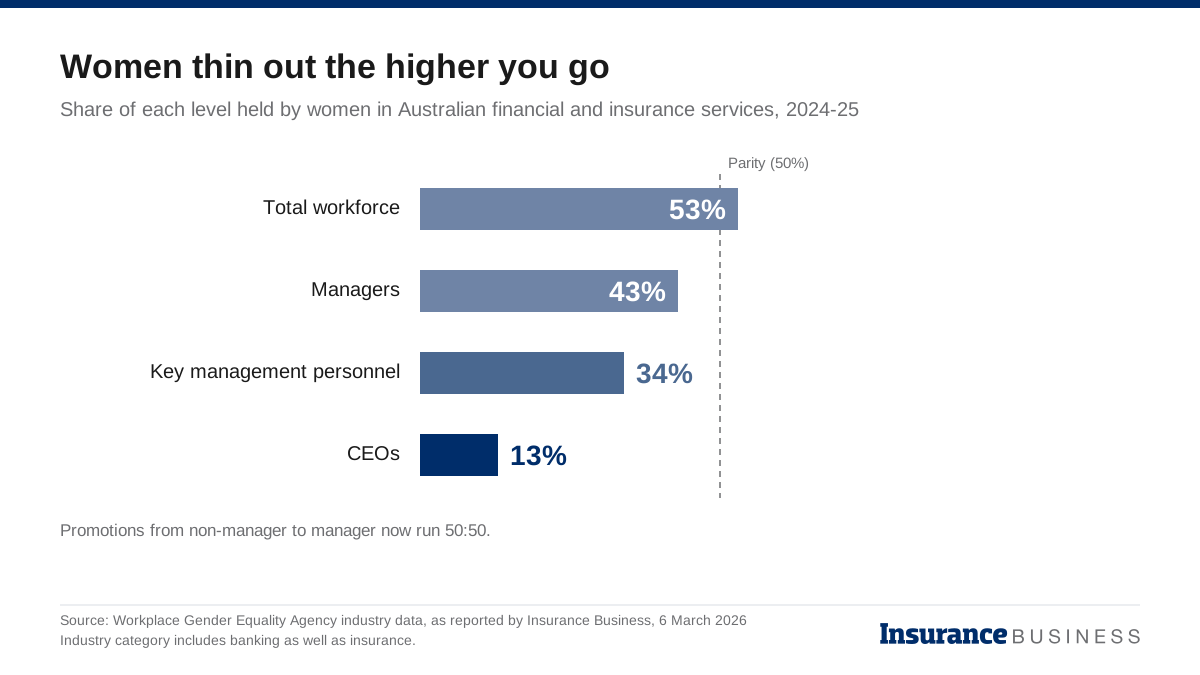
The figures cover banking as well as insurance, because WGEA reports the two as one industry. Even so, the fall between first-line management and the executive table is steep.
Read next: What the data says about women's progress in insurance
Parts of the industry are now targeting that middle layer directly. This week the Council of Australian Life Insurers (CALI) named eight women for the first intake of its year-long ReCALIbrate leadership programme, run with Future Women. Seven of them work in claims, underwriting, product, legal or customer roles at life companies including Zurich, TAL, AIA and NobleOak.
"When we back women to lead, we back the people they mentor, the teams they build, and the customers they serve," said CALI chief executive Christine Cupitt.
WGEA's 2024-25 employer gender pay gaps report shows where the money sits. In financial and insurance services, women hold 66% of the lowest-paid quarter of jobs, where average pay is $79,380, but only 37% of the highest-paid quarter, where it is $323,593.
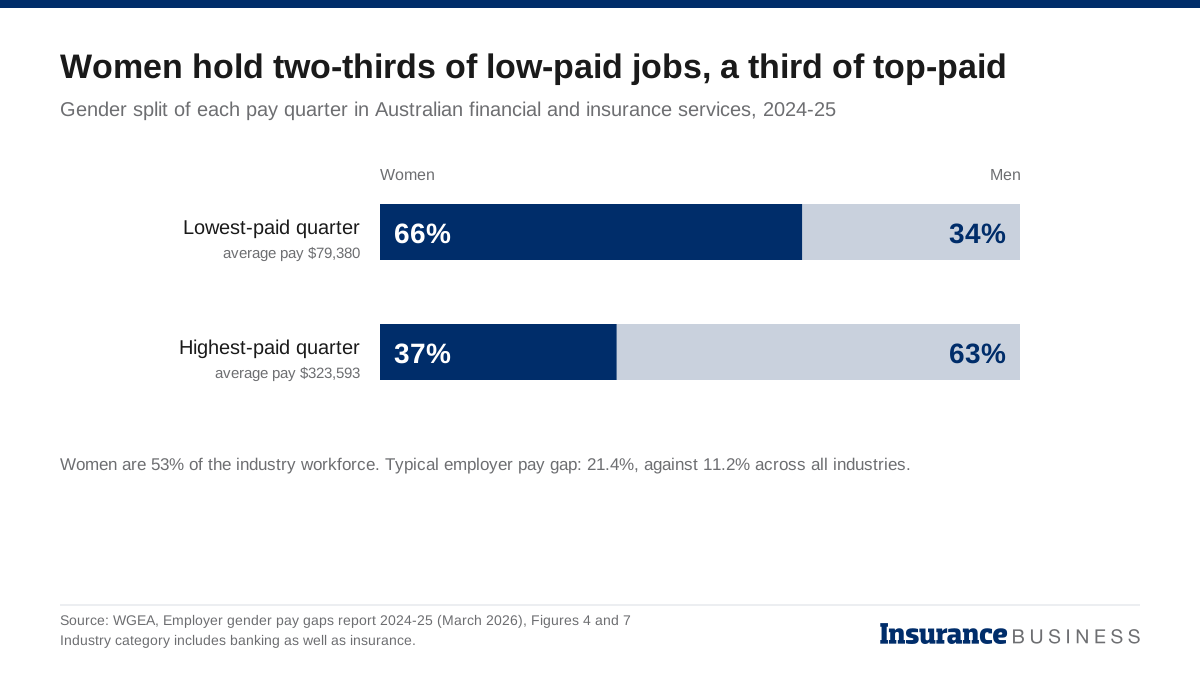
The typical employer in the industry has an average total remuneration gap of 21.4%. Only construction is higher, and the figure is almost double the 11.2% mid-point across all industries. Of the 396 financial and insurance employers WGEA assessed, 85% sat above that national mid-point, the same share as a year earlier.
ANZIIF chief executive Katrina Shanks told Insurance Business that many women still struggle to balance career progression with family responsibilities "particularly during the years when leadership opportunities often arise". She pointed to targets, accountability, flexible work, parental leave, mentoring and sponsorship as the levers that keep women moving up rather than sideways.
Others place the bottleneck at the move from technical specialist to commercial leader, the theme of this year's Women in Insurance Summit Australia. Suncorp's Belinda Speirs, speaking ahead of the summit, said the issue goes beyond individual resilience to "the leadership practices and workplace culture" that let women thrive.
Read next: Suncorp leader: Insurance sector needs culture fix, not individual grit
New research from the Lloyd's Market Association (LMA) suggests the problem isn't unique to Australia. The share of women judged ready now for senior underwriting leadership at Lloyd's rose from 15% to 25% this year, while their share of chief underwriting officer and lead underwriter roles slipped from 18% to 17%.
The LMA's survey explains how important sponsorship is. Two-thirds of women (67%) said backing from senior leaders is what most separates those who reach the top underwriting jobs, compared with 24% of men. Men were also far less likely to see a problem: 52% said there were no significant barriers to progression in their organisation, against 22% of women.
Under legislative changes starting in 2026, employers with 500 or more staff must select and meet gender equality targets, or show improvement, over three years, WGEA's report notes. Only 30% of reporting employers currently set targets for women in management.
WGEA also found that of employers who analysed their pay gap, only 24% did a comprehensive analysis covering recruitment, promotions and staff movements across the whole organisation. That is the work that would show who gets the large portfolios, key client relationships and leadership exposure that decide who reaches the top.
Read next: Elite Women 2026: Where influence is shaped beyond technical expertise
The LMA also asked about technology. Some 52% of respondents expect the skills future underwriting leaders need to change significantly, and 33% think some groups may get less access to the experience needed to succeed in an AI-enabled market.
Jobs and Skills Australia's Generative AI Capacity Study raised a similar concern locally, finding that women may face disproportionate risks from AI because of the occupations they are concentrated in.
Read next: APRA flags higher gender pay gap in latest report
For insurers, MGAs and larger brokerages, the first promotion is no longer the sticking point. What matters now is who gets picked for the roles that lead to the top, and from this year the biggest employers will have to set targets and show progress.