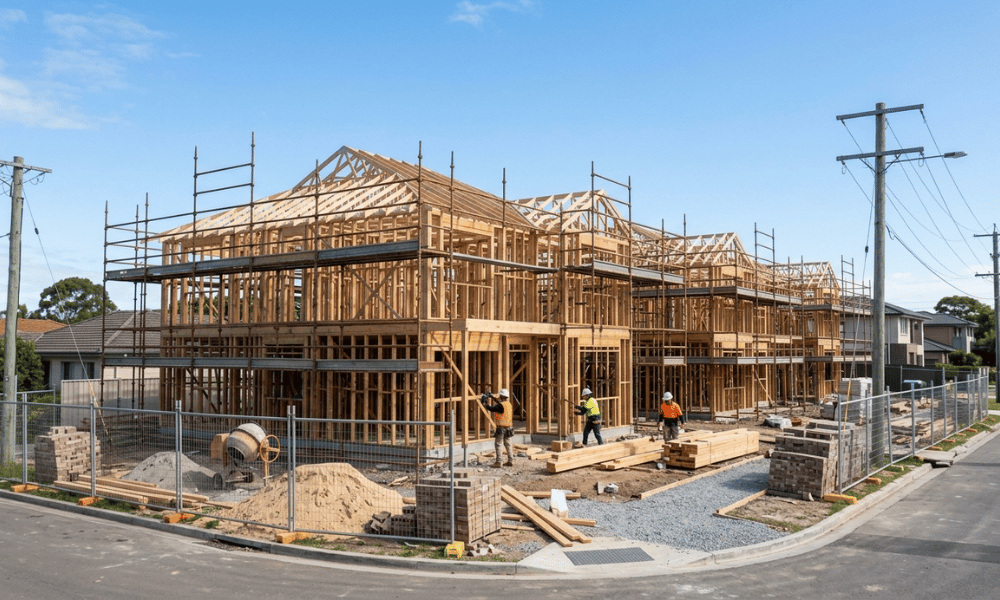
Five co-owners of a stalled Sydney townhouse development have been denied home building insurance cover after a court found they were developers - not homeowners - under New South Wales law.
The Supreme Court of NSW ruled on September 16, 2026, that the group's legal ownership of land earmarked for 10 townhouses triggered the developer exclusion in their insurance policy, even though a private deed between them had split the units so no individual would end up with more than three.
The result leaves the group with a roughly $3.75 million judgment against a builder now in liquidation and no insurance to fall back on.
The five co-owners - a married couple and three siblings from a connected family - became registered proprietors of land at Rosehill, in Sydney, as tenants in common in October 2015. They secured conditional consent from Parramatta City Council for a 10-unit townhouse development with basement parking for 23 vehicles, then signed a deed of partition in April 2016 that divided the future units among themselves. Under the deed, no single person was allocated more than three units.
In September 2017, they contracted with Dominium Homes Pty Ltd to carry out the construction. The builder obtained 10 certificates of insurance from NSW Self Insurance Corporation (SICorp) under Part 6 of the Home Building Act 1989 (NSW). Each certificate referred to the same policy number and a total contract amount of $2,360,000. The policy was backup cover, designed to step in where a loss cannot be recovered from the builder.
A dispute arose about the adequacy of the builder's performance. The co-owners terminated the building contract in March 2022 and commenced proceedings against the builder. The builder's licence was suspended in June 2023.
In August 2024, with the builder proceedings still on foot, the co-owners notified a claim on the policy. SICorp declined within days on the basis that each of them was a "developer" within the meaning of the policy wording. The policy does not cover claims made by a developer.
The co-owners joined SICorp to the existing proceedings in November 2024. Meanwhile, they pressed ahead against the builder and obtained judgment for $3,757,814.98 in March 2025. Just over two weeks later, a liquidator was appointed to the builder. The development remains incomplete and without an occupation certificate.
The core of the dispute turned on section 3A of the Home Building Act. That section defines a developer as a person on whose behalf residential building work is done where four or more dwellings in the development are or will be owned by that person.
The co-owners argued they were not developers because the deed of partition had divided their interests in equity. Under the deed, each person's beneficial ownership was limited to their allocated units - at most three apiece. They said the equitable position should override their joint legal ownership of the whole site, relying on the principle that equity prevails over common law.
SICorp's position was simpler: at law, all five remained registered proprietors of the entire land as tenants in common. Until the development was finished, a strata plan registered and individual transfers completed, every one of them would legally own all 10 dwellings. That was enough.
The court agreed with SICorp. The judge found that the Home Building Act's definition of "owner" - which covers anyone entitled to land "at law or in equity" - means legal ownership and equitable ownership can sit side by side. One does not cancel out the other. If there is one owner at law and a different owner in equity, both are owners under the statute.
Even if the deed of partition gave each co-owner a separate equitable interest limited to their allocated units, it did not change the position at law. When the building work was expected to be completed, all five would still have been the registered proprietors of the whole land, and therefore the legal owners of all 10 proposed dwellings.
The court also found that the phrase "will be owned" in section 3A(2)(a) directs attention to who will own the dwellings at the time construction is completed - not at some later point when strata subdivision and transfers might reduce each person's holding. A developer cannot escape the definition simply by planning to dispose of units after the build is done. If that were the case, the court reasoned, the consumer protection scheme in the Act would be seriously undermined.
The decision was consistent with a recent ruling of the NSW Civil and Administrative Tribunal Appeal Panel, where investors in an eight-dwelling development who intended to end up with two or three dwellings per couple were still found to be developers because they were legal owners of all the dwellings throughout the construction period.
The court acknowledged the result could seem harsh. The co-owners had suffered loss because of a builder's breach and insolvency - in one sense, the court said, that may be thought to be the kind of loss the Act seeks to protect against. But there was another perspective: the five co-owners joined together on a 10-unit construction project, and it was reasonable to suppose at least some contemplated selling units. Future purchasers from them would enjoy the benefit of statutory warranties against the co-owners as developers - the kind of beneficial outcome, the court noted, that the Act contemplates.
The proceedings were dismissed. The default costs order requires the co-owners to pay SICorp's costs unless they seek a hearing on the question by September 24, 2026.
For home building insurers and claims teams, the decision reinforces that legal ownership - not equitable arrangements between co-owners - is the touchstone for the developer exclusion, and that private partition deeds will not shrink a claimant's dwelling count below the statutory threshold.