A business jet that left Texas on Sunday morning carrying a tech billionaire and his family on holiday ended its flight in a fireball on a suburban road in Palm Beach County, Florida, killing all nine people on board and forcing hundreds of residents out of their homes.
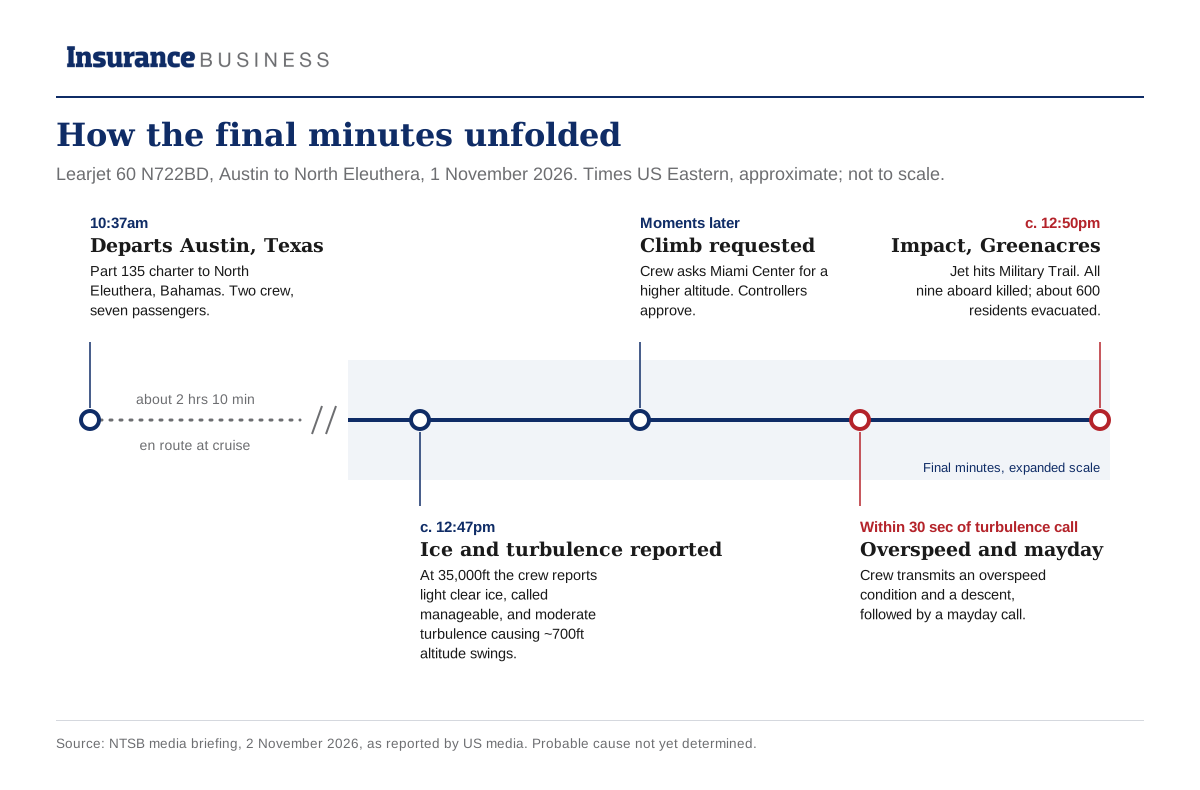
The Learjet 60, registered N722BD, came down on Military Trail near Greenacres at about 12:50pm local time on 1 November, according to the Federal Aviation Administration. It had departed Austin-Bergstrom International Airport bound for North Eleuthera in the Bahamas. US Transportation Secretary Sean Duffy confirmed there were no survivors.
The passengers were Austin tech founder Adam Robinson, his wife Helen Sharp, their two children aged four and two, two family friends and the children's nanny, relatives said in a statement. Captain Jeff Gregory and first officer Nathalia Filgueiras, 20, were at the controls.
At a briefing in West Palm Beach on Monday, National Transportation Safety Board member Tom Chapman walked through the jet's final minutes. Cruising at 35,000ft and in contact with Miami air traffic control, the crew reported light clear ice, which they described as manageable, and moderate turbulence that was shoving the aircraft around 700ft off its altitude. They asked to climb and controllers agreed.
Within 30 seconds the aircraft was reporting an overspeed condition and a descent, followed by a mayday call.
“Mayday, mayday, we’re descending 10,000 feet per minute,” the pilot radioed according to air-traffic audio from LiveATC.net.
As the plane plummeted towards the earth she called out “Declare an emergency,we are in an overspeed condition descending 20,000 feet per minute!”
The Learjet 60 is known as a high performance aircraft, that might also prove more difficult than some to fly.
Charter site Jettly says that the Learjet 60 has the highest incident and accident rate in its class, with most accidents occurring during landing phases. It also says that Bombardier's product support for the Learjet 60 has historically ranked low in industry surveys, a concern for operators.
It also labels the aircraft as unforgiving, demanding skilled handling, especially during landings.
Chapman said the NTSB had "some evidence that there was some breakup of the aircraft before impact", but would not say whether the horizontal stabiliser, the part of the T-tail that pilots online have been speculating about, was among the pieces that came off. Weather at altitude will be a central line of inquiry.
The practical obstacles are considerable. Maintenance records show a cockpit voice recorder was fitted, but investigators don't yet know if it was still on board, and the main wreckage sits in a water-filled crater in the roadway. About 20 NTSB specialists are on site, working with the FAA and the manufacturer. The board said it was not aware of any pattern of similar accidents involving the Learjet 60, and it won't speculate on a probable cause.
For aviation insurers, Greenacres shows how one private-jet accident can throw off claims far larger than the airframe.
The hull is the least of it. The aircraft was roughly 22 years old, and Bombardier stopped building Learjets in 2021, so the agreed value on a jet of that vintage is modest by business-aviation standards.
The weight sits in the liability layers. The NTSB said the flight was a commercial charter run under Part 135 of the US federal aviation regulations, with Aurora Aviation, trading as Upper Jets, as operator. FAA registry records list the owner as a separate Delaware company, LR60271 LLC. That split between owner and operator is standard in US charter, and it means claimants' lawyers will have more than one policy to look at, and potentially more if the investigation points to maintenance or design.
Then there's the ground. About 600 people were evacuated from a neighbouring mobile home park, power lines and water mains were damaged, and local officials have warned the road may stay shut for a month or longer. A motorist leaving the area suffered a leg injury. Each of those is a potential third-party property, bodily injury or economic loss claim.
Read next: Aviation insurance faces its biggest test since Ukraine
All of it will be argued in US courts, which is exactly where the market feels most exposed. In the latest International Union of Aerospace Insurers survey, US claims inflation ranked as the biggest operational headache for aviation reinsurers, ahead of rate adequacy. Gallagher's Plane Talking report earlier this year noted that some insurers had restricted capacity for US-exposed risks to manage their probable maximum losses from liability awards.
General aviation rates have stayed soft through 2026, with WTW's Q1 outlook describing ample capacity and fierce competition for larger operators, even as underwriters try to tighten discipline.
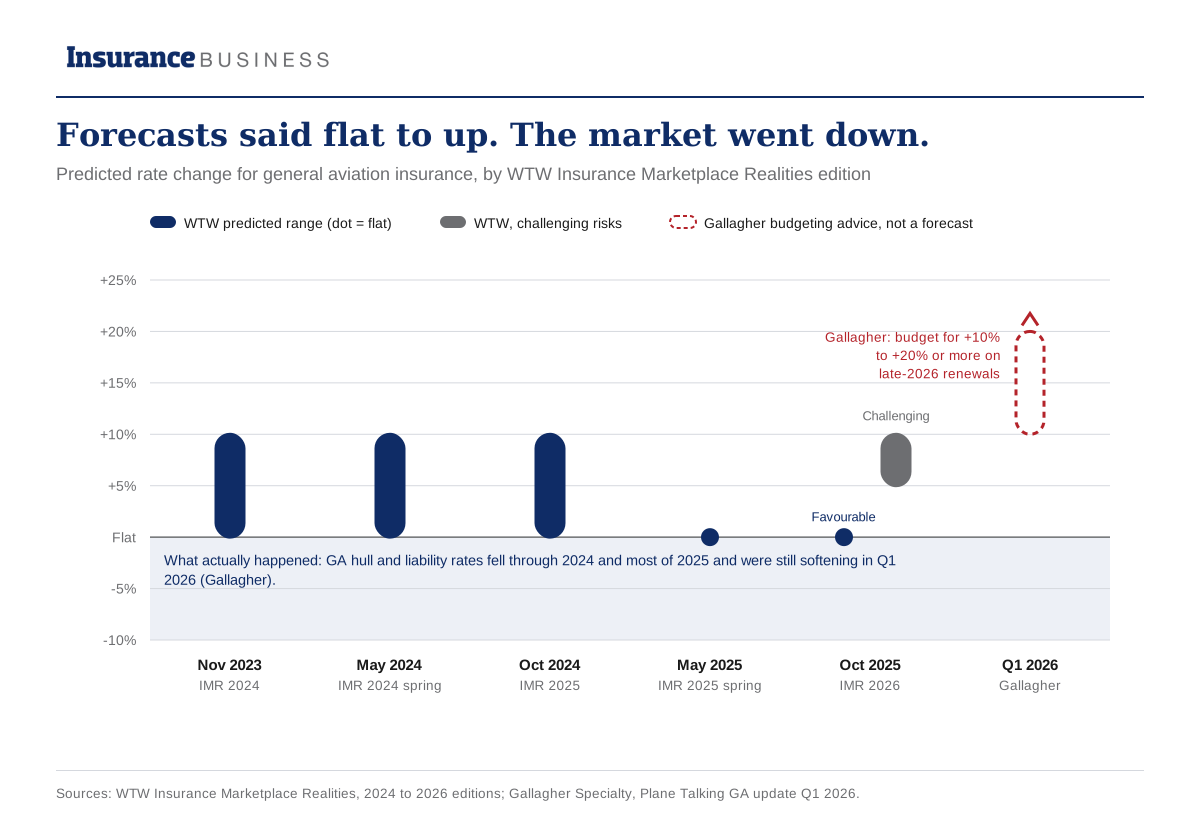
WTW's Insurance Marketplace Realities reports have predicted flat to modestly rising general aviation rates since late 2023, and the 2026 edition still pencilled in flat rates for favourable risks and rises of 5% to 10% for challenging ones. Rates went the other way. Gallagher's Q1 2026 general aviation update said hull and liability pricing kept softening into this year, after aggressive cuts through 2024 and most of 2025. It told buyers renewing late in 2026 to budget for possible increases of 10% to 20% or more if conditions shift.
Jason Riley, managing partner at Acrisure Aerospace, told Insurance Business earlier this year that he didn't think the market was "very congruent", with premiums still falling while claims costs climb.
One crash won't turn a market. But a fatal charter loss with seven passenger claims, crew claims, ground damage and a US venue is the kind of event underwriters cite when they argue that pricing for older light jets and smaller on-demand operators has drifted too low.
Read next: Middle East tensions and talent gaps test soft general aviation market – WTW
Chapman described the on-site work as the opening stage of a long investigation. Final NTSB reports typically take a year or more. For the insurers on this risk, the claims timeline is likely to run longer still.
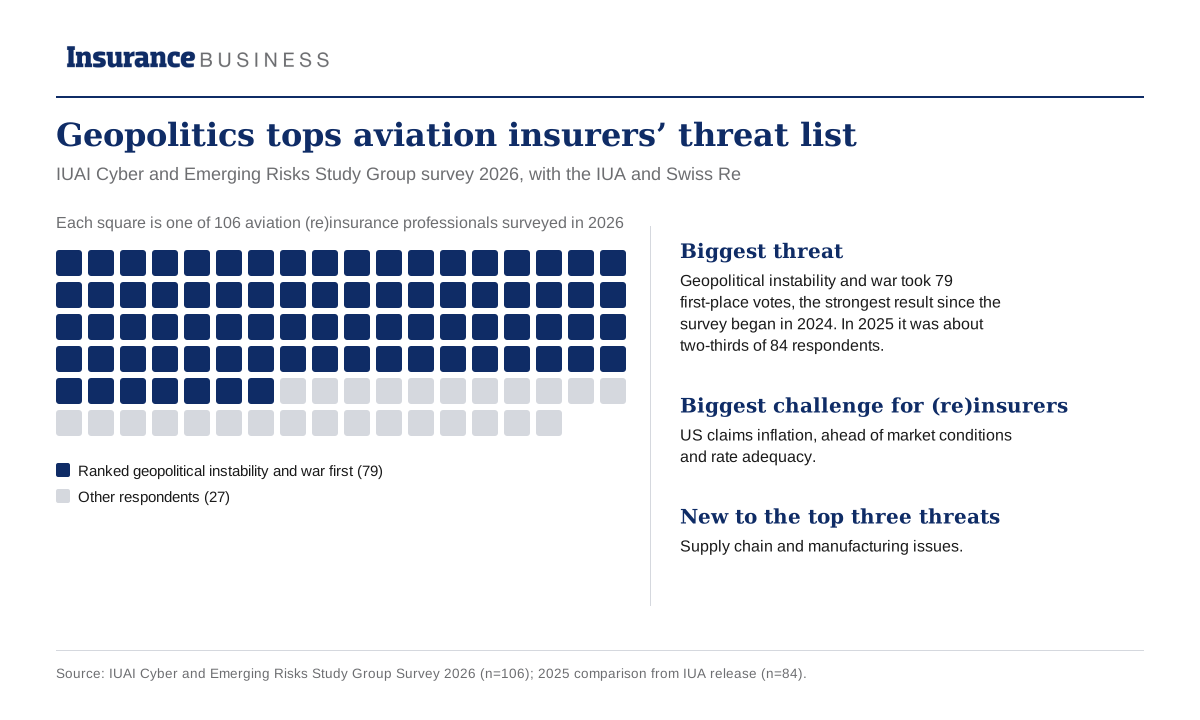
Read next: Geopolitical instability tops aviation insurance threat list for the first time: Report