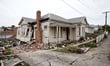
Anyone hoping for relief on their home insurance bill before polling day will have to keep waiting. Finance Minister Nicola Willis and Commerce and Consumer Affairs Minister Scott Simpson have pushed any decision on whether the Crown should step in on insurance affordability past the 7 November general election.
Instead, the Council of Financial Regulators will keep collecting information and filling data gaps before ministers consider whether intervention is needed at all. The routine review of Natural Hazards Commission (NHC) levy settings stays on ice until that work is finished.
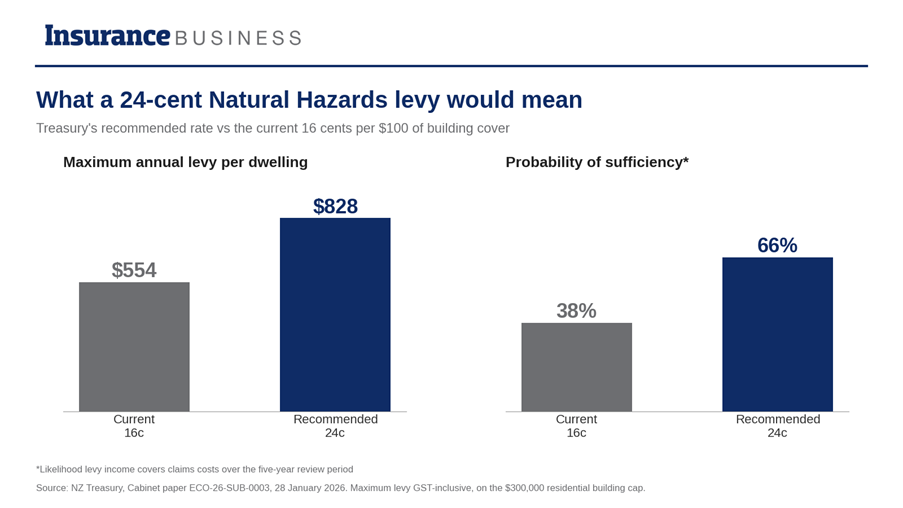
It is just another step in a holding pattern that has now lasted most of the year. When ministers asked regulators to dig into home insurance pricing in February, the plan was a six-month “discovery phase” with findings back to ministers by mid-2026. The Cabinet paper behind that review was blunt. Home insurance premiums had grown at three times the rate of CPI since 2011, including a 40% jump in just two years, and cover was getting harder to find in places exposed to both earthquake and flood risk, with Wellington, Marlborough and Canterbury named specifically.
Read next: Consumer group flags affordability, competition as big issues in insurance review
For insurers and brokers, the bigger unresolved issue may be the Natural Hazards Insurance levy.
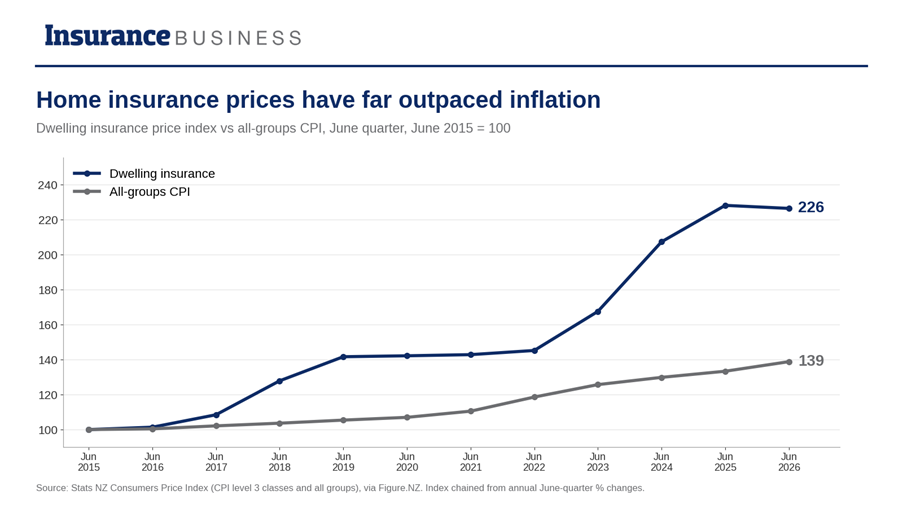
Treasury told ministers the current rate of 16 cents per $100 of building cover falls short of the 24-cent “technical” rate needed to meet the scheme’s long-run costs. The main reason is the 2022 update to the National Seismic Hazard Model, which lifted modelled national earthquake shaking hazard by an average of 50%. Moving to 24 cents would take the maximum annual levy per dwelling from $554 to $828, GST included.
The modelling behind that advice is stark. At 16 cents, Treasury puts the scheme’s probability of sufficiency (the chance that levy income covers claims costs over the five-year review window) at 38%. At 24 cents, it rises to 66%.
The government has already declined to lift the levy once, citing cost-of-living pressure, a decision the Insurance Council welcomed at the time. The Cabinet paper commits to restarting the levy review no later than the 2027/28 financial year.
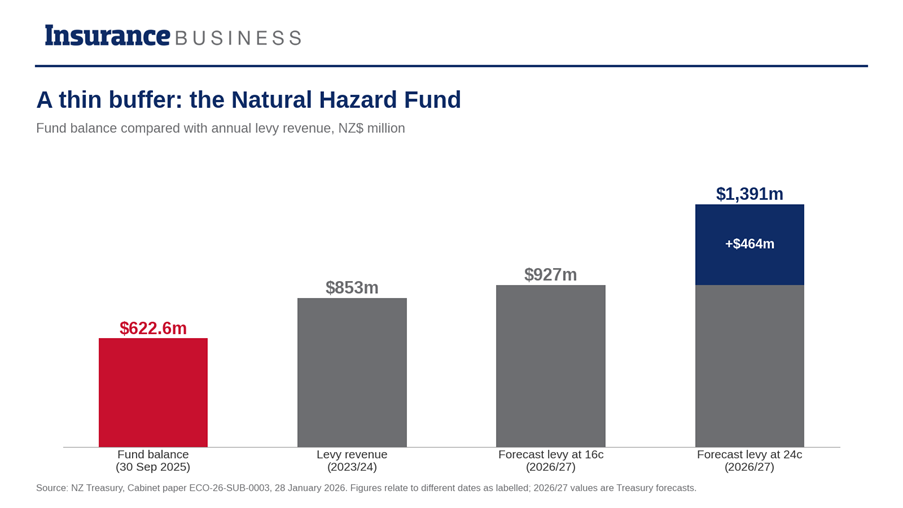
Meanwhile, the Natural Hazard Fund held just $622.6 million at 30 September 2025, against levy revenue of $853 million in 2023/24. Treasury estimated the 24-cent rate would raise about $464 million more each year.
The fund carries a Crown guarantee. If it can’t meet expected costs, the shortfall is covered either by a Crown loan, repaid by levy payers, or a grant funded through general taxation. Putting off the increase delays the bill. It does not remove it.
Read next: North Island quake tests what clients know about their seismic cover
The deferral arrived on the same day the Reserve Bank and Australia’s prudential regulator, APRA, released results from their first joint stress test since 2017.
The Trans-Tasman Stress Test covered ANZ NZ, ASB, BNZ and Westpac, which together account for 84% of lending in New Zealand. Alongside a severe recession scenario, it included a climate sensitivity. It assumed sharply higher premiums for the 2% of homes most exposed to river and surface flooding, and banks had to estimate the resulting strain on owners’ budgets and the knock-on hit to property values.
The regulators concluded the big four hold enough capital to cope, mainly because borrowers with very flood-prone homes make up a small share of their mortgage books. They also cautioned that climate-related risks could further weaken resilience if they hit during a severe downturn. They called for better climate data and closer links between property-level hazard information and banks’ credit risk systems.
For the insurance sector, the point is that the central bank now treats insurance availability as a financial stability issue. In May, the RBNZ’s Financial Stability Report flagged insurance affordability as an emerging risk. It set out how insurer retreat from flood-exposed areas could feed into bank balance sheets, through uninsured collateral, borrowers struggling to service loans and the risk of whole neighbourhoods being quietly red-lined.
Read next: Willis questions need for insurance levy overhaul
Part of the problem is that no one is quite sure how many New Zealanders have dropped their cover. Officials rely on three imperfect sources: the Insurance Council’s quarterly survey, NHC levy revenue and the Household Economic Survey. Together they put uptake somewhere between 83.7% and 95%, with the household survey pointing to a decline of roughly 5.5% since 2017.
A lack of competition is also in the frame. The Cabinet paper described the residential market as highly concentrated, and more so since the Canterbury earthquakes. It noted some evidence that insurers earn higher margins here than in Australia, which could reflect New Zealand’s higher risk profile or weaker competition. It asked the Commerce Commission for an initial market assessment that could lead to a full market study. Consumer NZ has long pushed for exactly that kind of scrutiny.
Then there is solvency. Insurers argue that New Zealand’s requirement to hold capital or reinsurance against a 1-in-1,000-year earthquake event pushes premiums up. The Reserve Bank’s solvency standards review has been on hold behind other prudential work, and the RBNZ has signalled it would rather restart it after the Insurance (Prudential Supervision) Act amendment bill passes in 2027.
Whoever forms the next government will start with a completed affordability review, a levy that Treasury says is too low, and a central bank that has already built insurance pricing into its stress tests.
For brokers, the near-term picture is unlikely to change much. Clients in quake- and flood-exposed regions will keep facing price pressure. Lenders are likely to ask more questions about insurability. Clients will need clear explanations of where NHC cover ends, at the $300,000 building cap, and private cover takes over. Any meaningful policy relief is now a 2027 conversation at the earliest. Ministers have also shown more than once that they would rather wait than raise a household cost in an election year.