Best Insurance Companies to Work for in Australia and New Zealand |
Top Insurance Employers
Jump to winners | Jump to methodology
Beyond the benefits
Insurance Business reveals the top insurance employers in Australia and New Zealand for 2026 – the insurance companies whose own workforces voted them the best places to work, each rated 75% or higher across 21 workplace categories
When evaluating the best insurance companies to work for in Australia and New Zealand for 2026, employee satisfaction across flexibility, benefits and leadership communication – measured anonymously across underwriting agencies, brokerages, general insurers, loss adjusters and premium funders – remains the defining differentiator.
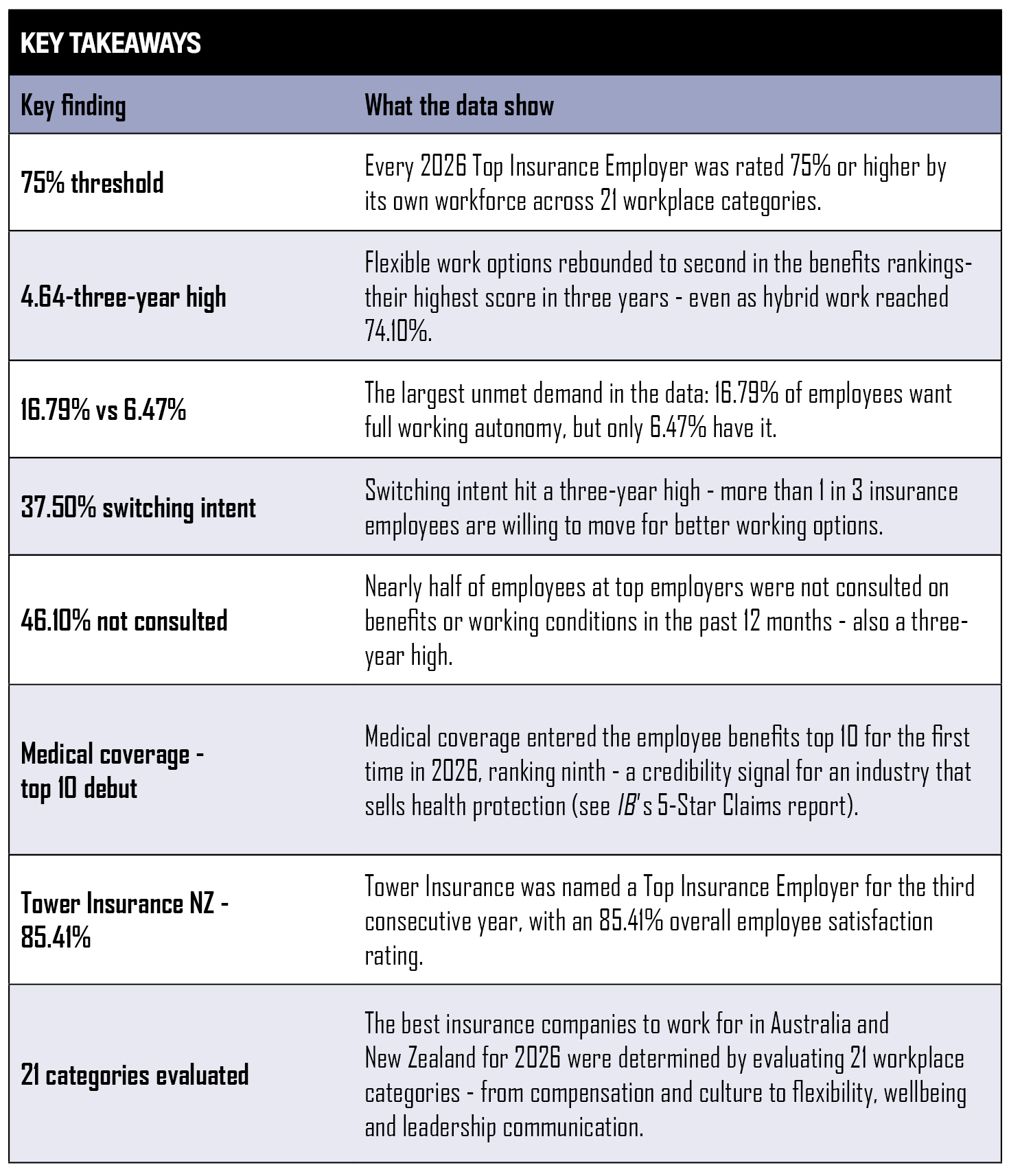
Key takeaways
What the best insurance companies to work for in Australia and New Zealand have in common
Insurance Business has named 21 organisations across Australia and New Zealand as the best insurance companies to work for in 2026 – each independently verified as a Top Insurance Employer by their own employees, who rated them 75% or higher across 21 workplace categories covering compensation, culture, flexibility, development and wellbeing. The result is a definitive, employee-driven answer to the question of which insurance employers are truly investing in their people.
Three years of asking the same questions produces a reliable kind of knowledge. Not just a snapshot, but a direction of travel, a picture of what insurance employees across Australia and New Zealand have consistently valued, what they have changed their minds about and where the gap between what employers offer and what people want is growing.
“The future workforce won’t be built solely by competing for experienced talent,” Ensure Recruitment managing director, New Zealand and Australia, Paul Murphy says. “It will be built by creating talent.”
That observation carries weight in a sector where the pipeline problem is structural, and the competition for experienced professionals is intensifying year on year.
IB’s 2026 Top Insurance Employers list is built on a clear threshold. Every employer named here was rated by its own workforce at 75% or higher across a demanding set of criteria covering compensation, development, culture, flexibility, recognition and wellbeing. These are not companies that did well on a few metrics. They are companies whose people, in aggregate, said this is a good place to work and said so in sufficient numbers to make that verdict meaningful.
What the data from those employees reveals, read across three survey years, is a workforce that has grown more exacting. The fundamentals have not shifted. Time off and flexibility remain the benefits rated most important, as they have been since this survey began.
But the specific shape of what employees want inside those categories has changed, and the direction of those changes tells a precise story about where the best employers are now earning their recognition and where the work is not yet done.
The most significant single movement in the 2026 data is the rebound of flexible work options to second place in the benefits rankings, with a score of 4.64, its highest across all three years.
That rebound is striking because it runs against what might be expected. Hybrid work simultaneously reached a three-year high in 2026, with 74.10% of employees in hybrid arrangements.
A sector with near-record hybrid adoption should, in theory, be satisfying its flexibility needs. The data says otherwise, and the reason is visible in the arrangement gap: 16.79% of employees want full autonomy over how and where they work, but only 6.47% actually have it – the largest unmet demand in the dataset. The best employers in 2026 are those who have understood that hybrid is infrastructure, not flexibility. Genuine flexibility is the experience of having a say.
Two other movements deserve particular attention from anyone reading this report. Corporate wellness programs recorded the strongest sustained growth of any benefit across all three survey years, from a score of 3.721 in 2024 to 3.894 in 2026, a 4.65% gain that reflects a workforce placing increasing weight on employers who take holistic wellbeing seriously as a daily operational reality.
And medical coverage entered the top 10 benefits rankings for the first time in 2026 at ninth place. That is a notable development in any sector. In insurance, it is a direct credibility question. The employers selling health protection products to the public, whose own people are now naming private medical coverage as an unmet priority, face an inconsistency that is increasingly difficult to absorb.
None of this diminishes what the employers on this list have built. Being rated at 75% or above by your own workforce, across every dimension of the employment experience, is a genuine standard.
As Gary Bloxham, director and partner at Tyler Wren, puts it, “The top insurance employers in 2026 won’t necessarily offer more perks. They will offer smarter, more impactful ones that combine practical incentives with flexibility and career growth.”
The 2026 employee verdict: how ANZ’s top insurance employers rated across 21 categories
2026 Top Insurance Employers: category-by-category ratings
Insurance Business ANZ
Top Insurance Employers 2026 — Employee Ratings by Category
All winning organisations | Anonymised by size band | Scores: 1 (poor) to 5 (excellent) | Colour scale normalised per column
| Employer | n | Compensation | Healthcare benefits | Retirement plan | Bonus / incentives | Loyalty leave / sabbatical | Professional development | Fair performance review | Career advancement | Workplace culture | Work-life balance | Flexible work options | Health & wellness programs | Family-friendly benefits | Diversity & inclusion | Team building & social | Employee recognition | Inspired to meet goals | Feel valued & appreciated | Leadership communication | Safe work environment | Job security | Overall satisfaction |
|---|
Colour scale is normalised per column: each cell is coloured relative to the highest and lowest score within that category across all listed employers. This allows genuine performance differences within each category to read clearly. Companies are ordered by size band (L → M → S), then by overall satisfaction score within band. Company names are withheld; size band and response count are shown.
Source: Insurance Business Top Insurance Employers survey 2026. Organisations achieving ≥75% average employee satisfaction rating. Scores represent mean employee ratings on a 1–5 scale.
ANZ top insurance employers 2026: flexibility, retention and the hybrid gap
Hybrid work is at a three-year high in ANZ insurance – but flexibility demand is rising faster
Australia and New Zealand’s insurance employers are navigating a workforce that has grown more precise about what it wants and more willing to act when it doesn’t get it. Across the brokerages, general insurers and underwriting agencies that make up this sector, the competition for skilled professionals in claims management, underwriting and risk advisory is intensifying year on year. The findings from IB’s 2026 Top Insurance Employers survey, drawn from employees at firms that met a 75% or higher satisfaction threshold, reveal a sector where the fundamentals are strong but the pressure points are sharpening.
Work arrangements: three-year trend and 2026 gap
Australia and New Zealand insurance employees | 2024–2026
Three-year trend: current arrangements
2026 gap: what employees have vs what they prefer
| Arrangement | Current % | Preferred % | Gap (pp) | Signal |
|---|---|---|---|---|
| Hybrid | 74.10% | 65.14% | −8.96 | Over-delivered |
| Employee's choice | 6.47% | 16.79% | +10.32 | Largest unmet demand |
| 100% office-based | 11.65% | 6.89% | −4.76 | Over-delivered |
| 100% remote | 8.06% | 11.19% | +3.13 | Modest unmet demand |
The employee's choice gap is the data's key number. A 10.32 percentage point shortfall between demand and provision of autonomous working arrangements explains why flexible work options score at a three-year high even as hybrid reaches record levels. Hybrid is growing — but on employer terms, not employee choice.
Source: Insurance Business Top Insurance Employers survey, 2024–2026. 2024 n=1,086; 2025 n=687; 2026 n=697.
The clearest signal in the 2026 data is the rebound of flexible work options to second place in the benefits rankings, with its highest score across three survey years at 4.64. That movement is striking in context: hybrid work simultaneously reached a three-year high, with 74.10% of respondents working in a hybrid arrangement. A sector with near-record hybrid adoption should, in theory, be satisfying its employees’ flexibility needs. The data says otherwise.
The explanation lies in what hybrid delivers. In 2026, 16.79% of employees say they prefer a model where working arrangements are their own choice, yet only 6.47% actually have that arrangement. That 10.32 percentage point shortfall is the greatest unmet demand in the dataset. Employers have built a hybrid infrastructure, but much of it operates on employer terms rather than employee preference. The distinction matters, and employees are drawing it clearly.
Nearly 4 in 10 ANZ insurance employees would move for better working options
The practical consequence is showing up in job mobility data. In 2026, 37.50% of insurance employees say they would move for a role offering better working options, the highest figure across the three years of this survey and a sharp reversal from 2025, when the equivalent figure dropped to 30.85%.
That dip, which coincided with broader labour market caution post-pandemic, turned out to be temporary. The rebound tracks almost exactly with the renewed premium employees are placing on genuine flexibility.
Would you switch jobs for better working options?
Australia and New Zealand insurance employees | 2024–2026
The 2025 dip was temporary. Switching intent fell sharply in 2025 as a cooling job market encouraged employees to sit tight. The 2026 rebound — to a three-year high — mirrors exactly the rise in flexible work options to #2 in the benefits rankings. The survey question is framed specifically around working options: these are not employees expressing general dissatisfaction, but people who could be moved by a competitor offering better flexibility.
Source: Insurance Business Top Insurance Employers survey, 2024–2026. 2024 n=1,086; 2025 n=687; 2026 n=697.
For a specialised sector where underwriting, claims, and actuarial capability take years to develop, a switching intent figure approaching four in 10 represents material retention exposure. The employees signalling willingness to move are not, for the most part, expressing generalised dissatisfaction as the survey question is framed specifically around working options. These are people who would otherwise stay, but whose current arrangement does not fully match their preference.
Medical coverage enters the ANZ insurance top 10 employee benefits for the first time
One data point in this year’s benefits rankings warrants particular attention. Medical coverage entered the top 10 for the first time, ranking ninth with a score of 3.881. For an industry built around the financial value of health protection, the fact that employees at insurance companies now rank private medical coverage as a top 10 workplace benefit creates both an alignment opportunity and a visible inconsistency for any employer who does not offer it competitively.
Insurers who sell health products to clients while their own people flag it as an unmet priority face a reputational tension that is increasingly difficult to overlook.
Elsewhere in the benefits data, corporate wellness programs recorded the strongest sustained growth of any benefit across all three survey years, from 3.721 in 2024 to 3.894 in 2026. The direction of travel is consistent. Employees are placing more value on holistic wellbeing support, and employers who invested early in wellness infrastructure are seeing that validated.
Top 10 employee benefits — rated by importance
Australia and New Zealand insurance employees | 2024–2026 | Scale: 1 (not important) to 5 (very important)
Key movement in 2026: Flexible work options rebounded to #2 with their highest score in three years (4.642), even as hybrid work arrangements hit a three-year peak. Medical coverage entered the top 10 for the first time, ranking #9 — a significant signal in a sector built on health protection.
Source: Insurance Business Top Insurance Employers survey, 2024–2026. Top employers only (≥75% employee satisfaction threshold).
Nearly half of ANZ insurance employees were not consulted on benefits or working conditions in 2026
Underlying all of this is a finding that deserves direct attention from HR leaders. In 2026, 46.10% of employees at the sector’s top employers – nearly half – said their employer had not consulted them on benefits or working conditions in the past 12 months. That figure is a three-year high, and it has been rising consistently. The “yes” rate peaked at 59.01% in 2025 and has since fallen by more than five percentage points in a single year.
Were employees consulted on benefits and conditions?
Australia and New Zealand insurance employees | 2024–2026 | Past 12 months
The direction of travel is unambiguous. "No" has risen in every survey year — from 38.95% in 2024 to 46.10% in 2026. "Yes" peaked in 2025 and is now retreating sharply. If the trend continues at the current rate, "No" will overtake "Yes" in the next survey cycle.
The connection to switching intent. Switching intent is at its highest in three years (37.50%) at the same moment consultation rates are at their lowest (53.90%). These two data points moving in opposite directions simultaneously is not coincidence. Employees who are not being asked about their preferences are exactly those most likely to take those preferences elsewhere.
Source: Insurance Business Top Insurance Employers survey, 2024–2026. Note: 2026 consultation question n=629 (vs n=697 for other questions in same year) — directional findings are robust but the smaller sample warrants noting in published analysis.
The data present a coherent causal chain. Employers cannot close gaps they have not measured. The arrangement shortfalls, the flexibility premium, and the rise in switching intent do not persist because these employers are indifferent to their workforce. For a growing proportion, they persist because the conversation is not happening often enough. Pulse surveys and manager check-ins are mechanisms, but they need to operate continuously, not as annual events.
The employers recognised in this report have earned that recognition from the people who work for them. The data also shows exactly what comes next.
ANZ Insurance Talent Market 2026: what’s driving candidate selectivity and employer competition
ANZ insurance employment is growing – but wage growth is the weakest of any Australian sector
The conditions shaping Australia and New Zealand’s insurance talent market in 2026 are not accidental. They are the product of several years of compounding pressure – pandemic disruption, rising general insurance premiums, digital transformation, regulatory change, and economic uncertainty – that has reshaped how insurance professionals evaluate employers and make career decisions.
The labour market context matters here. Australia’s financial and insurance services sector is projected to grow over the five years to November 2026 at a rate above the national average. Employment in finance and insurance in Australia reached 543,500 in February 2026, according to the Australian Bureau of Statistics, a sector large enough that talent competition is real and sustained.
Yet wage growth has not kept pace with that expansion. Financial and insurance services recorded the weakest wage growth of any sector tracked by KPMG in Australia through the year to September 2025, at 2.5%, below both the national average and the sectors it competes with for skilled professionals.
New Zealand’s labour market has spent two unsettled years marked by rising unemployment, declining job advertisements, and cautious business confidence. It is now moving back into growth, and that recovery is rebuilding hiring confidence – but it has also conditioned candidates to move carefully rather than opportunistically.
Ensure Recruitment’s Murphy has seen this caution in real-time candidate behaviour.
“Insurance professionals have navigated significant disruption. As a result, they’re making more considered career decisions and are no longer changing employers solely for a salary increase.”
More than 75% of Ensure’s placements across Australia and New Zealand in the past 12 months came from existing relationships, referrals or direct approaches, a signal of how difficult traditional advertising has become for reaching experienced talent.
Work-life balance now outranks pay as the top retention driver in ANZ insurance
The wider workforce data confirms what IB’s survey finds at the sector level. Randstad’s Workmonitor 2026, drawn from over 27,000 workers across 35 markets, found that while pay remains the top attractor for 81% of talent, work-life balance has become the greatest lever for retention: nearly half of workers cite it as the main reason they stay, versus just 23% for pay.
For the second year running, work-life balance ranked higher than pay when evaluating job offers – a shift that began with Randstad’s 2025 Workmonitor and was confirmed again in 2026.
The nuance the data adds is that flexibility and autonomy are not the same thing. Randstad’s Workmonitor Pulse survey from May 2025 found that 59% of workers globally would prefer autonomy over their working hours to a higher salary, and more than half would choose control over their hours ahead of control over their working location.
The distinction is one Tyler Wren’s Bloxham sees playing out directly in candidate expectations across the trans-Tasman market.
“What employees are actually asking for now is genuine personalisation. They want employers to move beyond a one-size-fits-all approach and offer adaptable options that reflect their specific life stage.”
For insurance employers who have built hybrid models and assumed the flexibility question is resolved, that is a direct challenge to that assumption.
Employee engagement in Australia and New Zealand has fallen to its lowest level since 2020, Gallup finds
The engagement picture adds a further layer of complexity. Gallup’s 2026 State of the Global Workplace report found that global employee engagement fell to 20% in 2025, its lowest level since 2020, costing an estimated US$10 trillion in lost productivity.
In Australia and New Zealand specifically, engagement sits at 21%, only marginally above the global figure, while 60% say it is a good time to find a job locally – though that is a sharp 12-point fall year on year.
The driver behind the global decline is not frontline disengagement but manager strain. According to Gallup’s 2026 State of the Global Workplace report, manager engagement fell from 31% in 2022 to 22% in 2025 – a nine-point drop that matters for insurance employers, where middle management carries the operational load of hybrid oversight, development conversations, and team cohesion.
Murphy states the consequence plainly: “The strongest insurance cultures share several common traits. Employees understand the organisation’s purpose, leaders are visible and accessible, development is actively encouraged, and there is clear alignment between what leadership says and what employees experience day to day.”
The same principle applies to structural changes in how and where people work. The employers absorbing that risk most effectively are those investing in manager capability as directly as they invest in policy.
What the market data and the recruiters’ evidence collectively establish is the context in which IB’s own survey findings land. The sector is growing, talent is mobile, autonomy is valued above flexibility, and the manager layer is under measurable strain. The employers recognised in this report are operating inside all of that and being rated highly by their own people despite it.
Industry expert Q&A: insurance recruitment and retention in Australia and New Zealand
Gary Bloxham
Director and partner, Tyler Wren, New Zealand
The sector talks a lot about culture as a retention tool, but your data suggests employees rarely cite it as a reason to move. What is actually going on?
It is one of the more counterintuitive findings we see. Only 8.4% of professionals cite culture as their primary reason for changing jobs. But that does not mean culture is unimportant – it means that when culture is working, people do not name it. They just stay.
Where culture becomes visible is in what an organisation consistently rewards, tolerates, and prioritises at a practical level. You measure true culture by whether internal mobility is actually happening – whether junior brokers are transitioning into mid-market roles or whether claims assessors are being upskilled into technical specialists. When that movement is occurring, you have a strong culture. When it is, no amount of value statements will compensate. The truest measure of a strong culture is one that an annual engagement survey will never fully capture.
Beyond the headline benefits, which practical perks are most under-delivered relative to how much employees actually value them?
Car parking is a genuinely powerful example that does not get nearly enough attention. It scores very highly in importance among professionals but is only offered to 43.3% of them. It is the kind of practical, day-to-day benefit that removes a real cost and a real friction from someone’s working life, and yet it is absent from the majority of employment packages.
Superannuation and KiwiSaver contributions above the statutory minimum tell a similar story. They are highly valued and directly tied to long-term financial security, yet only around 35% of employees receive above-standard contributions. The employers who understand this are not necessarily spending more overall – they are spending more intelligently on the benefits that actually register in people’s daily lives rather than on offerings that look good in a brochure.
Paul Murphy
Managing director, New Zealand and Australia, Ensure Recruitment
The pipeline problem in insurance is well documented. Where does the real bottleneck sit, and what are employers getting wrong in how they approach it?
The honest answer is that much of the challenge is a visibility problem rather than a supply problem. Despite insurance being one of the largest sectors within financial services, it remains largely invisible to students and graduates making early career decisions. Most professionals I speak with entered the industry by chance or through a personal connection – not through a deliberate career choice. That is a structural problem the industry has not taken seriously enough for long enough.
What is not working is continuing to recruit exclusively from traditional talent pools while expecting the pipeline to replenish itself. The industry needs to become genuinely comfortable hiring for potential and transferrable skills and then investing in development from that point. The future workforce will not be built solely by competing for experienced talent. It will be built by creating talent – and that requires a fundamentally different hiring philosophy than most insurers currently operate with.
How should employers be measuring whether their culture is genuinely healthy – and what signals matter more than engagement scores?
Engagement scores have their place, but they are a lag indicator. By the time a score moves materially, the cultural shift that caused it has usually been underway for months. The metrics that give earlier and more honest signals are voluntary turnover among high performers, internal promotion rates, employee referral rates and the tenure of key talent. Exit interview data is underused – most organisations collect it and do not act on it systematically.
One of the strongest leading indicators I rely on is whether employees would recommend the organisation to people they respect professionally. That is a meaningful test because it asks someone to put their own reputation behind their employer’s. When talented people are consistently willing to do that, it is a powerful signal of cultural health. When they are not, no engagement score will tell you what you need to know as clearly or as early.
Top Insurance Employer 2026: Tower Insurance NZ
Tower Insurance named a top insurance employer in New Zealand for the third consecutive year – here’s what its people say
For the third consecutive year, Tower Insurance has earned a place on IB’s Top Insurance Employers list, a record that reflects a consistent, daily commitment to how its people experience the business.
With an 85.41% overall employee satisfaction rating from a workforce of more than 500, Tower’s result is built on some of the strongest scores in this year’s cohort on work-life balance (4.48), flexible work options (4.69), culture (4.48), and diversity and inclusion (4.65).
Tower Insurance’s CEO has no office, and its employees rate leadership communication at 4.5 out of 5
Carly Orr joined Tower as chief people officer in February 2026 and found a culture already defined by something she had not seen elsewhere: genuine leadership accessibility. Tower’s CEO Paul Johnston does not have an office. He sits at an open table near the kitchen, available to anyone who stops by, and people do.
“He’s really well connected to the business, and oftentimes in our executive meetings he talks about something that some member of staff just happened to stop by and tell him,” Orr says.
No member of Tower’s executive team sits behind a closed door. The entire leadership group works in an open plan: one day a week, they sit together as a team, and on every other day, they are out in the business. The effect, Orr says, is that listening is not a structured event at Tower. It is a daily condition.
That philosophy carries through to how Tower measures engagement. The company runs surveys twice a year, but Orr is clear about where the real intelligence sits.
“I always say it’s just a moment in time. What I comb through is the verbatim; it’s what people take the time to actually type to us.”
In FY25, Tower recorded its highest-ever employee engagement score of 8.2, with a response rate well into the 90th percentile. Its peer relationships score of 9.0 places the company in the top 5% of global finance companies on that measure, a result Orr connects directly to what happens in the office day to day rather than to any specific program.
Tower Insurance scores 4.69 on flexible work and designs office experiences employees don’t want to miss
Tower’s flexibility philosophy is deliberate. The standing principle of “if it works for your team and your role, it works for them,” puts the test of reasonableness at the team level rather than in policy documents. But Orr has added a second layer, making the office somewhere people actively want to be.
“I want to make sure we create experiences in the office that make people want to come in. I call them commute-worthy experiences,” she says.
In practice that means:
-
cultural celebrations held in-office for Lunar New Year, Matariki, and Pacifica Day, including, most recently, dining on a whole roasted pig
-
people awards tied to company values, with the overall winner earning a coffee with the CEO to share ideas on improving the business
-
recognition built into the physical rhythm of the workplace, not confined to annual events
The most recent overall people award winner was Kayla Dalrymple, Tower’s external communications manager, who is shortly to go on parental leave, itself made possible by the top employer’s 26 weeks of fully paid parental leave entitlement.
Income protection insurance for all staff: the benefit fewer than 10% of large New Zealand employers offer
Tower’s strongest category scores from employees are in flexibility, work-life balance, and diversity and inclusion. But the benefit Orr singles out as the most meaningful, and the least visible, is income protection insurance, offered to all staff at full coverage.
“In New Zealand, I think, certainly in larger organisations, it’s less than 10% that offer income protection insurance. It’s always one of those things that I don’t think people truly value until they absolutely need it.”
For Orr, that benefit carries particular weight inside an insurance business. Tower’s people understand what financial risk looks like at a product level every day. Extending that protection to their own income is, she says, an expression of the same values Tower sells to customers.
How Tower Insurance is upskilling 100 AI champions across its workforce – and why it calls it a people investment
The initiative Tower has concentrated most energy on in the past 12 months is AI capability, approached as a people investment rather than a technology rollout.
The program operates on two tracks:
-
a new AI contact centre platform that handles routine, repetitive tasks and frees customer-facing staff for higher-value conversations
-
100 Copilot champions, trained specialists distributed across the business, serving as in-team resources as Microsoft Copilot rolls out to all staff
“People have to get comfortable with it and feel confident with AI, and we take that responsibility very seriously. If we don’t upskill people and get them on board with this, then we’re probably doing them a disservice.”
The framing matters. Tower is not presenting AI as an efficiency gain extracted from headcount. It is presenting it as a skill that belongs to the individual, one they carry with them regardless of where their career takes them next.
What Tower Insurance employees say: survey scores across 21 workplace categories in 2026
Tower’s survey scores tell a consistent story across the categories that most directly reflect daily experience:
-
work-life balance: 4.48
-
flexible work options: 4.69
-
workplace culture: 4.48
-
diversity and inclusion: 4.65
-
feel valued and appreciated: 4.55
-
leadership communication: 4.50
-
inspired to meet goals: 4.65
The pattern across those numbers is not one of exceptional performance on a single dimension. It is broad, even strong, representing a workforce that rates the fundamentals highly and does not identify a significant weak point. In a sector where the consultation gap and the flexibility shortfall are measurable across the industry, that kind of consistency is itself the story.
Q&A: Carly Orr, Chief People Officer
Tower Insurance NZ, Auckland, New Zealand
Flexibility is now an expectation rather than a differentiator across the sector? How do you make sure Tower’s approach still means something to your people?
It’s a really hot topic and has been ever since COVID-19, when every organisation had to work out what it meant for people to work from home. What I find interesting is that a lot of people actually want to work from the office. It’s not just about working from home.
Our general rule of thumb is if it works for your team and your role, then it works for us. But I also think about what we need from the office – to build the team, to build the culture, to support the business and to create the kind of environment where people do their best work together. So, the question I ask is how do we create experiences in the office that people genuinely don’t want to miss? Not because they have to be there, but because something is going on that matters to them.
Finding the right balance between what the organisation needs and what individuals need will remain one of the industry’s key challenges. I don’t think there’s a formula. It requires ongoing conversation and a lot of trust on both sides.
Tower has invested heavily in AI upskilling over the past 12 months. What is the philosophy behind that investment?
We’re approaching it in two ways: the platform side, which is about making day-to-day work better for our people, and the individual capability side, which is really where my focus sits as CPO.
We’ve just launched Copilot to all staff, and we have 100 Copilot champions across the business who’ve received specialised training and are a resource within their teams. But the thing I feel most strongly about is this: we are making sure our people are learning this skill now, whether they stay at Tower or go and work somewhere else.
People have to get comfortable with AI and feel confident with it, and we take that responsibility very seriously. The way I see it, if we don’t upskill our people and get them on board with this, we’re probably doing them a disservice. That’s how we think about it, not as a technology project, but as something we owe our people.
Top Insurance Employer 2026: Arch Insurance Australia
Arch Insurance Australia returns to the Top Insurance Employers list with the highest healthcare benefits score in this year’s cohort
Arch Insurance Australia returns to IB’s Top Insurance Employers list with a result that rewards close reading. With an 84.40% overall employee satisfaction rating, Arch’s recognition is not built on one or two standout categories. It is built on an unusual pattern: the company’s highest scores are in the places most employers find hardest to crack.
Arch Insurance Australia’s highest-rated benefit is the one most insurance employers score lowest
Healthcare benefits produced Arch’s single highest category score in the 2026 survey, at 4.833 out of five. That figure is not only Arch’s strongest result, but it is also the highest healthcare benefits score recorded by any employer in this year’s cohort.
In the context of the broader 2026 data, where healthcare benefits rank among the weakest categories across the sector and medical coverage entered the employee benefits top 10 for the first time, Arch’s result signals a deliberate investment choice that its workforce has noticed and valued.
The retirement plan score of 4.00 also sits well above the cohort median for that category, the area where even the sector’s best employers tend to record their most modest results. Read together, the two scores describe a company that has taken financial security benefits seriously at a time when most of its peers have not.
Regional manager Dominic Brannigan, based in Sydney, attributes Arch’s benefit profile to a direct line between what employees say and what the company does. “What we hear directly shapes how we work, whether that means evolving our benefits, expanding our learning and development offering, or investing in the wellbeing initiatives our people tell us matter most.”
Building a listening culture that operates year-round
Arch’s approach to employee listening runs through two parallel channels. The first is structural. Managers are actively encouraged to hold one-on-one conversations throughout the year rather than relying on periodic reviews. The second is peer-driven. A reward platform gives employees an ongoing mechanism to recognise each other’s contributions outside the formal management hierarchy.
The combination matters because it addresses the central weakness the 2026 data identifies across the sector, which is that employee consultation is increasingly episodic. In 2026, 46.10% of insurance employees at top employers said they had not been asked about their benefits or conditions in the preceding 12 months. Arch’s model is designed specifically to close that gap, embedding the conversation into the everyday rhythm of the business rather than reserving it for scheduled review points.
Flexibility as a conversation, not a checkbox
Arch’s flexible work options score of 4.23 sits modestly relative to some of this year’s highest performers, but the framing Brannigan places around it is significant. The company operates a hybrid model but explicitly rejects a policy-compliance approach to how it functions in practice.
“We treat flexibility as a conversation, not a checkbox, recognising that no two employees have the same needs and that meaningful flexibility requires a genuine willingness to listen and adapt.”
That framing aligns directly with what the 2026 data surfaces as the central employee demand. Not more hybrid arrangements but real agency within them. Arch’s work-life balance score of 4.37 and its safe work environment score of 4.51 suggest employees experience the flexibility philosophy in practice, not just in policy language.
Wellbeing investment that extends beyond the employee
The investment Brannigan identifies as most meaningful in the past 12 months is a sustained commitment to employee wellbeing, notable both for how it is structured and for its scope. Arch gives employees the freedom to invest in their health in ways that suit their individual circumstances and extends that support to employees’ immediate families.
“Our most meaningful investment has been in building a culture where people feel genuinely supported and recognised, not just at key moments in the calendar, but consistently throughout the year,” Brannigan says. “The difference is visible in the engagement, loyalty, and sense of community that defines our team today.”
The health and wellness programs score of 4.31 reflects that investment, as does the family-friendly benefits score of 4.17. Both sit above the cohort median for those categories.
What Arch Insurance Australia employees say: survey scores across 21 workplace categories in 2026
Arch’s scores tell a story of broad, considered investment rather than peaks in the obvious places:
-
healthcare benefits: 4.83
-
safe work environment: 4.51
-
retirement plan: 4.00
-
health and wellness programs: 4.31
-
work-life balance: 4.37
-
diversity and inclusion: 4.33
-
feel valued and appreciated: 4.28
-
professional development: 4.03
-
inspired to meet goals: 4.24
The standout pattern is financial security. Healthcare benefits and retirement plan are the two categories where the sector most consistently underperforms, and they are precisely where Arch records its strongest results. For a repeat winner on this list, that consistency across the hardest categories is the clearest indicator of where the company has chosen to place its investment and what its people have chosen to recognise in return.
The best insurance employers in ANZ have a roadmap for 2027 – the question is whether they use it
The employers recognised in this report were voted onto this list by their own people. That is the standard, and it is a meaningful one. An employee satisfaction threshold of 75% or higher, applied anonymously across 21 categories, is not a participation award. It is a workforce verdict.
What makes the 2026 data genuinely compelling is not what it confirms about these employers. It is what it reveals about the conditions even the best are struggling to get right. Nearly half of employees at these leading companies were not consulted on their benefits or working conditions in the past year. More than a third would move for better working options, the highest proportion in three years.
The arrangement employees want most, the ability to decide for themselves how and where they work, is the one most dramatically under-supplied. If this is what the best looks like, the industry as a whole has a significant reckoning ahead.
The root cause is not indifference. It is infrequency.
The flexibility gap, the switching intent rebound, and the under-delivery of autonomous working arrangements do not persist because these employers do not care about their people.
The consultation data makes the actual explanation visible. In 2026, 46.10% of employees at the sector’s top employers were not asked about their preferences in the preceding 12 months, a three-year high, rising consistently, at precisely the moment switching intent moved in the opposite direction.
Employers cannot close gaps they have not measured. For many, the gaps persist because the conversation is happening once a year at best, and in some cases not at all. Employee listening treated as an annual event is not employee listening. It is an annual survey.
The employers who will retain their standing in 2027 are those who act on four specific signals that the data has surfaced. Hybrid is infrastructure, not flexibility, and the workforce has made that distinction clearly, and the employers who respond by expanding genuine autonomy over working arrangements will directly address the greatest single unmet demand in the dataset.
Medical coverage is no longer a secondary benefit in this sector. Its debut in the top 10 is a credibility signal as much as a retention one, and insurers who lead on it are uniquely positioned to align what they offer internally with what they sell externally.
Corporate wellness has recorded the strongest sustained growth of any benefit across three consecutive years, and the employers who invested early are already seeing that validated in their scores. And consultation must become continuous, not a periodic exercise triggered by a difficult exit interview or a dip in engagement scores, but an ongoing operational practice embedded at manager level.
The real story of the 2026 Top Insurance Employers report is not that the best are good enough. The data their own employees have produced this year is both a recognition and a roadmap. The employers who treat it as both are the ones most likely to be standing here again in 2027. For a broader view of the professionals shaping the ANZ insurance industry this year, see the Insurance Business Hot List 2026 and the Elite Women 2026 reports.
Insurance Business ANZ
Five imperatives for top insurance employers in 2026
Distilled from IB's four-dataset analysis — what the data says employers must do next
Distinguish hybrid from flexibility
Hybrid is an arrangement. Flexibility is agency. Expanding employee's choice options — even for defined roles or senior cohorts — directly addresses the largest unmet demand in this year's data.
Make consultation continuous
46.10% of employees at the sector's top employers were not asked about their preferences last year. Pulse surveys, manager check-ins, and benefits review forums need to run year-round. An annual survey is not a listening culture.
Lead on medical coverage
Medical coverage entered the top 10 employee benefits in this sector for the first time in 2026. Insurers who move on this now have a genuine first-mover advantage — and close a credibility gap between what they sell and what they offer their own people.
Invest in wellness with the expectation of returns
Corporate wellness has recorded the strongest sustained growth of any benefit across three consecutive survey years. This is no longer a supplementary offering. It is becoming a baseline expectation, and employee scores are beginning to reflect which employers understand that.
Treat switching intent as a system signal, not a staffing problem
37.50% willing to move is not a recruitment problem. It is a diagnostic. The consultation data tells you why the gap exists. The arrangement data tells you what to fix. The benefits rankings tell you what to prioritise. The information is already in this report.
Consultation data
Why the gap exists
Arrangement data
What to fix
Benefits rankings
What to prioritise
Source: Insurance Business Top Insurance Employers survey 2024–2026. Top employers only (≥75% employee satisfaction threshold). Australia and New Zealand.
Best Insurance Companies to Work for in Australia and New Zealand | Top Insurance Employers
100 employees or less
- Aioi Nissay Dowa
- Arch Insurance Australia
- Elliott Insurance The Green Broker
- Grace Insurance
- Initio Insurance
- IQumulate Premium Funding
- PPS Mutual
- Shielded Insurance Brokers
- Simplex Insurance Solutions
- Tapanda
- TLC Insurance
- YDR Chartered Loss Adjusters
101–500 employees
- BizCover Australia
- Community Broker Network
- DUAL Australia
- DUAL New Zealand
- HDI Global
- Helia Insurance
- McLardy McShane Insurance Advisors
- Sedgwick New Zealand
501 employees or more
- Tower
Insights


Frequently asked questions
How are the Top Insurance Employers selected?
The process is entirely employee-driven. Insurance Business invites organisations across Australia and New Zealand to participate by submitting details of their workplace practices and benefits. Employees at nominated companies then complete an anonymous survey, rating their employer on a scale of one to five across 21 categories covering compensation, culture, flexibility, professional development, diversity and inclusion, recognition, wellbeing and leadership communication, among others.
To be considered for the final list, each organisation must reach a minimum number of employee responses scaled to its overall size. Only organisations that achieve an average employee satisfaction rating of 75% or higher across all categories are named Top Insurance Employers. The threshold applies uniformly regardless of company size, tenure in the industry, or previous recognition.
Can any insurance organisation enter, regardless of size?
Yes. The 2026 list includes employers ranging from organisations with fewer than 100 staff to those with more than 500. Response thresholds are adjusted proportionally so that smaller organisations are not disadvantaged by lower headcount. This year’s winners span underwriting agencies, brokerages, insurers, loss adjusters, premium funders and insurance technology firms across both Australia and New Zealand.
How representative is the employee survey data?
The 2026 survey drew responses from 697 employees across qualifying organisations. Respondents completed surveys anonymously, which the methodology is designed to encourage honest assessment rather than employer-influenced responses. The anonymity of the process is why IB treats employee ratings as the primary determinant of recognition, not employer self-nomination.
What separates the highest-rated employers from those that just cleared the threshold?
The spread between the highest and lowest qualifying scores in 2026 is meaningful. Overall satisfaction ratings among winners range from 75.26% to 91.92%, a gap of more than 16 percentage points. The highest-rated employers in 2026 consistently outperform on categories that employees across the broader survey rate as most important: flexible work options, workplace culture, feeling valued and appreciated, and leadership communication. The lowest-scoring categories across the cohort – retirement plan, healthcare benefits, and bonus and incentive programs – represent the clearest opportunity for employers currently sitting near the threshold.
Which category did employees rate most highly across all winning employers?
Flexible work options produced some of the highest individual scores in the dataset, with several employers recording ratings above 4.6 out of five. Work-life balance and feeling inspired to meet goals also scored consistently well across the cohort. These results align with IB’s broader three-year survey findings, in which flexible work options rebounded to second place in the benefits rankings in 2026 with their highest score across the entire survey period.
Where are the performance gaps even among top employers?
Healthcare benefits and retirement plan are the two categories where even the sector’s best employers score relatively modestly. Across the 2026 cohort, healthcare benefits scores range from 3.0 to 4.83 and retirement plan scores from 2.76 to 4.22 – the widest variance in the dataset and the lowest median scores of any category. For employers in the insurance sector specifically, the healthcare benefits gap carries a particular credibility dimension: employees at companies that commercially sell health protection products are rating their own employer-provided health coverage as the area most in need of improvement.
What does the data show about employee retention risk across the sector?
Switching intent reached a three-year high in 2026, with 37.50% of insurance employees saying they would move for a role offering better working options. That figure is up sharply from 30.85% in 2025 and represents the highest reading across the entire survey period. Critically, the survey question is framed specifically around working options rather than general job satisfaction – meaning the population expressing willingness to move is not broadly disengaged but specifically underserved on flexibility and autonomy. In a sector where underwriting, claims, and actuarial expertise take years to develop, a switching intent figure approaching four in 10 represents material, addressable retention exposure.
Is hybrid work delivering on employee flexibility expectations?
The data suggests it is not – at least not fully. In 2026, 74.10% of insurance employees work in hybrid arrangements, a three-year high. Yet flexible work options simultaneously rebounded to second place in the benefits rankings, with their highest score in three years. The explanation sits in the arrangement gap: 16.79% of employees prefer full autonomy over their working arrangements, but only 6.47% actually have it – a 10.32 percentage point shortfall that is the greatest unmet demand in the dataset. Hybrid infrastructure has been built, but much of it operates on employer terms. The employees registering the highest demand for flexibility are not asking for more days at home – they are asking for genuine control over how and where they work.
How does employee consultation affect retention outcomes?
The correlation in the 2026 data is direct and concerning. The proportion of employees at top employers who were not consulted on benefits or working conditions in the preceding 12 months rose to 46.10% – a three-year high – while switching intent simultaneously hit its own three-year high. These two data points moving in opposite directions at the same time is not coincidental. Employers who do not regularly ask their people what they want cannot identify or close the gaps driving mobility. Pulse surveys and manager check-ins are established mechanisms, but the data indicates they are being used less consistently across the sector than in previous years.
What do the results tell us about the pipeline problem in ANZ insurance?
The talent pipeline challenge is structural rather than cyclical. As Gary Bloxham of Tyler Wren notes, only 11.8% of insurance professionals currently receive a formal career progression plan, and just 45% feel they have a clear advancement path with their current employer. The offshoring of operational and support roles has simultaneously reduced traditional entry-level pathways – the back-office roles that historically served as training grounds for future underwriters and claims specialists. The top employers addressing this most effectively are those investing in structured mentorship, pairing mid-tier professionals with retiring senior brokers to transfer complex knowledge before it leaves the organisation.
How should insurers read this report if they did not make the list?
As a benchmark with a precise gap analysis built in. The methodology is transparent, the categories are fixed year on year, and the threshold is consistent. Any insurer that did not qualify in 2026 can use the published data to identify which categories their own workforce is most likely rating below par – flexibility, consultation frequency and career progression are the three areas where the sector’s broader data show the most consistent shortfalls. Paul Murphy of Ensure Recruitment puts the competitive framing plainly: the organisations retaining top talent in 2026 are those creating clear career pathways, investing in leadership capability, and offering meaningful development opportunities. Remuneration alone no longer closes the gap.
How often is the Top Insurance Employers list published, and how can organisations participate in 2027?
The list is published annually by IB as part of its special reports program covering Australia and New Zealand. Participation opens through an employer nomination process, details of which are published on the IB website ahead of each survey cycle. Organisations that have not previously participated are eligible, and there is no requirement to have won previously. Given that more than 75% of placements at specialist insurance recruiters now come through existing relationships and direct approaches rather than advertising, being publicly recognised as a top employer carries practical recruitment value well beyond the report itself.
Which are the best insurance companies to work for recognised in 2026?
A total of 21 organisations across Australia and New Zealand were named Top Insurance Employers for 2026 by IB, each rated 75% or higher by their own employees across 21 workplace categories. They include Tower (Tower Insurance NZ), Arch Insurance Australia, DUAL Australia, DUAL New Zealand, BizCover Australia, Community Broker Network, Helia Insurance, HDI Global, IQumulate Premium Funding, McLardy McShane Insurance Advisors, Simplex Insurance Solutions, Shielded Insurance Brokers, Sedgwick New Zealand, PPS Mutual, Aioi Nissay Dowa, Elliott Insurance, Grace Insurance, Initio Insurance, TLC Insurance Limited, YDR Chartered Loss Adjusters, and Tapanda
Methodology
To find and recognise the best employers in the industry, Insurance Business invited organisations across Australia and New Zealand to participate by filling out an employer form outlining their various offerings and practices.
Next, employees from nominated companies were asked to complete an anonymous form evaluating their workplace on a scale from 1 (poor) to 5 (excellent) on various metrics, including benefits, compensation, culture, employee development and commitment to diversity and inclusion.
To be considered for the final list, each organisation had to reach a minimum number of employee responses based on overall size. Organisations that achieved a 75% or greater average satisfaction rating from employees were named Top Insurance Employers of 2026.