
Top Insurtech Companies | Global 5-Star Technology and Software Providers
Jump to winners | Jump to methodology
The platforms brokers trust most
The broker-rated insurance technology providers delivering measurable impact across underwriting, claims, and distribution in 2026
Key takeaways
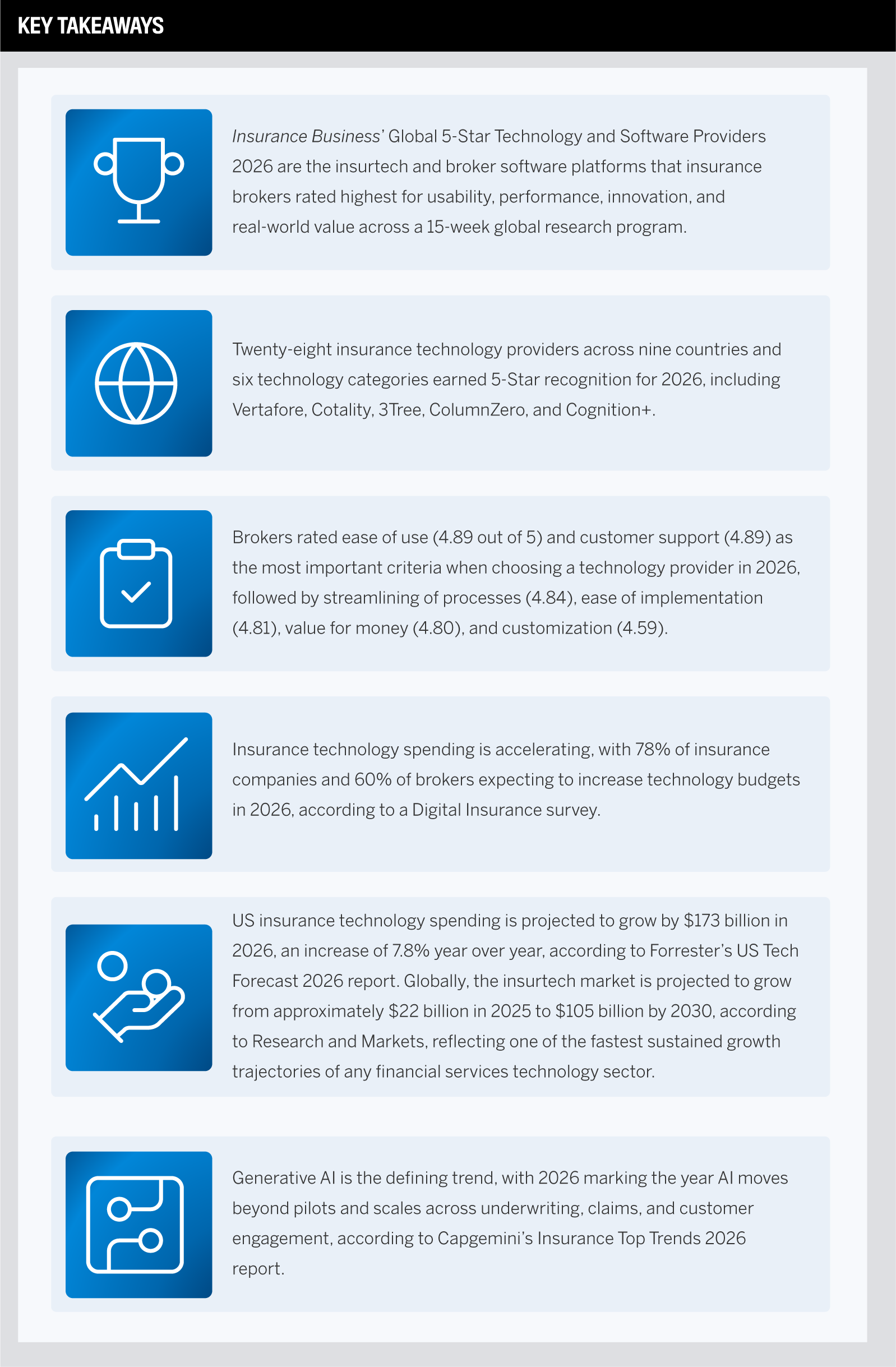
Market-leading is a claim made freely in the insurance technology space. But for 2026, Insurance Business set out to identify the top insurtech companies by grounding that distinction in something more durable than marketing copy – the independent verdict of insurance brokers, captured through a 15-week global research program spanning thousands of data points across usability, performance, innovation, and real-world value.
The result is IB’s Global 5-Star Technology and Software Providers 2026, a recognition of 28 insurtech providers spanning nine countries and six technology categories, all recognized for delivering measurable impact where it matters most, in the hands of the people who use these platforms every day.
Rising to the moment in the insurtech industry
The timing could not be more consequential. With insurance executives planning to increase AI spending in 2026 despite skills shortages that threaten their ability to scale the technology, the industry is in the midst of the most significant technology investment cycle in its history.
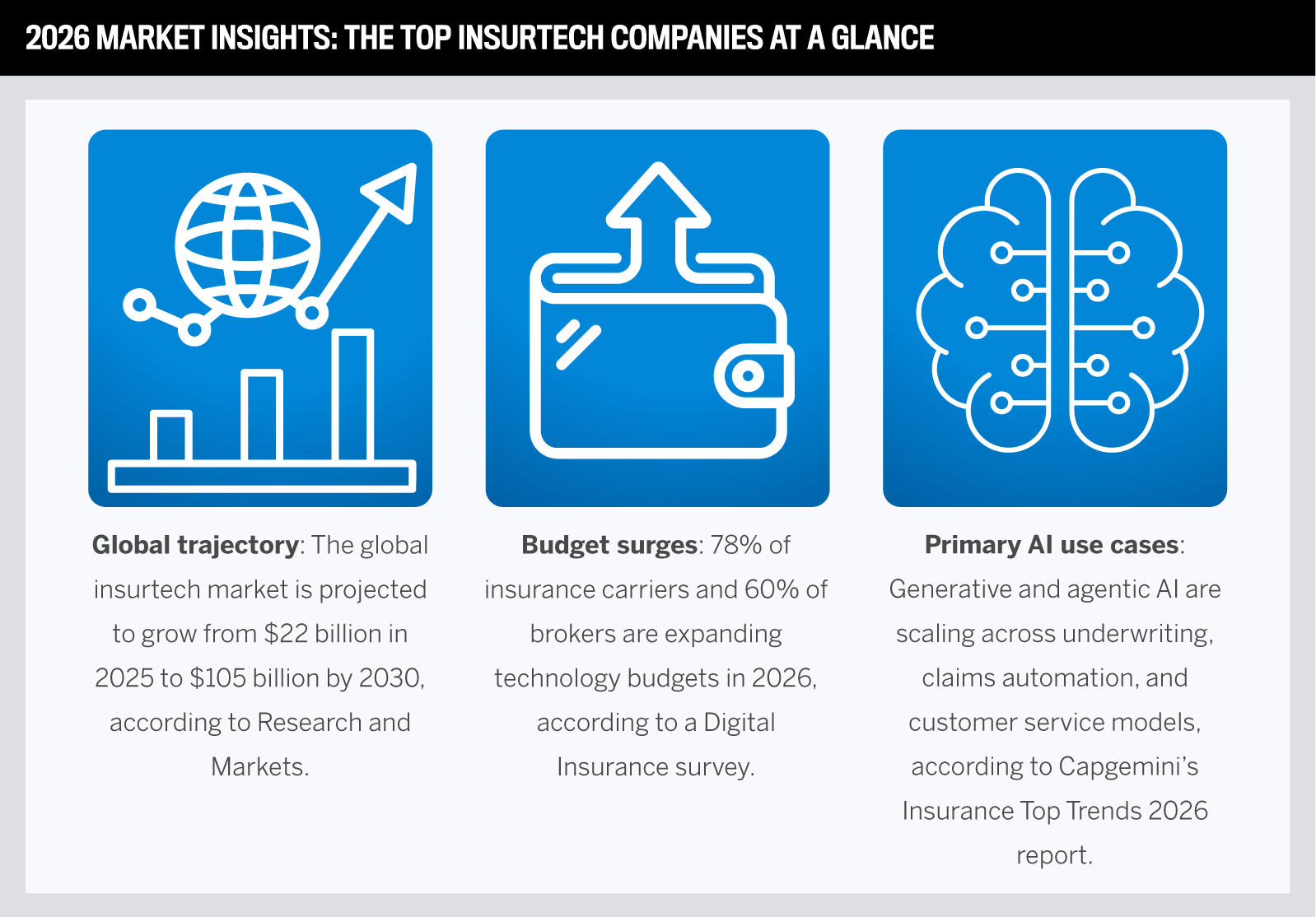
According to a Digital Insurance survey of agents, brokers, carriers, reinsurers, and adjusters conducted from October through December 2025, 78 percent of insurance companies and 60 percent of brokers anticipated increasing their technology spending in 2026.
Generative AI was cited by 52 percent of respondents as likely to change how carriers operate, while cybersecurity and threat intelligence tools were cited by 53 percent, signaling an industry simultaneously embracing transformation and bracing for new categories of risk.
The platforms that earn broker trust are not necessarily those with the largest marketing budgets or the boldest AI claims. They are the ones that are easiest to use, fastest to implement, most reliable when something goes wrong, and most effective at cutting the manual work that has long consumed broker time. This report identifies them and lets their users explain why.
How AI is reshaping insurance technology in 2026
The pressure on insurance technology has rarely been more acute. Rising catastrophe losses, tightening margins, persistent talent shortages, and a new generation of policyholders with digital-first expectations are forcing insurers, brokers, and managing general agents (MGAs) to modernize at pace.
Technology is no longer a back-office efficiency play. It is, as Capgemini noted in its Insurance Top Trends 2026 report, the foundation for resilience, growth, and trust across the industry. AI is at the center of this transformation.
2026 marks the year AI starts to drive serious value for the insurance sector, moving beyond pilots and scaling across underwriting, claims, and customer engagement. Manual, rule-based processes are being replaced by automated, AI-powered underwriting that accelerates decision-making and improves accuracy, while enterprise-wide AI is enabling insurers to act in real time and proactively manage risk.
Insurtech’s progress is uneven so far, but the shift is not uniform. While enterprise carriers invest heavily in AI-powered core systems and cloud-native architectures, independent brokers and MGAs are navigating the more immediate challenge of how to extract meaningful productivity gains from their existing technology investments without the IT resources or capital budgets of larger institutions.
As research into the global broker-insurer technology readiness gap shows, smaller intermediaries remain stuck in manual handoffs even as larger players modernize at pace. For these professionals, the criteria that matter most are not always the ones vendors lead with.
The stakes have rarely been higher. Insurance carriers are no longer looking to replace one old system with another, says Michelle Rosen, managing principal at Capco in Jamison, PA. “They are looking for a strategic partner that can change how work gets done,” she says.
Companies want partners that connect their disparate technologies, understand the full insurance value chain from underwriting and claims to payments and distribution, and produce measurable, often specifically financial, outcomes.
What brokers look for in the top insurtech companies
To understand where the industry’s technology benchmarks are moving, IB asked brokers to rate the importance of six core criteria when choosing a technology provider, on a scale of one (not important) to five (very important). The results, tracked across three consecutive years, reveal a market that is becoming more demanding and more specific about what good technology looks like.
What brokers want from their technology: importance scores for six criteria across 2024, 2025, and 2026, based on Insurance Business broker survey data
Insurance Business broker survey, 2024–2026
What brokers want from their technology
Importance scores out of 5 across six criteria for choosing a technology provider
Source: Insurance Business broker survey, 2024–2026. Scale: 1 = not important, 5 = very important.
Four editorial insights drawn from the Insurance Business broker survey 2024 to 2026, covering ease of use, customer support, ease of implementation, and customization trends
Ease of use
Unmoved at the top for three straight years
Ease of use has held the top position across all three years, an unbroken signal that brokers will not tolerate complexity, regardless of how sophisticated the underlying technology may be. A platform that requires training, workarounds, or persistent IT support is a platform that loses broker confidence.
Customer support
The biggest ranking swing in the dataset
Customer support has climbed from second place in 2024 to fourth in 2025 and back to second, now effectively tied with ease of use at 4.89, in 2026. Brokers do not just want technology that works. They want a partner that responds when it does not. In a market where platforms are becoming more capable but also more complex, the quality of the support relationship is increasingly the differentiator.
Brokers do not just want technology that works. They want a partner that responds when it does not.
Ease of implementation
Brokers have grown impatient with slow onboarding
Ease of implementation has shown the steepest upward trajectory of any criterion over the three-year period, rising from fifth place in 2024 to third in 2025 before settling at fourth in 2026. The trend reflects a market where brokers have grown impatient with lengthy, disruptive onboarding processes. Speed to value, the time between signing a contract and extracting measurable benefit, has become a competitive battleground in its own right.
Customization
Last place every year, despite rising scores
Customization remains ranked last across all three years, despite its score rising from 4.44 in 2024 to a peak of 4.66 in 2025. Brokers want some degree of flexibility, but they consistently prioritize platforms that work well out of the box over those that require extensive configuration. For technology vendors who lead with configurability as their primary selling point, this is a persistent caution.
Insights from the top insurtech companies of 2026
Five of this year’s 28 recognized providers spoke with IB about the challenges they solve, the outcomes they deliver, and where insurance technology is heading.
How Vertafore is turning “distribution velocity” into the operating model brokers need in 2026
In a year when nearly every insurance technology vendor is talking about AI, Vertafore’s chief product officer, James Thom, is focused on a more specific question: “What happens when AI creates fragmentation instead of solving it?”
That distinction, between automation that accelerates a single task and automation that improves the flow of the entire business, is at the center of how Vertafore has positioned itself in 2026, and it goes a long way toward explaining why brokers rated its products at a perfect 5.0 across every criterion in this year’s IB survey. A result that remarkable across a product suite that broad does not happen by accident.
Thom credits it first to people. “Across our teams, we have an incredible depth of insurance expertise, people who understand the day-to-day realities of agencies, brokers, carriers, and MGAs because they have spent years working closely with them and, in many cases, working in the industry themselves,” he says.
That domain knowledge, accumulated through long-standing client relationships and decades of proximity to how work moves through the distribution channel, is what Thom argues produces consistency at scale.
Even the most modern insurtech still requires your best people
Technology alone cannot deliver it. Understanding the workflows, pressures, and opportunities customers face, and then building solutions that reflect that reality, is what does. Those relationships, he adds, keep Vertafore focused on the problems that matter most rather than chasing innovation for its own sake. “They help us deliver value consistently across the solutions our customers rely on every day.”
Twelve months after implementation, the impact is measurable across multiple parts of the business. In employee benefits, AI-powered data ingestion can reduce processes that once took 45 minutes to just a few minutes.
Agencies using AgencyOne are experiencing up to 40 percent faster time in finding information. In rating and quoting, better connectivity between agencies and carriers can cut personal lines quoting time in half.
How MGAs are facing AI
For MGAs, Vertafore’s AI-backed Portal Launcher Agent helps bring new programs to market faster while reducing the errors that come from manual data entry. But Thom frames these gains carefully. Individual task improvements are only part of the story.
“What changes over that first year is not just one task or one metric,” he says. “It is the operating rhythm of the business. Information moves faster. Employees have better access to what they need. Leaders can scale more confidently because fewer workflows depend on manual handoffs or institutional knowledge trapped in different systems.”
That operating rhythm is what Vertafore calls “distribution velocity,” a framework for helping insurance organizations move faster, adapt more easily, and grow by connecting workflows, reducing manual work and making human expertise more productive across quoting, servicing, compliance, and operations.
It is not a product feature. It is a philosophy that shapes how Vertafore approaches every part of its suite, and it has become increasingly relevant as the conversation in broker offices has shifted.
Three years ago, most of those conversations were about digitization, adopting new tools, moving processes online, and modernizing specific parts of the business. Brokers have made real progress there.
Today, the question is more demanding. The biggest operational problem brokers are bringing to Vertafore in 2026, Thom says, is how to achieve automation with AI without creating more fragmentation. AI can generate tremendous productivity gains, but only when it connects to the systems, data, and workflows brokers already rely on.
Implemented as a point solution, it creates new handoffs, new exceptions, and new places where information gets trapped, speeding up one task while quietly slowing the broader workflow around it.
“The opportunity is to apply AI in a more connected way, reducing duplicate work, moving information between systems, surfacing insights at the right point in the workflow, and helping employees act faster with better context,” Thom says.
The brokers making the most progress are those treating AI as part of their operating model rather than as another layer of technology sitting alongside existing processes. They are focused, as Thom puts it, on connected automation that makes their people more productive and their business easier to scale.
Vertafore: Q&A with James Thom, chief product officer
The insurance industry talks a lot about digital transformation. What does that actually mean for an independent agency in practice?
For an independent agency, digital transformation is not just adopting new technology. It is changing how work moves through the agency so people can spend less time on administrative tasks and more time advising clients, building relationships, and growing the business. In practice, that means reducing duplicate data entry, eliminating unnecessary handoffs, making client and policy information easier to access, and connecting the workflows that support quoting, servicing, renewals, compliance, and reporting.
The agencies seeing the greatest results are not simply digitizing the same old workflows. They are rethinking those workflows end to end and connecting the systems, data, and people involved in delivering insurance. At its best, transformation creates more flow across the agency. Information moves faster. Decisions happen with better context. And the agency becomes easier to scale because growth is not held back by manual work, disconnected systems, or processes that depend too heavily on institutional knowledge.
What is the most common mistake brokers make when adopting new technology, and how does Vertafore help them avoid it?
The most common mistake is starting with the technology instead of the business problem. Brokers are under pressure to move faster, improve client service, and do more with the teams they have, so it is natural to look for tools that solve an immediate pain point.
But when technology is adopted around a single task without looking at the broader workflow, it can create new complexity, including duplicate data entry, disconnected processes, manual handoffs, and information that does not move easily across the business. We help brokers avoid that by starting with the workflow and the outcome. How does work move through the organization today? Where does friction exist? Where are employees spending time on low-value administrative work instead of advising clients or growing the business?
The goal is not simply to add another tool. It is to create Distribution Velocity, helping information, decisions, and work move through the business with less friction, so brokers can operate more efficiently, serve clients better, and scale with greater confidence.
How Cotality is turning fragmented claims into seamless policyholder experiences
When a claim comes in, the clock starts. For too long, what followed was a process defined by disconnection. Re-keyed data, repeated conversations, siloed systems, and a policyholder caught in a start-stop experience that had little to do with how well they were covered.
Cotality, based in Irvine, CA, was built to change that. John Herr, vice president of technical sales, has spent more than two decades in the insurance industry watching the gap between what claims technology promised and what it delivered. Cotality’s answer is an end-to-end claims platform that connects every step of the workflow, from first notice of loss (FNOL) through to final settlement.
The starting point is a problem the industry has largely talked around rather than solved, one that sits not in any system or platform but in the people who are slowly leaving the workforce.
“What we’re really thinking about is taking what’s historically lived in the minds of your experienced tenured adjusters and embedding that, taking that knowledge, and putting it into a workflow, into a tool that can actually help give that scalable best practice without having to just train harder, without having to just train longer,” Herr says.
In practice, that means intelligent dispatching at the front end of the workflow, where complex algorithms factor in geographic nuances, traffic, loss type, and adjuster skill sets to identify the best available resource for each claim and then continue optimizing that decision right up until deployment.
It is not a one-time calculation. Cotality continually re-evaluates the assignment over the course of several days to ensure the best person is still the right person when it is time to go to the loss.
Cotality’s structured approach to damage assessment tech
Guided damage assessment adds another layer. Cotality’s Scope tool walks adjusters through a structured questionnaire covering roof type, age, and condition to automate the repair-versus-replace decision on exterior losses, one of the most consequential and experience-dependent judgments in the claims process.
“Regardless of who the person is, whether they’re a 20-year adjuster or a two-year adjuster, you’re going to get the same scalable, reliable, consistent output,” Herr says.
That consistency matters beyond efficiency. Carriers have regulatory obligations to settle claims fairly and accurately, and digitizing best-practice knowledge into repeatable workflows is as much a compliance story as a productivity one.
Cotality’s approach extends all the way to supplements, the stage where hidden damages or building code requirements surface late in the process and typically trigger delays. A contractor may have construction underway but cannot proceed until a supplement is reviewed, evaluated, and approved.
By connecting the supplement review to the estimates already processed in the system, Cotality gives carriers the ability to handle that final step with full context rather than starting from scratch, removing one of the most common sources of policyholder frustration at what should be the finish line.
How catastrophe insurance has increased the urgency around insurtech
The catastrophe landscape has sharpened the urgency of all of this. Herr has watched the definition of catastrophe expand considerably across his career. Where once the word conjured hurricanes in the southeastern US, it now covers history-making flooding events, wildfires across California, hail across entire regions, and rain events of a scale that would once have been unthinkable.
The flash flooding that struck Toronto and the Greater Toronto Area on July 15–16, 2024 caused close to $1 billion in insured damage, according to the Insurance Bureau of Canada.
“The consistent theme over the last two to three years in the catastrophe space is that there is no consistent theme,” Herr says. Carriers can no longer forecast storm types, frequency, or geography with any reliability. What they need instead are systems that scale instantly, triage severity rapidly, and support smart deployment decisions, whether staff or contingent resources are being used.
Real-time visibility matters as much as speed. Leaders need data that tells them where policyholders are being served well and where intervention is needed, without having to call every adjuster individually to find out.
What sets Cotality apart in a crowded market of top insurtech companies, Herr argues, is its refusal to be a point solution. Carriers have made clear they do not want a dozen individual providers, each excellent at one thing.
“What they really want is a provider, a single source to help them with their entire workflow,” he says. Cotality’s position is reinforced by the depth of property data it holds from its real estate and mortgage services, which can pre-populate claim information from the moment FNOL is received.
“We almost have an unfair advantage in that regard,” Herr says. “Because we know so much about these properties.” That data foundation powers not just pre-filling but also the platform’s quality engine, which can evaluate estimates with a level of property-specific knowledge that the estimate alone cannot convey.
On straight-through processing, Herr is direct about where the limits lie. Coverage disputes, complex damage scenarios, and ambiguous data all remain areas where human judgment is not optional. But the goal was never full automation.
“We’re not trying to replace adjusters in the whole process,” he says. “We’re trying to amplify their impact by removing the low-value work and helping them do the things that their tribal knowledge, their expertise, is really designed to do.”
In Cotality’s model, technology handles the busy work so adjusters can focus on policyholders. “People focusing on people,” as Herr puts it.
Cotality: Q&A with John Herr, vice president of technical sales
The property insurance market has been under enormous pressure from catastrophic events. How has that changed what insurers need from their claims technology?
The consistent theme over the last two to three years in the catastrophe space is that there is no consistent theme. We’re not seeing regular, consistent hurricanes that cause damage and have an impact.
We’re seeing very significant events that are unusual and history-making. Carriers can no longer consistently expect to forecast the exact number of storms they’re going to have, the types of storms or events, or the geographic areas where they need to be staffed up. What it really means is they need systems that will scale rapidly, scale instantly, because you just can’t ever have enough staff in enough parts of the country to deal with these unexpected things that you just didn’t forecast.
The real requirements on carriers have shifted toward how you rapidly triage and score severity, rapidly figure out your policy-in-force count, and whether you have systems in place so that decisions don’t have to sacrifice quality.
What does straight-through processing mean for a complex property claim, and where are the limits?
Straight-through processing is not a binary, all-or-nothing proposition. Our approach is that we don’t look at it from an all-or-nothing perspective. We think about where we can add value, where we can add automation, where we can remove the busy work and help adjusters do the things they are best equipped to do. Straight-through processing still has challenges to overcome in areas like coverage disputes and complex damage scenarios and where there is incomplete or ambiguous data.
But if we can take intelligent segmentation and figure out what can be approved for the next step, that is hugely impactful. We are not trying to replace adjusters in the whole process. We are trying to amplify their impact by removing the low-value work and helping them focus on policyholders. People focusing on people.
How 3Tree’s Unite platform is giving Canadian brokers their workflow back
For Canadian insurance brokers, the daily reality of navigating a fragmented technology landscape has long meant one thing: becoming a system specialist on top of being an insurance expert.
Logging into a broker management system (BMS), then navigating out to an assortment of carrier portals and comparative raters, each with its own interface and logic, made for what Lisa Teggart, partner at 3Tree in Norval, ON, calls a “suboptimal workflow”. The Unite Insurance Exchange Platform was built to end that.
Unite moves brokers back to where they want to be, inside their own BMS, with transactions starting and stopping in one place. The workflow is consistent regardless of the carrier, and in many cases, portal access is eliminated entirely.
The implications for broker offices are immediate and practical. “When they hire a customer service representative, and the person is new to the industry, they have to go and get them trained on every single broker portal of the markets that they have within their office,” Teggart says. “And it’s hugely time-consuming.” Unite removes that burden at the source.
From BrokerFlow to Unite: a decade of insurtech in the making
The platform has been a decade in the making, and the question of why the connectivity problem is solvable now when it wasn’t before has a specific answer.
In 2018, the Insurance Brokers Association of Ontario (IBAO) ran an industry initiative called BrokerFlow, which established an agreed model for broker-carrier connectivity, a single application programming interface (API) suite through which carriers connect once and gain access to the entire ecosystem. The community was aligned on the optimal approach, and the proposed architecture was sound. Community alignment on timing and funding for the solution could not be reached, however.
“Despite great efforts, a community funding model with all of the competing carriers couldn’t be aligned on,” Teggart says. 3Tree stepped in, committed the funding, completed the initial build, and implemented it with foundational carriers. Each major BMS is already preconnected, with more broker system integrations to come this year.
In order to move the industry forward at a rapid speed, the need to be able to connect everyone without introducing any barriers to entry, such as specified data formats, was an early identified prerequisite.
Being fortunate to have some leading Canadian experts in insurance data exchange, with the application of technical and business know-how and a culture of delivery, 3Tree was able to move Unite forward into production with many willing partners.
“We’ll take what they have to get the connectivity moving forward,” Teggart says.
That flexibility means carriers can repurpose services they have already invested in rather than undertaking costly new builds, a compelling case to make at a board level. The platform also stores no data and keeps all interactions within Canada, removing two of the most common concerns carriers raise around privacy and regulatory compliance.
The result is that onboarding, which once took months or years, now typically takes weeks. Carrier adoption has followed accordingly. The conversation 3Tree now has with prospective carriers is a straightforward one. Connect once, gain access to every broker and BMS in the ecosystem, and start delivering value to broker partners quickly.
Traditionally, carriers would need to establish connectivity with five or more broker technology systems, and now they can achieve this with just a single connection.
3Tree has spent the past five years proving the technical model, with both the technology and the processes institutionalized. This included adding all key transaction types to the Unite data exchange so that carriers who connect can provide a full suite of sales and service capabilities to their brokers, including inquiry, quote and policy submission across personal lines as well as real-time commercial property quoting.
Unite’s insurtech community set to surpass 20 partners
Unite is now entering a carrier expansion phase, with the Unite Community forecast to reach over 20 connected carriers by the end of the year.
“Since everything’s very well defined, the process is very smooth,” Teggart says. 3Tree’s implementation framework maps out the integration process from the beginning, and the team brings what Teggart describes as the definitive expertise in insurance data. Word of mouth among carriers has done much of the selling. Good connectivity experiences, it turns out, travel fast.
The Canadian market’s broker distribution model, distinct from the more captive agent-driven structure common in the US, shaped Unite’s approach from the outset. Rather than forcing a uniform solution onto a fundamentally varied landscape, 3Tree built a platform that normalizes complexity without commoditizing it.
“Everyone’s product differentiation remains,” Teggart says. “All of the unique components of their products get highlighted just from the work the brokers are doing.”
No carrier has to dilute its offering to participate. And no broker, once they have adopted Unite, has switched back to the old way of working. Real-time connectivity is not the end goal, Teggart notes. It is the foundation for what comes next.
Straight-through processing and automated underwriting both depend on the robust broker-carrier connections that Unite is now putting in place.
“We’ll see even later this year a lot more coming out from 3Tree about Unite specifically on the more advanced features that the platform enables,” Teggart says. The infrastructure is built. The next phase is already underway.
3Tree: Q&A with Lisa Teggart, partner
Canadian insurance has unique connectivity challenges compared to other markets. What makes the Canadian broker-carrier relationship different, and how does that shape what Unite does?
We have a lot more captive agent-type scenarios in the US, for example, where what they’re using is a fundamentally different model from our highly valued broker distribution model here.
From a Unite perspective, we appreciated that things are fundamentally different here, and instead of trying to fit it all into one package, we’re capitalizing on the fact that everything’s different and finding an ability to provide commonality very easily.
Through the Unite Insurance Exchange Platform, we normalize everything so that the complexity on either side never has to be managed anymore. For a broker, they just log into their BMS, and all of the magic of it happens for them. And without commoditizing anything, everyone’s product differentiation remains.
What would it take for a broker to switch back to the old way of working after using Unite, and has that ever happened?
It hasn’t happened to date. Once you embrace the simplified method of doing things and not having to go to a bunch of different systems, you quickly change your workflow. Working within your own system has been the goal of brokers for several decades here.
We’ve just never gotten to the point where a real-time interaction was possible to deliver on that. And the beauty of real-time connectivity is it’s not an end game in itself. It’s giving us the ability to do more advanced features, straight-through processing, and automated underwriting, which we can’t do until we have the more robust connections between the brokers and the carriers.
How ColumnZero built a broker portal no off-the-shelf software could match
ColumnZero, formerly the technology arm of High Street Underwriting Agency in Brisbane, Australia, has recently spun out as its own company under the 11th Avenue brand, which also owns High Street.
Over 10 years of building, breaking, and rebuilding a proprietary portal from the ground up, the team has grown large enough to begin servicing additional agencies beyond the one it was originally built for.
Chief technology officer Andrew Martin describes that journey as “a labor of love,” and the broker ratings bear him out. The platform scored among the highest of any recognized provider across ease of use, customer support, and streamlining of processes in this year’s survey.
Why ColumnZero chose to build its own insurtech
The decision to build and maintain a proprietary portal rather than buy off the shelf was not made lightly. When the platform was first developed a decade ago, Martin says the available options were restricted, designed for simple risks or just designed for brokers, with clunky workarounds required for underwriters to function at all.
High Street writes complex risks alongside vanilla ones, and that breadth demanded a level of configurability no existing product could provide.
“Having full control of a code base meant that we could replicate all of the binder requirements and edge cases and allow us to automate as much as we could,” Martin says. Off-the-shelf offerings have improved since then, and competitors have recognized the gap, but none has caught up.
“There’s still nothing that really ticks every box for us,” explains Martin. “I probably would make the same decision now.” He adds that insurance knowledge has a way of constantly expanding.
“Every time you think you’ve seen every possible scenario, a new one appears immediately,” he says, and no off-the-shelf product could give ColumnZero the nimbleness and speed it needs to respond.
Turning broker feedback into live insurance tech functionality
That nimbleness is not theoretical. One of the platform’s defining qualities is the speed at which broker feedback becomes live functionality, and Martin offers a concrete example. For years, the portal exported policy documents as PDFs, treating them as final, non-editable outputs.
But many brokers were using legacy desktop software and needed to copy and paste policy content into their existing systems, a persistent double-handling problem across the policy lifecycle.
Requests came in from multiple brokers asking whether the portal could also export Word documents. For desktop software such as WinBeat, that would have been straightforward. Delivering it through a cloud-based platform was more complex.
“When you’re doing work online on the cloud, there are many hurdles to jump over with that,” Martin acknowledges. Once the team formulated a plan, however, the majority of the build took only two to three weeks. The Word documents are not pixel-perfect matches for the PDFs, since the two formats are built differently, but they are close enough to eliminate the friction that had been slowing brokers down.
The competitive advantage of owning the technology, rather than licensing it, comes down to a specific kind of developer investment.
“You get better results when people understand not only what they’re building but also who they’re building it for,” Martin says. “And they’re there to see the results of what they do. They don’t build it and move on, because you learn a lot from that.”
That continuity matters in a market where requirements can shift overnight. “Things happen in London, and they want it done yesterday,” Martin says. “Having full control of everything means that with the updates we can be very agile and react swiftly to time-sensitive updates.”
What the platform does today bears little resemblance to what was originally envisioned. When it launched a decade ago, it was purely an internal tool, simple binders with no grand ambitions.
“There was no end goal really,” Martin recalls. It was business software built to help High Street internally, nothing more. But the team had the foresight early on to build enough structure to keep the platform rigid where it needed to be while allowing for flexibility as requirements evolved.
Building an internal tool that becomes a white-labeled insurtech tool
Every month for 10 years has brought an “Oh, so that’s a thing, didn’t know that before” moment. Now, with parent company 11th Avenue acquiring additional agencies, ColumnZero is building full white-labeling capability into the platform so each agency it onboards can present it as its own.
A second agency is already in the process of being set up, opening what Martin describes as an entirely new dimension of what ColumnZero can do for the industry. The pace shows no signs of slowing.
“I keep saying the last six months have been the craziest six months, but I keep saying that every month,” he recalls.
ColumnZero: Q&A with Andrew Martin, chief technology officer
Brokers tell us ease of use is the single most important criterion when choosing a technology provider. How did that shape the design of your portal?
Several of our developers have experience in web and software development, where usability and intuitiveness are key. They’re right at the top of what you think about when you’re designing. Ultimately, brokers need to get what they want with as few clicks as possible and as little work as possible.
When there are multiple options for them to go to, you don’t want to give them any excuse to go somewhere else. That could be something like an extra click or a page that takes a couple of seconds too long to load. We consistently get feedback from brokers that the portal is easy to use, and it’s something we always keep at the forefront of our minds as we expand the functionality.
What is the competitive advantage of being an underwriting agency that also controls its own technology, rather than being a pure technology company?
Probably the main advantage is that we have developers who are specialized. They’re not just invested in the software but also in the insurance business that it supports. You get better results when people understand not only what they’re building but also who they’re building it for. And they’re there to see the results of what they do.
They don’t build it and move on because you learn a lot from that. Having full control of everything means that with the updates we can be very agile and react swiftly to time-sensitive updates, because things happen in London, and they want it done yesterday. So it means we can jump on things as quickly as we can.
How 30 years of Canadian insurance expertise gives Cognition+ an edge no new entrant can match
Replacing a core system is one of the most consequential decisions a property and casualty insurer can make. The typical commitment runs 10–20 years; the organizational disruption is significant, and the stakes are high enough that even the most forward-thinking CIO will approach the process with a degree of anxiety.
Brodie McLellan, vice president of business development at Cognition+ in London, ON, has heard every version of that anxiety. “It is a big decision, and everybody gets nervous,” he says. “If they weren’t nervous, they wouldn’t be doing their job.”
That healthy respect for the complexity, McLellan argues, is often precisely what leads to successful outcomes. What he also tells those CIOs, however, is that the bigger risk is frequently doing nothing.
Legacy systems create growing challenges across operational efficiency, talent recruitment, cybersecurity, regulatory responsiveness, and customer expectations. Over time, the cost of maintaining outdated technology can exceed the cost and risk of modernization itself.
The goal of a successful core system replacement, in Cognition+’s view, is not just to swap out software; it is to create a technology foundation that allows an insurer to operate more efficiently, respond to market changes faster, and deliver better experiences to policyholders, brokers, and staff for the next decade and beyond.
Getting there requires a process that begins long before any software is configured. A Cognition+ implementation starts with a collaborative discovery phase in which the company’s business analysts, project managers, and implementation specialists work closely with the insurer’s own teams to understand current processes, future-state objectives, regulatory requirements, and opportunities for operational improvement.
From there, the two sides establish a jointly owned project plan with clear governance, milestones, responsibilities, and success metrics. The implementation then progresses through configuration, data migration, integrations, testing, training, and user acceptance, with Cognition+ resources embedded throughout who understand the realities of Canadian underwriting, claims, billing, and broker operations.
The sweet spot for most carrier clients is eight to 10 months from kickoff to go-live, though the team tailors the timeline to account for business cycles.
The difference between a smooth transition and a difficult one, McLellan says, is rarely the technology itself. Successful projects share a common set of characteristics, including strong executive sponsorship, dedicated client subject matter experts, clear decision-making processes, and a genuine willingness to adopt best practices rather than simply replicate legacy workflows in a new system.
“A technology project really doesn't always boil down to the technology itself,” he says. “It actually is much more of an operational and organizational transformation.” When insurer and vendor operate as one team with shared accountability, implementations are consistently faster, lower risk, and deliver greater long-term value.
The client-focused product governance committee is one of the features that most clearly distinguishes Cognition+ from newer entrants. The committee gives clients direct input into the priorities and future capabilities of the platform, ensuring that investment is directed toward solving real industry problems rather than technology problems in search of a use case.
A recent example illustrates how that works in practice. As broker consolidation accelerated across Canada, carriers began waking up to find that long-standing producer relationships had changed hands overnight, putting premium sources at risk.
The governance committee identified the need for tighter broker connectivity, and Cognition+ responded by developing integrations with leading BMSs, allowing brokers to quote, upload new business, and access policy information directly within their own BMS without logging in to a separate system. The result was a capability that addressed a common pain point across multiple insurers simultaneously.
That responsiveness is grounded in three decades of accumulated knowledge. Cognition+ has navigated multiple market cycles, regulatory changes, evolving distribution models, and technology shifts across its 30-year history. “Innovation is important, but so is stability,” McLellan says.
Making sure you technology investments are long-term investments
A core insurance system is a long-term strategic investment, and insurers need confidence that their technology partner will be present for the entire journey. Cognition+’s clients are not betting their future on a startup that may be acquired, pivot, or disappear.
They are partnering with a company that has continuously invested in its platform and supported insurers through decades of change. The accumulated experience across Cognition’s client base means the platform has, as McLellan describes it, approximately 900 years of insurance operations factored into it.
Prospective clients are invited to throw any scenario they can think of at the platform during demonstrations. Chances are, McLellan says, it is already there.
Longevity also means Cognition+ has learned when not to try to do everything itself. The company's marketplace, built through API layers and established data standards, allows clients to integrate the latest insurtech innovations in days to weeks rather than the months or years it would once have taken to build them into a core system.
Carriers can trial new services, keep what works, and set aside what does not, all without destabilizing the core platform beneath them. And for prospective clients who need reassurance that goes beyond a vendor pitch, Cognition+ puts them directly in touch with existing clients who can give an honest account of the experience.
“All of those things de-risk that decision for a CIO and give them the comfort of knowing that their core system will allow them to leverage any innovation to come out of the insurtech landscape in the future,” McLellan says.
Cognition+: Q&A with Brodie McLellan, vice president of business development
Core system replacement is one of the most feared projects in insurance. What do you tell a CIO who is nervous about making the switch?
First off, I tell them that they're not alone. We put many prospective clients in touch with our existing clients so that they can get an honest assessment and opinion about the work we do and the decision they're about to make.
Our role is to reduce implementation risk through proven methodology, experienced resources, realistic planning, disciplined governance, and transparent communication. We have completed numerous insurance system transformations and understand where projects typically encounter obstacles and how to avoid them.
They should be concerned about data silos, any sort of obsolescence of their data, or any inability to extract greater insight or value from their data, which is a very valuable asset. A partner with 30 years of experience and a deep client community removes those risks in ways a newer entrant simply cannot.
What does a Canadian P&C insurer need from its technology in 2026 that it didn’t need five years ago?
Insurers need technology that actively drives operational performance and competitive advantage. They need AI-enabled productivity to automate repetitive tasks and help employees focus on higher-value work. They need real-time data and analytics to improve underwriting, claims management, pricing decisions, and business performance monitoring.
They need open integration capabilities that connect seamlessly with broker systems, third-party data providers, digital channels, and ecosystem partners. They need improved customer and broker experiences through self-service capabilities, faster processing, and digital engagement. And they need operational agility that allows them to launch products, adjust rates, and respond to regulatory or market changes more quickly.
Most importantly, insurers need a platform that combines modern technology with deep insurance functionality. The winners in the next decade will not simply be the insurers with the newest technology. They will be the insurers that can adapt, innovate, and execute faster than their competitors. Cognition+ is designed to provide that foundation.
What a top insurance technology strategist sees in 2026
Michelle Rosen is a managing principal at Capco, a global business and technology consultancy dedicated to the financial services industry. With a career spanning senior operational and governance roles at Prudential Financial before joining Capco, she advises insurance carriers on digital transformation, technology strategy, and AI governance. Her focus includes how agentic AI is replacing legacy automated customer service systems – including interactive voice response (IVR) – across insurance operations. She spoke with IB about the forces reshaping the industry in 2026.
What are the key challenges insurance businesses face today that technology providers must solve effectively?
Some of the historical challenges insurers face remain, such as fraud, operational risk, climate volatility, and evolving broker and client expectations, but these all seem to have ratcheted up in scale and magnitude. Insurers are no longer looking for the bad actor.
They now face broader cyber risk from ransomware, cloud outages, privacy liabilities, large-scale data breaches, and state-sponsored hacking. Data no longer sits in a single system but may be hosted across various vendor platforms, and risk can truly be the weakest link between systems.
On liability, the excitement for what AI can deliver is quickly tempered by the risk that accompanies hallucinations, evolving regulations, and uncertainty around how autonomous decisions are made, knowing that, in the end, the insurer is ultimately responsible. And many insurers still rely on fragmented legacy systems supplemented by manual workflows, leaving a real question: should I just wait? Is my ecosystem so broken that I cannot actually benefit from AI?
How has agentic AI changed your expectations of what insurance software should deliver, and what governance guardrails should insurers be demanding from their technology partners?
Agentic AI has absolutely impacted expectations regarding software providers and also where technology investment dollars go. The biggest impact is being seen in the summarization of data to drive better decisioning for critical transactions such as underwriting and claims.
This includes flagging missing information, pulling key facts from large data files, detecting potential fraud behaviors, and recommending next best actions, leaving the final decision to a well-trained professional.
Customer and broker service models are being transformed by agentic AI assistants answering policy questions, explaining coverage, and facilitating maintenance transactions around the clock with a better and more dynamic experience than the IVR systems of old. While the opportunity is clear, the risk is as well.
Insurers need to ask how decisions are documented to support audit, what the plan is for human-in-the-loop intervention to mitigate risk, how permissions and limits are managed, and how the tool monitors for drift, hallucinations, or unexpected behavior. Agentic AI must be assessed not only by the efficiency it can bring but also by how safely it can produce the outcomes.
Embedded insurance and MGA-model insurtechs are reshaping how coverage reaches customers. What does this mean for the technology infrastructure insurers need to build or buy?
Embedded insurance and MGAs have needs that exceed those of a more traditional insurance ecosystem. Succeeding in this space requires mature APIs to embed capabilities in someone else's journey, so typical nightly batch processes and manual handoffs simply do not work.
There is a need for real-time processing across the value chain, whether that is pricing, eligibility, fraud checks, or presenting a coverage offer. Delegated authority controls and data transparency are critical for all stakeholders to ensure appropriate controls and outcomes are met. Though many see embedded insurance as a distribution play, the reality is that it is a true test of the insurer's infrastructure.
Where insurtech is headed next
The 28 providers recognized in this report are operating in a market that shows no signs of slowing. According to Forrester’s US Tech Forecast 2026 report, US insurance technology spending is projected to grow by $173 billion in 2026, an increase of 7.8 percent year over year.
Globally, the insurtech market is projected to grow from approximately $22 billion in 2025 to $105 billion by 2030, according to Research and Markets, reflecting one of the fastest sustained growth trajectories of any financial services technology sector.
The providers best positioned for that growth share a common characteristic. They have moved beyond promising transformation and begun demonstrating it. As AI accelerates toward enterprise-wide operationalization across the insurance industry, the defining challenge for the next 12–24 months is embedding intelligent automation into underwriting, claims, and broker workflows rather than running it alongside them.
For brokers, the implication is both an opportunity and a pressure. The platforms that earn five-star ratings in 2027 and beyond will not simply be the ones that are easiest to use today. They will be the ones who use AI to anticipate what brokers need next by surfacing the right data, automating the right workflows, and freeing professionals to focus on the work that requires human judgment, expertise, and client relationships.
The ROI conversation has shifted fundamentally, Rosen notes. Where technology programs were once justified by cloud migration or AI experimentation, boards and C-suites are now asking different questions.
“Will this improve my underwriting quality? Will this lower my expense ratios or grow premiums more profitably? Will this significantly reduce risk?” she says. “The ROI conversation has shifted from pure efficiency to something that changes the underlying economics of the insurance business.”
The best technology partners, she argues, will help insurers deliver results through a combination of modern architecture, deep insurance expertise, and the ability to govern AI responsibly.
The standard for 2026
What distinguishes the 28 providers in this report from the hundreds competing for broker attention is not a single feature or a single market. It is a consistent pattern of broker-verified usability, clear and honest differentiation from competitors, and an ability to demonstrate outcomes that justify the investment, whether in time saved, errors reduced, processes streamlined, or decisions made faster.
In a market where market-leading has become noise, broker evaluation cuts through. The platforms on this list earned their recognition not through nomination alone but through the independent assessment of the professionals who depend on them. That is the standard IB holds and the standard these 28 providers have met.
Top Insurtech Companies | Global 5-Star Technology and Software Providers




- 4WARN
- Acturis Canada
- Applied Systems
- BAIS insurance technology
- CaptiveSimple
- Cognition+
- Entsia
- ePayPolicy
- Exdion Solutions
- Finity
- Grappler.io
- Guidewire Software
- InsuredHQ
- ISI (Insurance Systems Inc.)
- KYND
- Lumen Risk Services
- mea Platform
- QuickFacts
- QuoteCheck
- Quotey
- Send Technology
- Sixfold
- Total Systems
- Vision RE Partners
Insights

Frequently asked questions
What criteria do brokers consider most important when choosing a technology provider?
According to IB’s 2026 broker survey, ease of use ranks as the most important criterion (4.89 out of 5), followed closely by customer support (4.89), streamlining of processes (4.84), ease of implementation (4.81), value for money (4.80), and customization (4.59). The near-tie between ease of use and customer support in 2026 marks a shift from 2025, when customer support ranked fourth, suggesting brokers are placing increasing weight on the quality of post-sale support relationships.
What technology categories do the 2026 winners cover?
The 2026 recognized providers span broker management technology, claims technology, cyber technology, policy administration systems, underwriting platforms, AI-powered automation, insurance accounting, data integration, and digital risk intelligence, among others. Winners operate across nine countries, reflecting the global scope of the IB research program.
How does AI feature in this year’s winning platforms?
AI features prominently across the 2026 recognized providers, with applications ranging from AI-powered submission handling and underwriting automation to conversational data querying, claims orchestration, and digital risk intelligence. According to Capgemini’s Insurance Top Trends 2026 report, 2026 marks the year AI begins to drive serious value for the insurance sector, moving beyond pilots and scaling across underwriting, claims, and customer engagement. The platforms recognized by IB reflect that transition from pilot to production.
Can any insurance technology company enter the IB 5-Star Technology and Software Providers program?
The program is open to insurance technology providers operating globally. Entry involves submitting a detailed nomination outlining the provider’s solutions, target audience, competitive differentiation, and regional availability. Broker survey ratings provide an independent assessment of each platform’s performance across the six evaluation criteria.
What defines the top insurtech companies in 2026?
The top insurtech companies in 2026 are those that have moved past experimental AI pilots and focused on connected automation that delivers measurable outcomes. According to the IB 2026 broker survey, the platforms brokers rate most highly are those that prioritize ease of use (4.89 out of 5) and customer support (4.89 out of 5) over bold, unverified marketing claims. The top-rated insurtech firms combine deep insurance domain expertise with AI-powered workflows that reduce manual work, accelerate underwriting and claims decisions, and integrate seamlessly with the systems brokers and carriers already rely on.
Methodology
“Market-leading” is a claim often made in the technology space, but for 2026, it’s a distinction grounded in measurable impact, innovation, and independent research. This year’s recognition highlights the insurance technology providers driving the most meaningful transformation across the industry, as evaluated by the people using these solutions every day: insurance brokers.
To identify the best insurance technology providers, Insurance Business undertook a rigorous 15-week research program combining qualitative and quantitative insights. The process included in-depth, one-on-one interviews with brokers alongside large-scale surveys distributed across IB’s global network, capturing thousands of data points on usability, performance, innovation, and real-world value.
In parallel, technology providers submitted detailed nominations outlining how their solutions are advancing digital transformation – whether through automation, data intelligence, customer experience, or operational efficiency – and demonstrating clear differentiation in a competitive market.
All inputs were analyzed to pinpoint the platforms delivering the strongest outcomes and driving tangible change. Following this comprehensive evaluation, 28 insurtech providers were recognized as 5-Star Insurance Technology Providers for 2026 – setting the benchmark for excellence in insurance innovation.