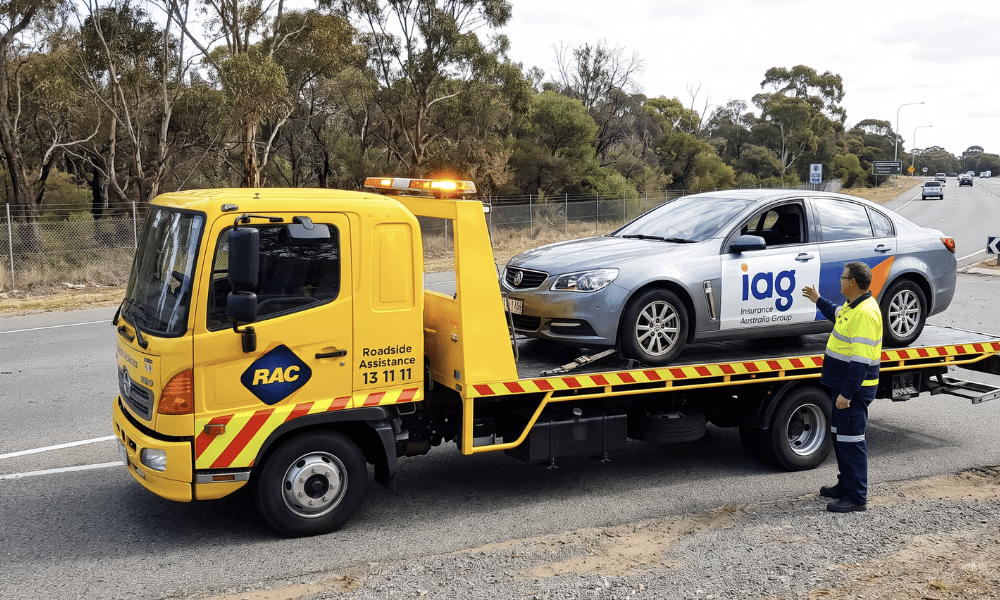
For a business IAG still isn’t allowed to buy, RAC Insurance has had a remarkably good year.
The Perth-based underwriter is the dominant home and motor insurer in Western Australia. It lifted its pre-tax insurance profit by 45% to $420.2m in the 2026 financial year. That result carried its parent, the Royal Automobile Club of WA, to a record net surplus of $288.2m. Higher premium income and a lighter claims bill did most of the work.
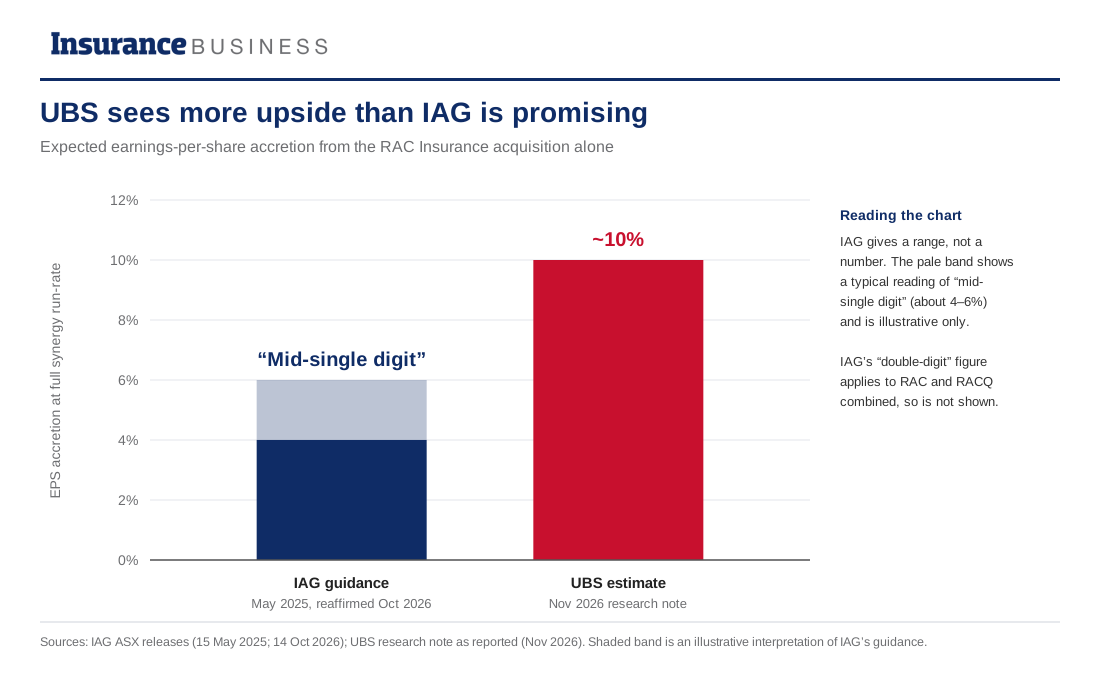
The numbers have sent UBS back to its spreadsheets. In a note to clients this week, the bank’s analysts said the chances of the deal completing had improved. With synergies unchanged, they estimated the acquisition could eventually add about 10% to IAG’s earnings per share.
That is a bold call. IAG has never promised more than “mid-single digit” accretion from RAC alone at full synergy run-rate. It set that figure when the deal was announced in May 2025 and reaffirmed it in October, even after offering to give up its own WA book to win over the regulator. UBS had been cool on IAG’s prospects with the ACCC. It was that concession that seems to have changed its mind.
Read next: IAG offers NRMA’s WA renewal rights in bid to save RAC deal
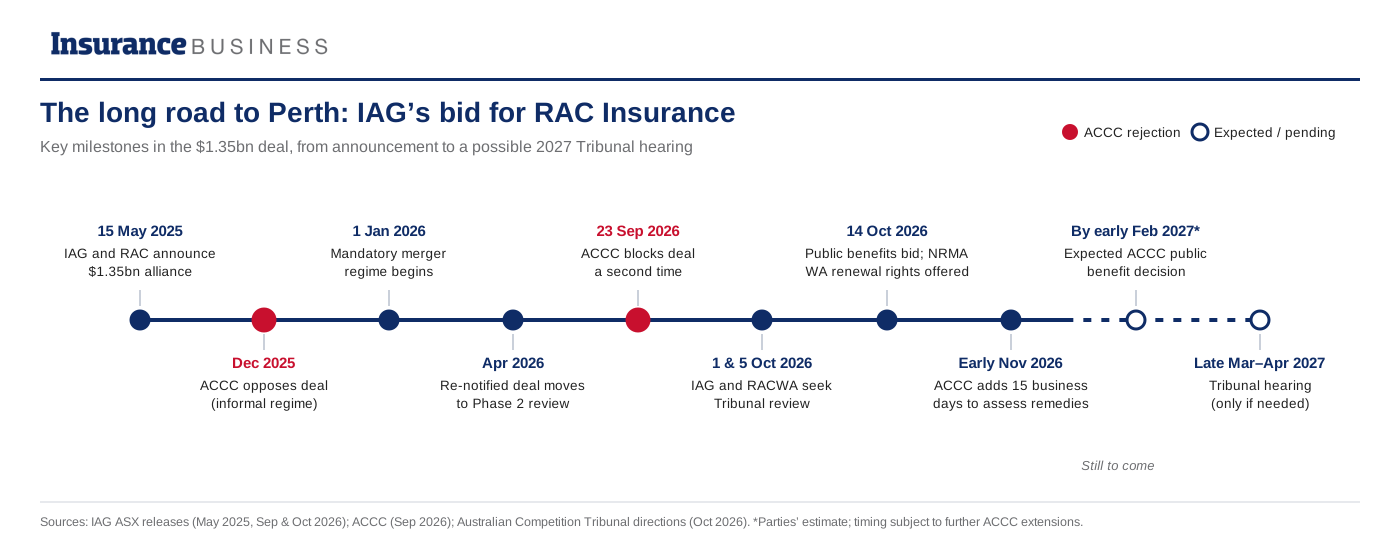
The deal is worth $1.35bn. That splits into $400m for the RACI shares and a $950m upfront payment for a 20-year exclusive distribution and brand agreement. It has now been knocked back twice. The ACCC first opposed it in December 2025 under the old informal merger process, and IAG refiled under the new mandatory regime that started on 1 January.
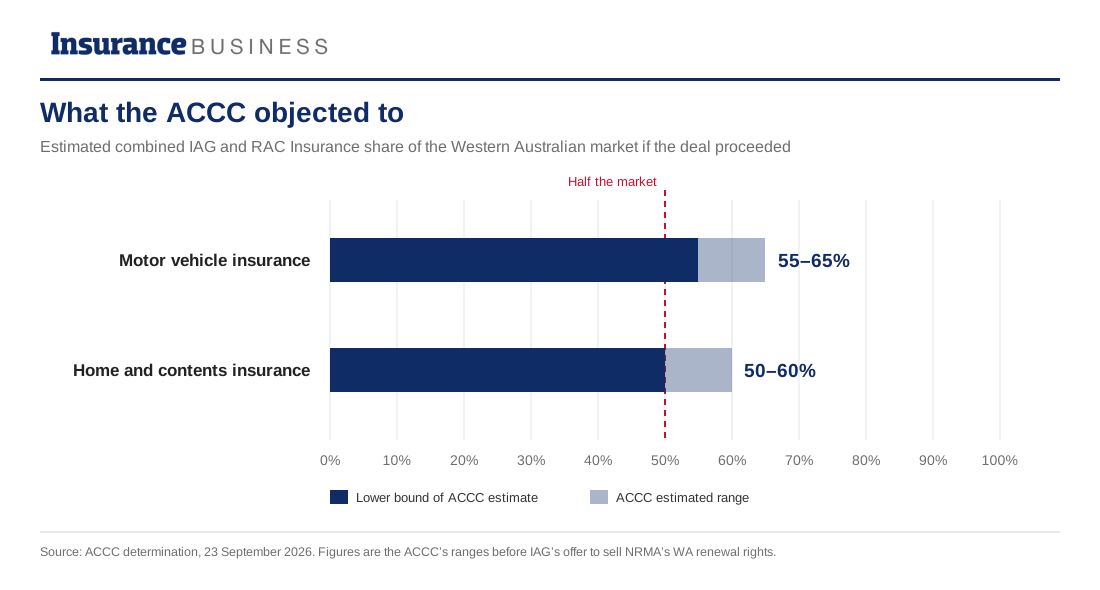
That second attempt went to an in-depth Phase 2 review in April. It ended on 23 September, when the ACCC blocked the acquisition again. The regulator found the combined group would hold roughly 55% to 65% of WA motor insurance and 50% to 60% of home and contents.
IAG’s third attempt is a public benefits application, lodged on 14 October. It is the first of its kind under the new regime. Under this route, the ACCC can approve a deal that lessens competition if the wider benefits to the public outweigh the harm.
To strengthen its case, IAG has offered four commitments:
The full package is listed on the ACCC’s acquisitions register.
Giving up the NRMA book costs IAG something, but not much. IAG’s original deal deck said RAC would bring in about $1.5bn of gross written premium. After the NRMA transfer, IAG puts the net gain at about $1.2bn a year.
The ACCC has 50 business days to decide, subject to extensions. It has already used one, adding 15 business days to assess the divestment remedy. IAG had expected a decision in December, but the parties told the Australian Competition Tribunal they expect one by early February at the latest. If the answer is still no, IAG and RACWA Holdings have a 12-day Tribunal hearing pencilled in for late March to mid-April 2027.
Read next: $1.35b on ice: IAG takes RAC Insurance block to 12-day hearing
Unfortunately for all concerned, the better RAC Insurance performs, the harder it becomes to argue that it needs a bigger partner.
When the ACCC first opposed the deal, it concluded that RACI was a strong, profitable competitor. In its view, RACI could cope with heavier weather losses, rising reinsurance costs and growing regulatory demands without IAG.
RAC’s annual report argues the opposite. It says owning an insurer has become riskier for its members because of reinsurance costs, climate change and tougher regulatory scrutiny. A 45% profit jump makes that a trickier case to put to a sceptical regulator.
For IAG shareholders, though, the price now looks considerably better. On a rough reading, $1.35bn is a little over three times RACI’s latest annual pre-tax insurance profit. That comparison does flatter the deal somewhat. The price also buys two decades of distribution rights, and one benign claims year in WA guarantees nothing about the next.
The public benefit test also asks a different question. It doesn’t ask whether RAC can survive alone. It asks whether cover in the north-west, catastrophe response capacity and access to IAG’s reinsurance programme are worth more to Western Australians than the competition they would lose. Nobody yet knows how the ACCC will weigh that, because it has never had to.
For now, the structure of WA personal lines hasn’t changed. The more interesting commercial question is who would take the NRMA book if the deal goes ahead.
The ACCC has named the insurers already competing in WA: Suncorp, Allianz, QBE, Auto & General, Youi and Hollard. It found that none of them was likely to replace the head-to-head rivalry between IAG and RACI. A ready-made WA renewal book could change that for whichever of them buys it, and brokers with WA clients will be interested to see how those renewals are moved across and priced.
The deal also sits within a broader consolidation story that has bothered repairers. The Motor Trades Association of Australia urged the ACCC to reject IAG’s earlier remedy offer. It points to IAG’s completed takeover of RACQ Insuranceand Allianz’s purchase of RAA’s insurance arm as evidence that member-owned insurers are vanishing quickly.
Read next: MTAA backs ACCC block on IAG’s RAC Insurance acquisition
Why do UBS and IAG see different numbers? IAG’s guidance was set before RACI’s 45% profit jump, and IAG has had no reason to raise it while the deal remains blocked. UBS, by contrast, is pricing in a business that has just had its best year on record.
The difficulty for IAG is that the ACCC can see those results too. Every dollar of extra profit that makes the deal more valuable to IAG also supports the regulator’s view that RACI can manage perfectly well on its own. IAG CEO Nick Hawkins has promised that “RAC will remain local”. The ACCC will rule on whether that promise is worth the competition WA would lose.