Business owners in Alice Springs spent Tuesday mopping out lobbies, throwing out spoiled stock and checking roofs after a storm that some locals are calling the worst in four decades.
The Bureau of Meteorology recorded gusts of up to 96km/h at Alice Springs airport on Monday afternoon, the ninth-highest October wind speed there in 75 years. Power and Water Corporation said about 9,000 properties lost electricity. It was the second storm to hit the town in less than a week.
Alice Springs Town Council said every part of town had some damage, and concentrated its clean-up on The Gap and Gillen. Emergency crews received dozens of calls for help, mostly for trees on houses and cars and for roof damage.
The storm hit on the day IAG published a McKell Institute report arguing that Australia already knows how to make homes withstand events like this one. What’s missing, it says, are the systems to do that work at scale.
Read next: Insurers set up Port Pirie claims hub after severe storm
The DoubleTree by Hilton was among the worst-affected commercial buildings. Video circulating online showed rain blowing under the front doors and water coming through the ceiling above reception. General manager Todd Grierson said the damage went well beyond the foyer, reaching tenancies, a beauty salon, restaurants, the ballroom, meeting rooms and back-of-house areas. Guest rooms were not affected. He estimated repairs would cost more than $500,000.
At café The Roastery, the problem was the power outage. A delivery had arrived the day the first storm hit, and food safety rules meant much of it had to be thrown out once the fridges went off. Owner Kim Hopper said staff were photographing the stock before pouring hundreds of litres of milk down the sink. She said replacing it would cost thousands of dollars, on top of the lost trade, and that the café had insurance and would be claiming.
Taking photos before clearing up is what the Insurance Council of Australia advises. It also tells policyholders to speak to their insurer before authorising any building work, emergency repairs included, and to get approval in writing. Brokers handling spoilage and business interruption claims from this storm will want clients to have that record.
Read next: Small businesses are failing after disasters. Insurance paid out. They closed anyway.
At Undoolya Station, about 20km east of town, owner Ben Hayes said the wind seemed to come from every direction at once. “I’ve never been in a storm like that before in my life,” he said.
On the station, a lean-to collapsed onto a house, windows were smashed, a chook pen was blown away, and the wind tore the roof off a historic storeroom. Hayes said his wife Nicole was drying out old station records, which are being kept in shipping containers until the storeroom roof can be replaced. About 250km south-west of Alice Springs, Lyndavale Station reported hailstones the size of golf balls.
Losses like these show how farm policies value heritage outbuildings, and whether old records and other irreplaceable items are covered at all.
The storm caps a difficult 2026 for the town. The Northern Territory government activated emergency arrangements on 1 March for areas including Alice Springs after heavy rain sent the usually dry Todd River over its banks.
Insurance costs were already a problem. In March, TIO said homes near the Todd River may carry extreme flood risk and are priced to match, and ICA chief executive Andrew Hall called for $30bn in federal flood defence funding nationwide.
Read next: Alice Springs floods put disaster mitigation and insurance gaps in view
The report, Resilience Delivery Gap: Turning Australia’s Housing Resilience Knowledge into Action, was commissioned by IAG. It makes 20 recommendations across four pathways and sets out a three-stage plan for putting them in place. Its main proposal is a National Housing Resilience Guidance Framework, which would make disaster readiness part of how homes are planned, built and rebuilt.
IAG’s priorities include stronger national leadership on housing delivery and land use planning, and upgrading existing homes when they are repaired, renovated or replaced. The report also wants lending and insurance products to help households and businesses pay for those improvements.
The report puts a number on the cost of doing nothing. Without stronger adaptation, the combined bill for cyclone, flood and bushfire damage to homes, covering insured and uninsured losses plus government recovery payments, is projected to pass $35bn a year by 2050.
McKell Institute chief executive Veronica Newman said the steps to build tougher homes are known, but “what we lack is the system to deliver them at scale”.
IAG managing director and CEO Nick Hawkins called insurers a shock absorber for the economy. He said no single organisation can fix resilience on its own, and that governments, businesses, communities and insurers need to work from a shared understanding of risk. The study follows earlier IAG research, including the third edition of Severe Weather in a Changing Climate in 2025 and a 2023 report on land use planning. iag
Read next: IAG calls for addressing disaster resilience in land use planning
IAG says Australia has had 17 declared catastrophes and 13 significant weather events since the 2019-20 Black Summer bushfires, with insured losses of more than $23bn.
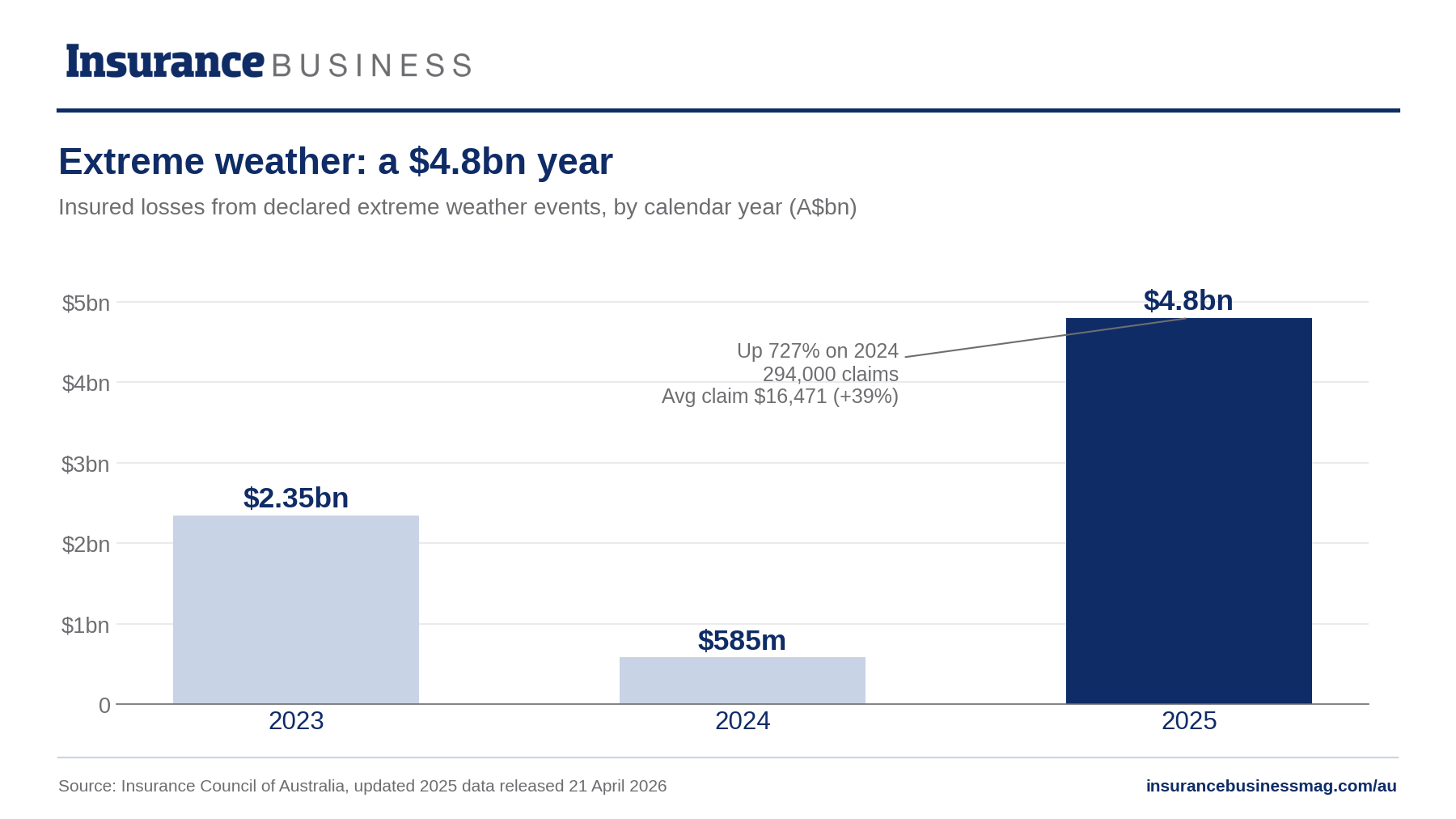
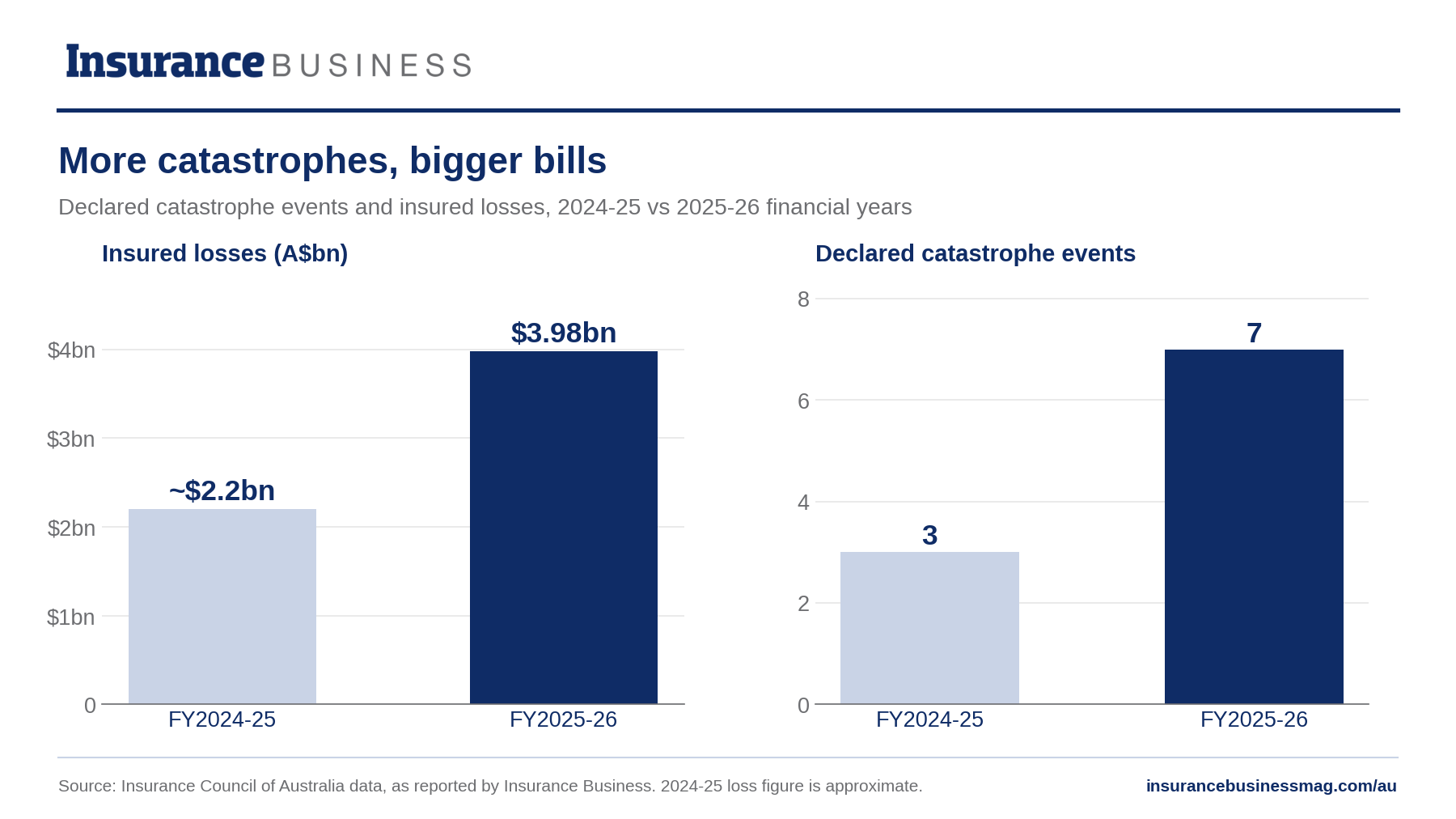
Insurance Council data shows how much the annual bill can swing. Extreme weather caused $4.8bn in insured losses in 2025, more than $4.1bn of it in Queensland, compared with $2.35bn in 2023 and $585m in 2024. Insurers handled 294,000 claims from declared events last year, and the average claim rose 39% to $16,471. In the 2025-26 financial year, the ICA recorded $3.98bn across seven declared catastrophes, up from about $2.2bn across three events the year before.
Read next: BOM’s summer outlook comes with an unusual warning sign
The report’s idea of upgrading homes during repairs is aimed squarely at claims teams. Over the coming weeks, contractors in Alice Springs will replace roofs, ceilings and fences. That is the cheapest point to make them stronger. Most home policies, though, pay to restore a property to how it was before the damage. Turning repair work into resilience work will depend on someone covering the difference between the two.
Forecasters said more storms were on the way. The Bureau warned of further thunderstorms over Alice Springs, Yulara and Ti Tree, while parts of NSW and Queensland faced a week of storm risk. No industry loss estimate for the Alice Springs storm had been published at the time of writing