Nearly everything's getting cheaper in commercial insurance right now. Casualty is the exception - but the real story isn't "casualty rates are rising." It's "US casualty rates are rising while everyone else's are falling," and those are two very different problems for a broker to manage.
Marsh's Q2 2026 Global Insurance Market Index put global casualty rates up 2% for the quarter, the only major product line moving in that direction while property, financial and professional lines, and cyber all kept falling. Zoom out from the US, though, and the picture flips completely: Marsh's numbers show casualty rates actually fell in every region outside the US this quarter. It's American litigation pressure, on its own, dragging the global figure into positive territory - US casualty rates rose 7% in Q2, only a touch softer than the 9% rise in Q1, and still the standout number in the whole report.
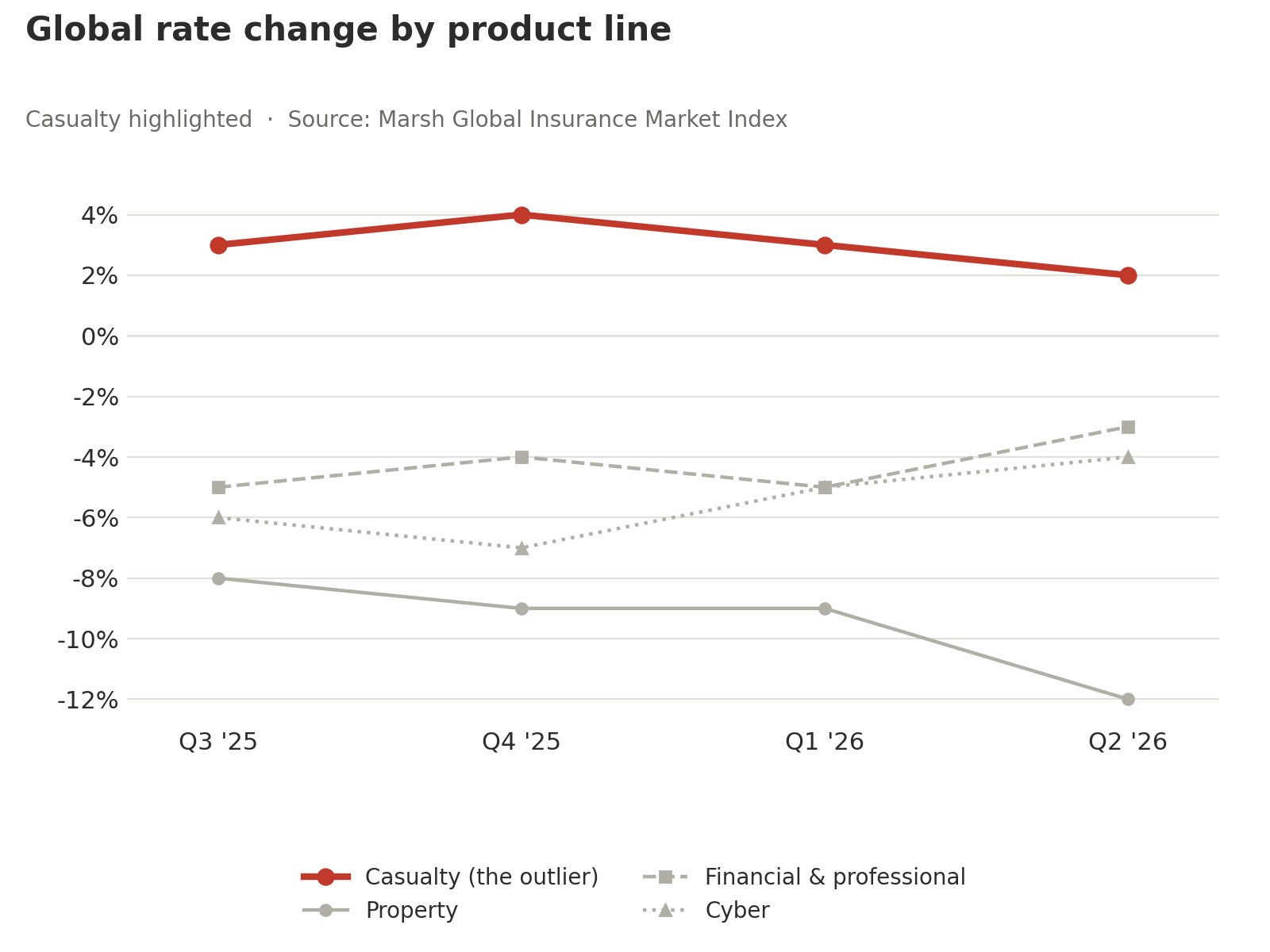
The contrast is hard to miss next to everything else in Marsh's data. Global property fell 12% in Q2, financial and professional lines fell 3% (with just one small US exception, up 1%), and cyber notched its twelfth straight quarterly decline. Casualty is the outlier in that story - and US casualty is the outlier within the outlier.
Marsh puts the US pressure down to "claims severity and ongoing litigation pressures," and says capacity, while still there, has gotten more selective, with underwriters leaning hard on risk quality and how programmes are structured. There's a bit of good news buried in there too: Marsh notes "there are early signs that the pace of increase may be slowing" in the US, even if the market "remains challenging."
It's not just Marsh's placement data showing this split. Gallagher Re's half-year facultative market report, published in mid-July, found much the same pattern one layer up the risk transfer chain: international and UK casualty facultative rates fell by 5% to 25% in the first half of 2026, while US casualty was, as that report put it, "the clearest holdout in an otherwise buyer-driven market." The named culprits are the same ones behind the Marsh numbers - third-party litigation funding, nuclear verdicts, social inflation and climbing defence costs. Gallagher Re also flagged just how thin the supply side has become: only four or five traditional reinsurance markets are still actively writing US casualty facultative business at all. Two separate data sets - one from primary placement, one from facultative reinsurance - landing on the same fault line is a reasonably strong signal this isn't a one-quarter blip.
A few practical implications follow from the split, rather than just noting it exists:
Neither Marsh nor Gallagher Re is calling an imminent end to the US casualty hardening, though both note the pace of increase easing slightly quarter on quarter. With Q1 2027 renewals starting to come into view for multi-year and long-tail placements, this divergence looks set to be one of the defining features of how international programmes get structured over the next couple of renewal cycles, rather than a passing Q2 anomaly.