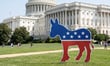
American voters have handed the Democrats control of the Senate and the House of Representatives, according to projections from the major US networks.
Insurers hoping that would ease tariff-driven claims inflation and trade credit pressure are likely to be disappointed, however. A number of news outlets has projected the party will hold the Senate from January, though not every network had called the upper chamber at the time of publishing.
Inside the US, the story is about subpoenas, stalled bills and the shape of Donald Trump's last two years in office. For Australian insurers and brokers it is narrower and a lot more practical. The tariff settings that have been feeding into claims costs, insured values and exporters' receivables sit largely with the president, not Congress, and a change of control on Capitol Hill doesn't hand them back.
Although a Democratic House can block legislation, launch inquiries and make life awkward for the administration, it can't easily wind back trade measures the president imposes under executive authority, and Trump keeps his veto, which takes a two-thirds vote in both chambers to override.
Coface's North America economist Marcos Carias made the point before polls opened. Speaking at a pre-election briefing covered by Insurance Business US, he argued a president boxed in domestically may lean harder on trade and foreign policy, saying there was "a high chance that he will become more active here after the midterms".
There are already tools in play. The Office of the United States Trade Representative opened Section 301 investigations in March into excess manufacturing capacity among major trading partners, including China, the European Union and Mexico. Vehicles, machinery and construction materials are on the list of sectors under examination, and every one of those lines runs straight into motor and property claims.
Read next: Credit insurance covers €9.58trn in trade as insolvencies rise
Australian exporters don't need to imagine what an active White House looks like. Since 24 July, goods heading to the US have attracted a 12.5% tariff, up from the temporary 10% baseline. Washington put Australia among 60 economies it said had failed to properly enforce a ban on goods made with forced labour, a rationale Deputy Prime Minister Richard Marles said "makes no sense". Steel, aluminium and car parts sit under separate measures, and food categories exempt under the old rate stayed exempt.
The insurance consequence is less obvious than it looks. A tariff isn't an insured peril. The exposure shows up further down the line, when a US buyer squeezed by higher landed costs pays late or not at all. That's a receivables problem, and standard cargo and business interruption wordings generally won't respond to a buyer who simply stops paying. Trade credit is the cover that does.
The credit picture is hardly reassuring. Allianz Trade's October outlook, cited by Insurance Business US, forecasts US business insolvencies rising about 12% in 2026 and a further 4% in 2027, against roughly 5% and 1% globally. Allianz Trade attributes that to financing and energy costs as well as trade policy, so tariffs aren't the whole story. But for an Australian exporter with a concentrated US buyer book, the direction of travel matters more than the precise cause.
For brokers, three questions are worth putting to clients selling into America before their next renewal. How concentrated is the US buyer book? Does the trade credit program, if there is one, actually cover the buyers most exposed? And have customs or logistics delays shifted enough to change the cargo picture? The Department of Foreign Affairs and Trade is the place to check current tariff arrangements for specific goods.
Tariffs also leak into loss costs, and not only in America. Aon research presented at the Casualty Actuarial Society's spring meeting this year modelled post-tariff inflation of 5.7% for auto physical damage and 4% for residential and commercial construction costs, against a 2.8% baseline. Those are US estimates, and they depend heavily on how much of the extra cost suppliers pass on. Still, they give a sense of the order of magnitude.
Australia imports a large share of the vehicles, parts and building materials that sit behind motor and property claims. ANZIIF has pointed out that local construction leans heavily on imported steel, timber and glass with few domestic substitutes. When global trade flows get diverted, parts pricing gets jumpy, repair times stretch and business interruption periods lengthen.
The quieter risk is underinsurance. If replacement costs keep creeping up while sums insured stay put, the gap only shows at claim time. Percentage-based deductibles make it worse, because the client's retained share grows with the value of the loss.
Read next: Why captive insurance for cyber and trade credit is growing
Markets moved fast as the early counts came in. Reuters reported that benchmark 10-year US Treasury yields fell about six basis points to roughly 4.91% on Wednesday, while the dollar index slipped around 0.3%. US stock futures dropped as traders priced in less fiscal stimulus from a divided or Democratic Washington.
For insurers, the bond move cuts both ways. Lower yields lift the value of existing fixed-income holdings but trim what new money earns, which matters for anyone leaning on investment income to offset softer underwriting margins. Asset manager Conning, in its pre-election commentary, also warned there appears to be little political appetite in Washington to tackle deficits, which keeps pressure on government bond yields over the longer run.
The currency matters too. Much of the reinsurance Australian carriers buy is priced in US dollars, so a softer greenback ahead of the 1 January renewals would, all else equal, take a little sting out of the bill in Australian dollar terms. It would be a mistake to bank on it. Several analysts quoted by Reuters suggested the initial selloff may be overdone and that recent weakness in AI stocks was doing more to move markets than the election itself.
Read next: Geopolitical disruption is moving faster than insurance programs
The other change a Democratic House brings is oversight. Conning flagged the prospect of congressional investigations into the AI sector, with subpoena power reaching into model safety and algorithmic pricing. That is a US process, but global carriers with American operations will feel it, and Australian insurers using AI in pricing and claims will be watching what standards emerge.
What it means at renewal is a handful of focused conversations. Exporters selling into the US should have their trade credit cover tested against the buyers most exposed. Property and motor clients should have sums insured checked against current replacement costs rather than last year's. And anyone whose reinsurance or investment assumptions were built on a strong US dollar should treat this week as a reminder that those assumptions can move overnight.
The midterms will reshape Washington for the next two years. For Australian brokers, the more useful takeaway is the opposite one: the policies doing the most damage to clients' risk profiles are the ones the election is least likely to change.