Mental health care has become the heaviest weight on Australia's top tier of private hospital cover, according to HCF, and the fund's boss says gold policies are heading towards a price point many members simply won't pay.
Lorraine Thomas, who took the top job at the not-for-profit fund in July last year, told The Australian Financial Review that mental health now makes up 90% of HCF's gold-tier claims. The average benefit HCF paid for an overnight private mental health admission passed $15,500 in 2025.
Without reform, Thomas said, it was hard to see how gold products could "remain affordable".
HCF, which has around 2.1 million members, is putting numbers behind that warning in a white paper released today, developed with input from 40 people working across the mental health sector. Its central projection makes bleak reading for private health cover. Unless the way conditions such as depression, bipolar disorder and drug and alcohol addiction are treated and funded changes, 1.2 million Australians are expected to drop gold cover over the next 10 years.
Read next: Health premiums set to surge up to 25%
According to HCF's figures, private health funds paid roughly $749m in benefits for hospital mental health treatment in 2024-25, around 4% of all benefits paid. Overnight admissions accounted for $629.6m of that, with same-day care making up the other $119.3m.
The cost of each admission is starting to apply pressure to premiums. The average benefit for a mental health admission rose from $3,386 in 2019-20 to $3,980 in 2024-25, an increase of about 18%. Overnight stays climbed faster, from $12,515 to $15,541, or roughly 24%. Patients admitted with an acute episode now stay an average of 19 days, and HCF says that figure is still going up.
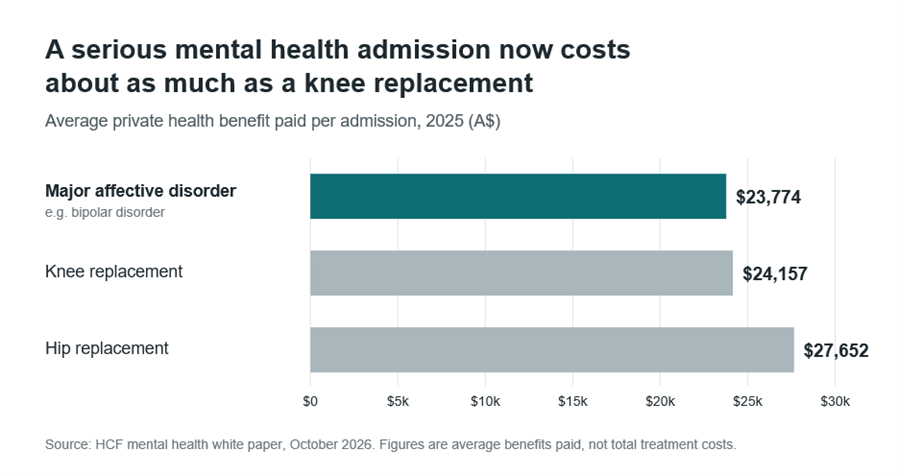
The most serious cases cost about as much as major orthopaedic surgery. The average benefit for a major affective disorder admission, a category that includes bipolar disorder, was $23,774 in 2025. A knee replacement came in at $24,157 and a hip replacement at $27,652.
At the same time, the pool of people paying for gold is shrinking. HCF says gold accounted for 28% of hospital cover last year, down from 40% in 2019, while the average gold premium rose 71% over the same stretch. Consumer group CHOICE found a similar pattern earlier this year, with some gold products, including HCF's own Hospital Optimal Gold, facing rises of up to 25% in the April round.
Thomas also pointed to rival brands pulling gold products from sale, which she said means the cost of high-end claims is no longer shared evenly across the market.
Read next: Bupa's reform push lands in a PHI market under structural stress
The fix HCF is pushing is one the industry has been asking for all year: let funds pay for mental health care before a patient ends up in a hospital bed. Out-of-hospital services such as appointments with a psychiatrist sit outside what private health insurance can cover, and insurers argue that funding them would head off longer, more expensive admissions down the track.
Bupa made a near-identical case in August, calling for changes to the Private Health Insurance Act 2007 so insurers could fund community-based mental health care and early intervention. Its own modelling suggested the shift could avoid up to 41,000 hospital admissions a year.
Canberra is at least listening. In July the Department of Health, Disability and Ageing released a private health reforms consultation paper covering contemporary models of mental health care alongside product simplification, which many in the industry read as a chance to rethink the gold, silver, bronze and basic tiers. Submissions closed in August, and the department has encouraged funds to factor the proposals into their 2027 premium applications, due in November.
The politics, though, as always in Australia, are messy. On October 14 the Senate voted 38-23 to discharge Labor's bill removing the higher private health insurance rebate for Australians aged 65 and over, a measure the government said would free up about $3bn over four years for aged care beds. Under the bill, the higher age-based rebate rates set out by the Department of Health would fall to the under-65 rate from April 2027. Health minister Mark Butler put the identical bill back before parliament the next morning, so funds are lodging 2027 prices without knowing whether it will pass.
Read next: Senate shelves private health rebate cut, but Butler vows to bring it back
The squeeze isn't confined to hospital cover. Life insurers have been wrestling with the same trend, and Council of Australian Life Insurers data shows mental health claims payouts passed $2.2bn in 2024, almost double the figure five years earlier, with mental health now behind about one in three total and permanent disability claims paid. As in health insurance, younger Australians are driving much of the growth.
Employers are seeing it too. Safe Work Australia figures show serious workers' compensation claims for mental health conditions hit 17,600 in 2023-24, up 14.7% on the year before and 161% over a decade. Those workers spend a median 35.7 weeks off the job and receive median compensation of $67,400, against $16,300 across all serious claims. As HRD has asked, part of that growth may reflect changes in how young people describe and report distress, not only a rise in illness itself, which matters for any insurer trying to price the trend forward.
For brokers and advisers, the practical question is what happens to clients who hold gold mainly for psychiatric cover. The current rules let members upgrade once to access in-hospital psychiatric care without serving the usual waiting period, and Bupa's paper put benefits paid under that exemption at about $81m in 2024-25. Funds say that pattern of upgrading to claim and downgrading afterwards is part of what is pushing gold prices up for everyone else.
Clients weighing a move down from gold should know they may be giving up more than mental health cover. Joint replacements, cataract surgery and pregnancy and birth are also gold-only inclusions, and policies can be compared on the government's PrivateHealth.gov.au site.
Read next: Mental health claims are reshaping life insurance, and advisers are on notice
Whether HCF's warning shifts the debate may come down to timing. The white paper has arrived just as funds prepare their 2027 premium submissions, with the rebate fight unresolved and the tier review yet to produce a firm proposal.