Earlier this year, Kalshi and Polymarket both let their users trade on who would win the Farrer by-election. Australians could not legally take part, because neither platform is licensed here. The two US prediction markets keep finding their way into the Australian conversation, though, and Kalshi's latest pitch is aimed at a group brokers know well: small businesses that are underinsured or not insured at all.
Kalshi is now marketing its event contracts to SMEs as protection against tariff rises, bad weather and even power cuts. Its showcase customer is a New York rice brand, Not So Boring, which fears new US duties on Indian rice could cost it more than US$60,000. Chief executive Izzy Sarrafzadeh told the Financial Times the contract was easier to follow than rice futures, and that no bank would build a bespoke hedge for a firm her size.
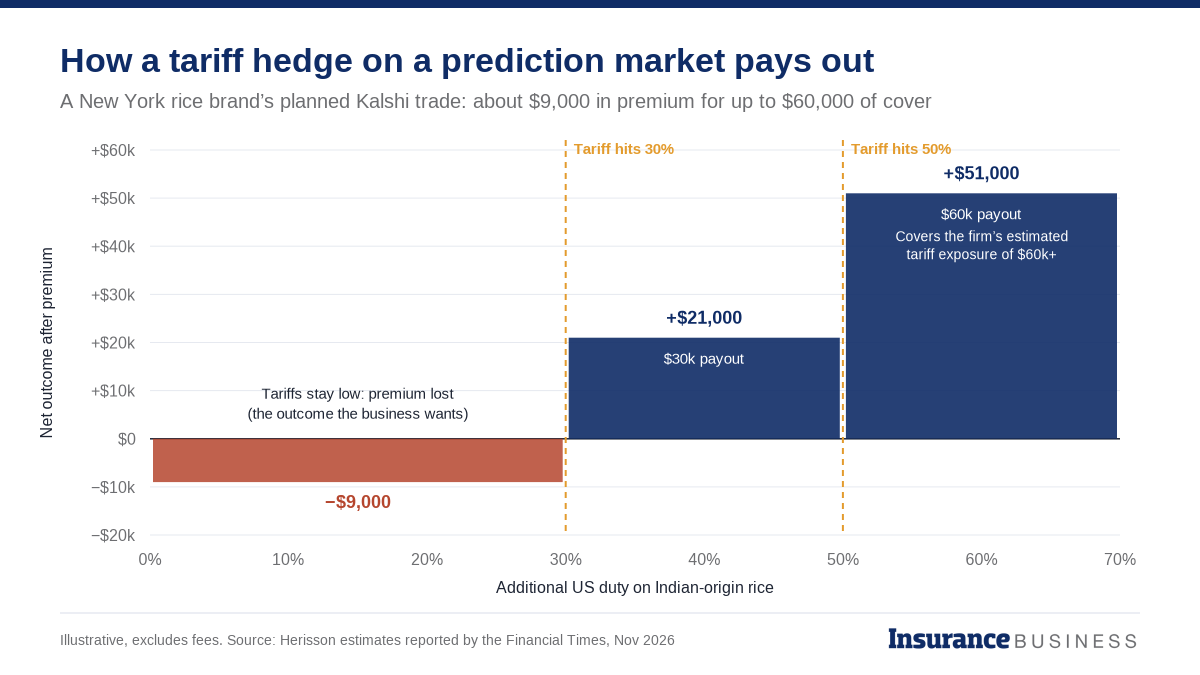
The trade was structured by brokerage start-up Herisson. It asks whether the extra duty on Indian-origin rice will pass a set level by a set date. The company expects to pay about US$9,000 and would receive US$30,000 if tariffs hit 30%, or US$60,000 at 50%. If tariffs stay low, the premium is lost, which is the outcome the business is hoping for.
Kalshi says about 500 businesses have used the platform to hedge commodity prices, heatwaves and blackouts. Its director of business development, Nicolas Hull, has likened the product to microinsurance. He also says that almost none of the small firms he speaks to have ever hedged.
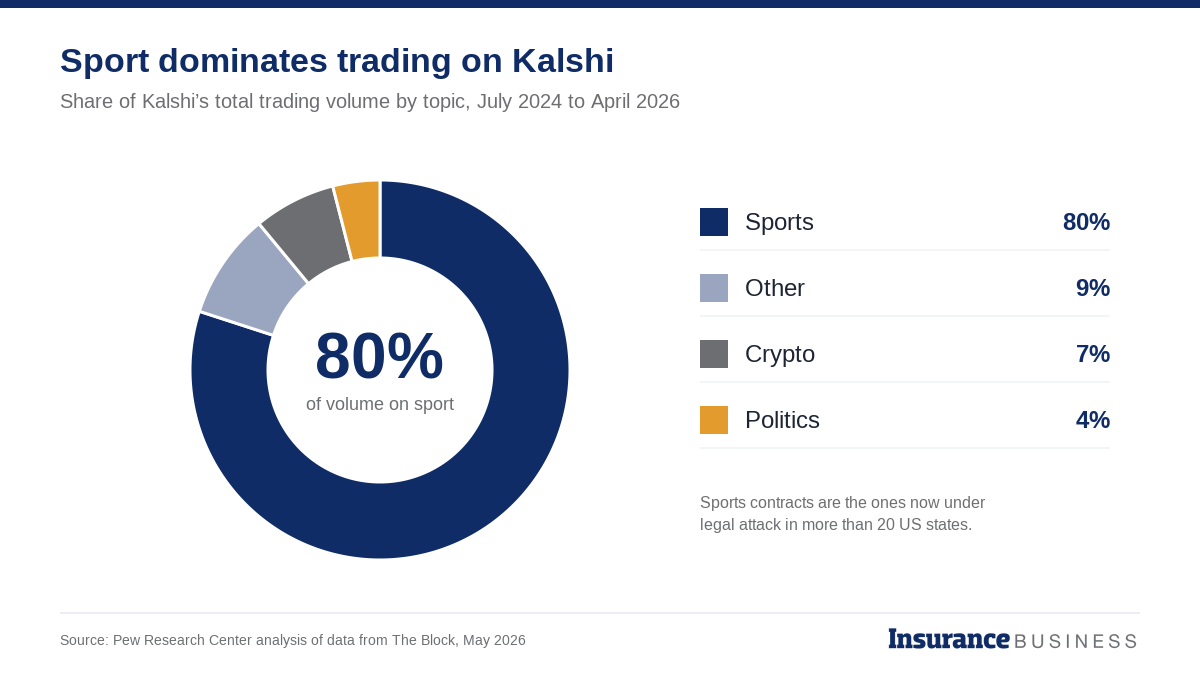
The motive is clear from Kalshi's numbers. Pew Research Center found that sports made up 80% of its trading volume between July 2024 and April 2026. More than 20 US states are now in court arguing those sports contracts are unlicensed betting.
Kalshi's position is that, as an exchange regulated by the Commodity Futures Trading Commission, it sits outside state gambling law. That argument is losing in some places. This week Kalshi stopped serving Utah residents after a federal appeals court refused to halt the state's enforcement action.
Insurers have been experimenting too. IB has reported on one that used Kalshi to hedge a US$3m college football coaching bonus.
Read next: Prediction markets are becoming a cheaper reinsurance alternative for sports bonus risk
Start-up brokers such as Herisson and Castle Tech use AI to scan regulatory and legal changes. They look for businesses that a new tariff or tax could hurt, then turn those exposures into contracts. The harder part is finding counterparties. For now these are mostly trading firms such as Susquehanna and Jump Trading, an investor in Castle, and Kalshi is paying cash incentives to keep its business markets liquid.
Castle co-founder Lucas Cavalieri has summed up the problem. Popular markets such as elections have plenty of money but rarely mirror any one company's losses, while tailored markets fit better but draw fewer traders. Australian parametric underwriters will recognise this as basis risk.
Brokers aren't rushing in yet. Lockton's Sarah Downey told the FT the platforms have pitched themselves as a way to close gaps in traditional cover, "but we haven't seen much uptake yet."
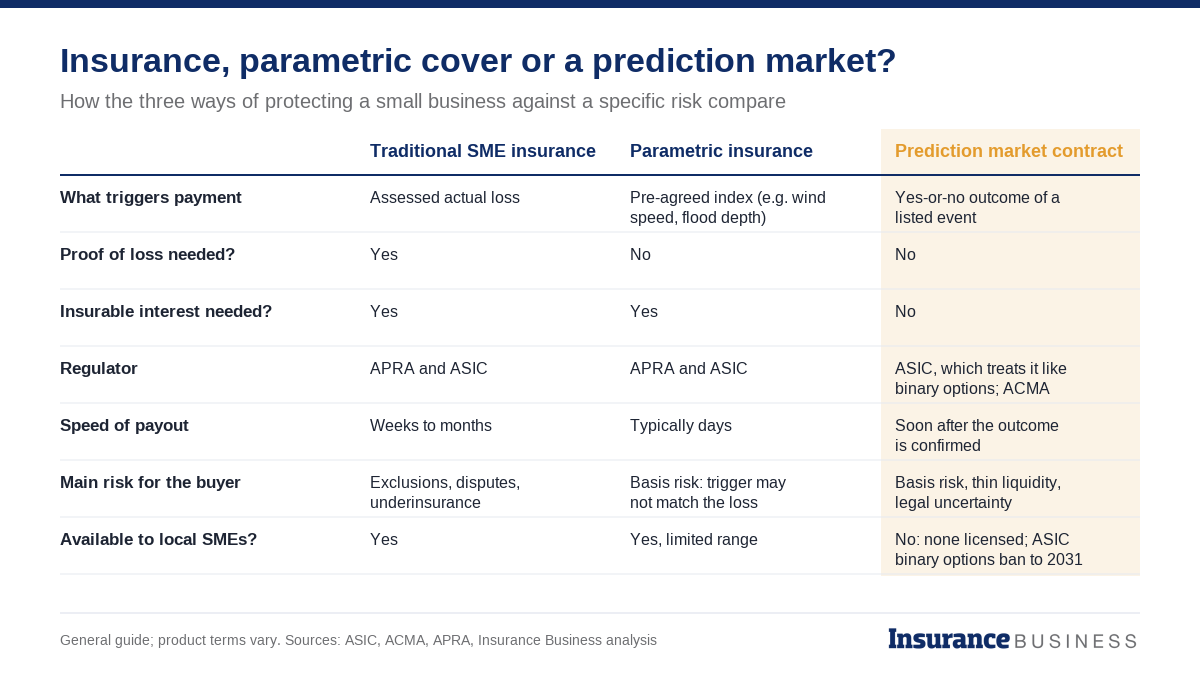
A prediction market contract doesn't require an insurable interest or a loss. It pays whoever holds the winning side. That is what makes it quick. It also means there's no claims process to lean on, no AFCA (the Australian Financial Complaints Authority) to complain to, and none of the duty-of-care obligations that come with an insurance policy.
Read next: Is a Kalshi-style weather contract insurance? Look to insurable interest
In Australia this product isn’t going anywhere at the moment. ASIC chair Sarah Court told Senate estimates in late October that no prediction market operator had applied for a licence. She said any that did would face strict scrutiny and be judged as binary options, which ASIC has banned for retail clients since May 2021 and until October 2031. ASIC's Moneysmart guidance warns that users are more likely to lose money than make it on these platforms, and that offshore operators offer no dispute resolution or client money protections.
The ACMA blocked Polymarket in August 2025 under the Interactive Gambling Act. Kalshi already lists Australia as a restricted country. A local futures firm, FEX Global, has pitched what could become Australia's first regulated prediction market, but no operator holds a licence.
The SME problem Kalshi is trying to solve exists in Australia too. The 2026 Vero SME Insurance Index found that 75% of small businesses manage risk only on an ad hoc basis, as IB reported in its coverage of Australia's persistent SME underinsurance gap. Cyber cover is thinner still, with fewer than 4% of small businesses holding a policy.
Those gaps have been aired in Canberra this year through the federal inquiry into small business insurance, chaired by Senator Deborah O'Neill. The National Insurance Brokers Association (NIBA) was among those that gave evidence. IB covered the inquiry when it launched.
Read next: One in 10 Australian SMEs report inadequate insurance cover
The takeaway for brokers isn't that clients will soon be placing bets. It's that small firms want quick, trigger-based payouts for narrow risks. Australian insurers already sell this kind of cover, from embedded flight-delay cover to bespoke construction structures. If that capability reaches SMEs at a price they'll pay, there won't be much room left for an offshore prediction market, licensed or not.
Read next: Parametric construction delay cover: inside an $18 million structure