A contract that pays a retailer whenever a snowstorm shuts 20% of businesses in its area sounds like a federal swap. A contract that pays the same retailer for its own lost sales sounds a lot like insurance, which states can regulate. That is the line drawn by Daniel Schwarcz, Fredrikson & Byron professor of law at the University of Minnesota Law School in Minneapolis and a former consumer representative to the National Association of Insurance Commissioners.
The distinction is starting to attract attention as prediction-market operator Kalshi fights state regulators in federal courts over whether its event contracts are swaps under the Commodity Exchange Act. Swaps on exchanges like Kalshi fall under the exclusive jurisdiction of the Commodity Futures Trading Commission (CFTC). The question is important to the industry because insurers have already begun using the exchange as risk capacity, including one that hedged a potential $3 million coaching bonus through Kalshi.
On September 25, the Sixth Circuit ruled against Kalshi in its suits against Ohio and Tennessee gaming regulators. The unanimous panel held that Kalshi had not shown its sports event contracts are swaps, and that even if they were, federal law would not stop the states from enforcing their sports-betting laws, Legal Sports Report reported. The ruling came at the preliminary-injunction stage: it affirmed an Ohio court's denial of an injunction and vacated one Kalshi had won in Tennessee, according to SBC Americas. Kalshi petitioned for rehearing en banc, according to DeFi Rate.
The Sixth Circuit joins the Ninth, which sided with Nevada against Kalshi in late August, DeFi Rate reported. The Third Circuit went the other way. A divided panel ruled 2-1 on April 6 that Kalshi's sports contracts are swaps and that federal law preempts New Jersey's sports-wagering laws as applied to them, according to Gaming.net. New Jersey has asked the Supreme Court to resolve the split, and Kalshi's response is due November 9.
Those cases concern sports contracts and state gaming law, not insurance. Schwarcz, who said he has not followed the litigation closely or read the opinions, spoke instead to the underlying federal framework that decides when an event contract can be regulated as insurance.
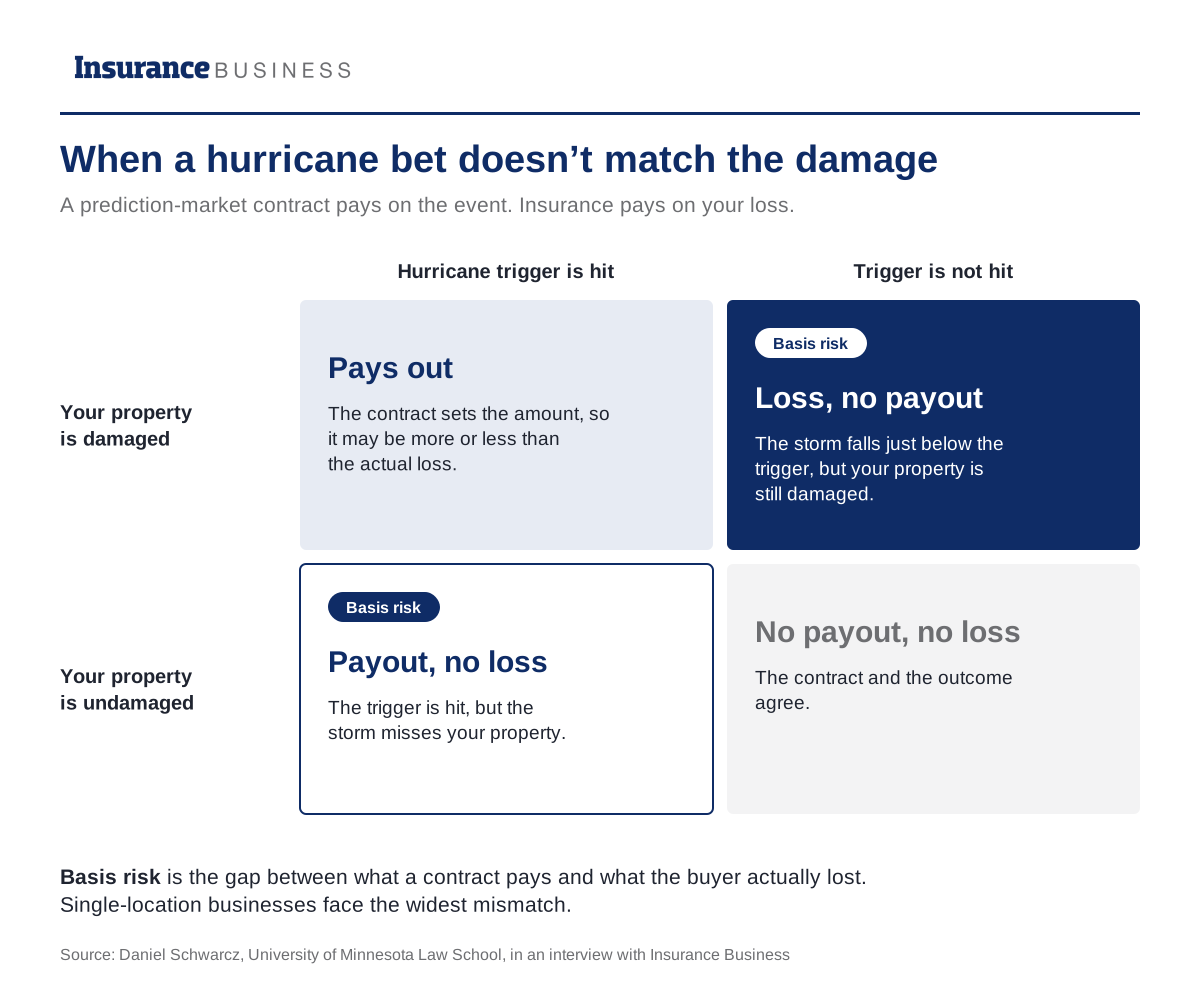
Schwarcz explained the mechanism with a Florida hurricane. "If a hurricane hits Miami, obviously there's a significant possibility that if you own a home in Miami, it might be damaged," he said. "So if you can place a bet on that where the bet pays off if the hurricane hits, then indeed it looks like it's serving an insurance function."
Traditional insurance measures whether the policyholder's property was actually damaged, Schwarcz said, while a betting market pays on an observable event regardless of what happened to the bettor. "It might be that it pays out even though your house didn't suffer a loss, or it might be your house suffered a loss, but it's not a hurricane that hits," he said. That gap is called basis risk, and Schwarcz called it the core economic dilemma with using betting markets to insure risk.
"Federal law is pretty clear that swaps are not regulated as insurance," Schwarcz said. Once a contract qualifies as a swap, he said, states lose the authority to regulate it as insurance because federal law preempts them.
The carve-out for insurance comes from a 2012 joint CFTC and SEC rule defining "swap." Under its insurance safe harbor, the beneficiary must have an insurable interest and bear the risk of loss, and payment must be limited to the value of that interest, according to the CFTC's fact sheet on the rule.
"When the payment that's being made is specific to an insured and is consistent with the insured's insurable interest, then it's not considered a swap under federal law, and states can regulate it," Schwarcz said. "If it's a specific insured's lost sales, then that sounds like insurance."
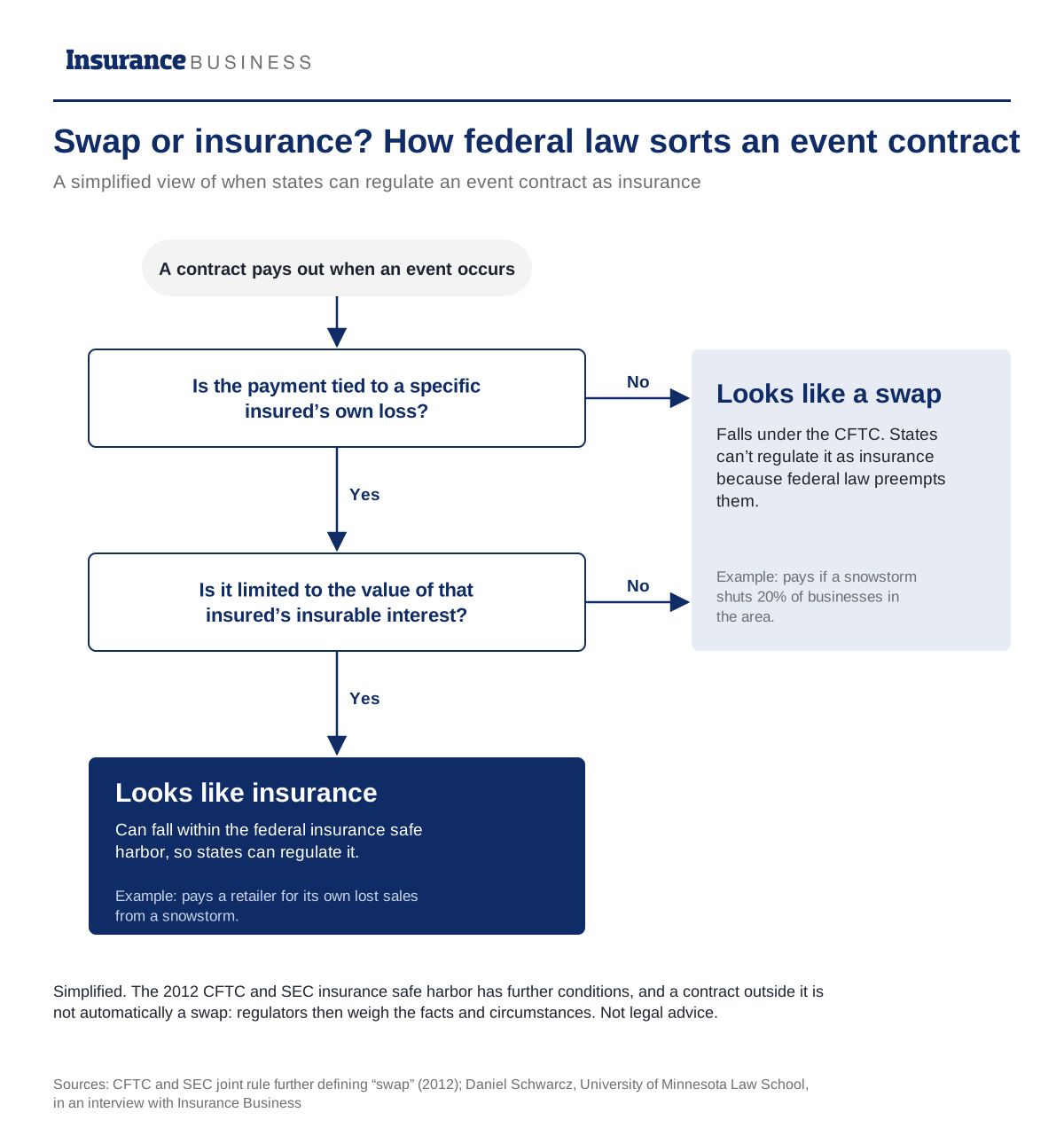
A payout keyed to an area-wide metric is different. "If it just is a payment that says, look, if there's a snowstorm and it causes 20% of the businesses in the area to shut down, we'll make a payment, then that sounds like a swap," he said. Schwarcz added that such contracts have "at least traditionally" been treated as swaps, setting aside the recent litigation.
For brokers fielding client questions, that offers a starting point. A contract whose payout ignores the client's own loss is unlikely to qualify as insurance, or to carry the protections of state insurance law. The safe harbor is not the final word, though. Products that fall outside it are not presumed to be swaps, and regulators classify them on the facts and circumstances.
For a corporate buyer weighing a prediction-market position against a policy, the trade-off comes down to how closely the contract's trigger matches the buyer's own exposure, Schwarcz said. The platform, not the buyer, writes the terms. "The website is the one that specifies exactly how the risk is described and how it's going to be evaluated based on objective metrics," he said.
"In theory, you might be able to describe some objective metric that aligns quite closely to your exposure so that you've limited the basis risk," Schwarcz said. "But I think in most cases, the basis risk would be significant enough that you'd have concerns about it."
Small businesses face the widest mismatch. A company with many operations across the Miami area can predict its hurricane loss "just by the law of large numbers," Schwarcz said. A single-location business might escape a storm untouched or be devastated. "Small businesses are going to have a much harder time using this than large, and even large, I just think the basis risk in most of these cases is massive," he said. He added that very few users of these sites use them to mitigate risk.
Schwarcz said designing parametric contracts that meet demand for immediate payouts and more certainty is a reasonable response for carriers. "I've written in favor of some deregulation that would allow for certain types of parametric contracts that reduce basis risk and have some of these benefits," he said. That approach is "attractive for insurers too," he said, but it requires regulatory adjustments at both the federal and state levels.
Parametric contracts with closely calibrated triggers "can be quite effective, especially again for large purchasers who can evaluate their basis risk," Schwarcz said. "It's not that I think this type of approach can't work. In fact, I think it can work quite well for certain types of risks," he said. "But I think in practice what's going on in Kalshi and some of these other websites is unlikely to meet that objective."