
Marsh's Global Insurance Market Index (GIMI) tracks what's happening to premiums. Marsh's own quarterly results show what that's doing to the people placing them. Put the two side by side and you get a pretty clear picture of how a prolonged soft market shows up in a broker's P&L - growth doesn't stop, but where it comes from shifts noticeably.
The headline Q2 2026 numbers, reported by Insurance Business UK, looked solid: consolidated revenue of US$7.4 billion, up 6% year over year (5% underlying), and adjusted EPS up 9% to US$2.96. CEO John Doyle summed it up as "6% overall revenue growth, 5% underlying revenue growth, and 9% growth in adjusted EPS" for the quarter. Dig into the segments, though, and the softening market Marsh itself reports on every quarter is visibly showing up in its own numbers.
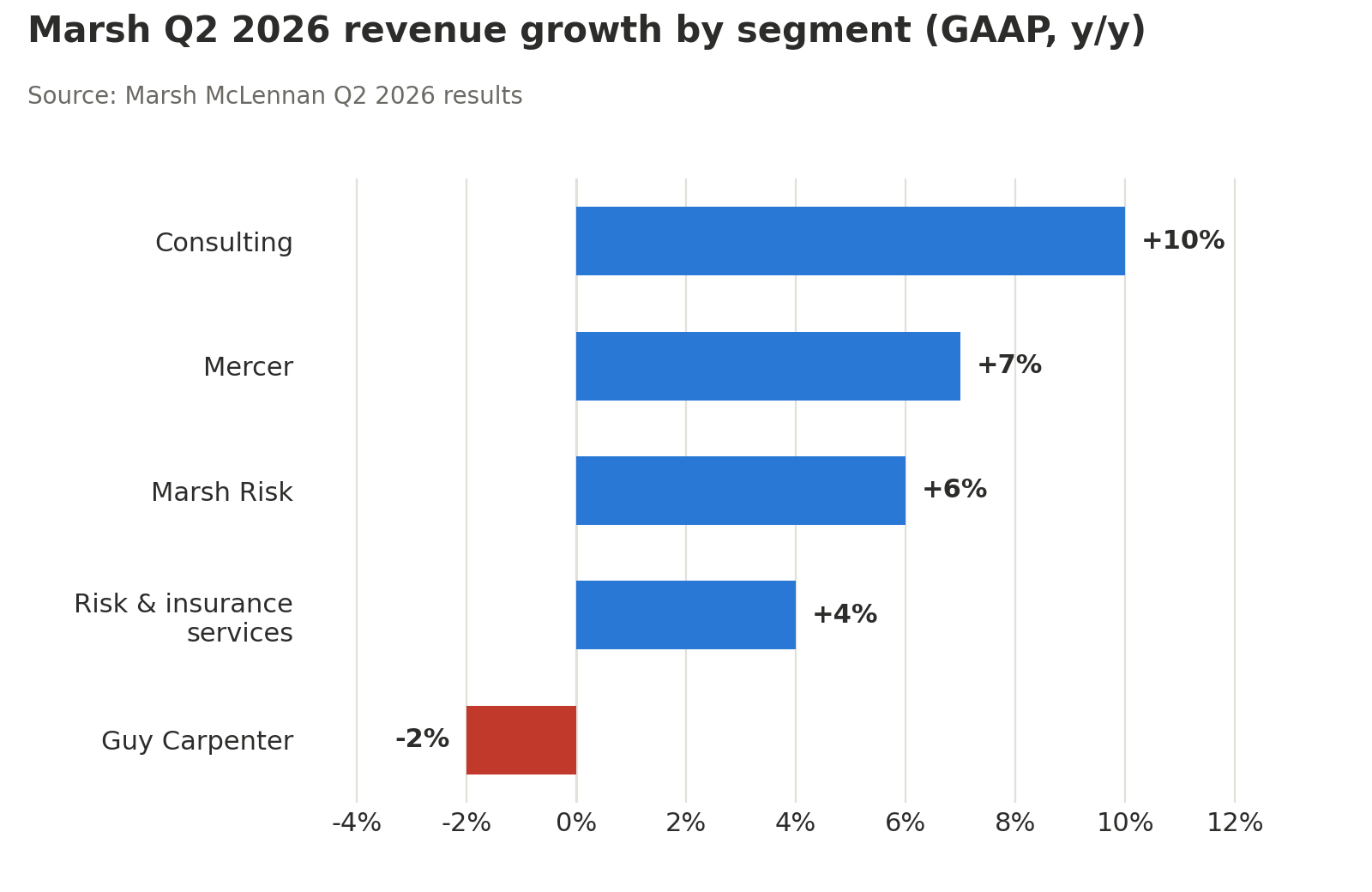
Marsh Risk, the core broking business, brought in US$4.1 billion in Q2, up 6% GAAP and 4% underlying. That growth is coming from new business and added services rather than rate inflation, given rates are falling almost everywhere Marsh operates. The wider risk and insurance services segment grew a bit slower still, at 4% GAAP (3% underlying) - the softest-growing of Marsh's three main businesses.
Guy Carpenter, Marsh's reinsurance broking arm, didn't grow at all. Q2 revenue was down 2%, both GAAP and underlying, with six-month underlying revenue flat against last year. That's about as direct a read-through from pricing as you'll find: Guy Carpenter's own July 2026 renewal report put the global property catastrophe rate-on-line index down 16% at midyear, and broking commissions are largely tied to premium volume. Rates fall this much, the revenue base commissions sit on falls with them.
The real growth story this quarter came from outside insurance broking altogether. Consulting brought in US$2.6 billion, up 10% GAAP and 8% underlying, with Marsh Management Consulting leading the way at 13% underlying growth - easily the fastest-growing part of the business. Mercer added US$1.6 billion, up 7% GAAP.
That shift is worth keeping an eye on. As the rate cycle keeps softening - eighth straight quarterly decline now, after seven years of a hard market before that - the parts of Marsh most tied to premium-linked commission, especially reinsurance broking, are growing slower or shrinking, while advisory and consulting are doing more of the heavy lifting. It raises a fair question for the whole broking sector: how much of the industry's recent growth has really been rate-driven versus service- and advisory-driven, and how exposed is that mix to a market that keeps softening?
Whether this pattern is Marsh-specific or sector-wide isn't fully clear yet, since most of its peers haven't reported Q2. Aon is due to release its Q2 2026 results on July 29 - after this piece was filed - so a direct comparison isn't possible today. For context only, Aon's first-quarter 2026 results, reported on May 1, showed revenue of approximately US$5 billion, up around 6% year over year, with adjusted EPS climbing 14% to roughly US$6.48 (these figures come from secondary reporting rather than Aon's own release, so treat them as approximate). That's a similar top-line growth rate to Marsh's Q2, though it's a Q1-to-Q2 comparison rather than a clean like-for-like. Given Aon Reinsurance Solutions operates in the same soft reinsurance pricing environment as Guy Carpenter, it's a reasonable bet - though not yet a confirmed one - that Aon's reinsurance broking revenue is under similar pressure. That's worth revisiting once Aon's actual Q2 numbers land, to see whether the same broking-versus-consulting split shows up there too.
Marsh isn't struggling here - revenue and adjusted operating income are both up, and the board just raised the quarterly dividend by 10%. But a "buyer's market" headline cuts both ways. The same abundant capacity and competition making renewals cheaper for clients is squeezing the commission pool brokers compete over. Marsh's scale and its consulting arm are cushioning that for now. Smaller, broking-only firms without that diversification may feel the squeeze more directly as more Q2 results land over the coming weeks.