Brokers who rely on memory and the odd diary entry to record client calls have until January 1 to change their habits.
The 2027 Insurance Brokers Code of Practice, launched at the NIBA Convention on the Gold Coast last month, expects subscribers to keep contemporaneous notes of their dealings with clients, insurers and anyone else involved in a placement. Speaking exclusively to Insurance Business at the convention, NIBA president Nick Cook (pictured) named record keeping as one of the first things brokers should look at, alongside an earlier renewal deadline and a firmer position on remuneration.
"It's been the culmination of two years work, a lot of consultation through that process, which is only fair," said Cook, who is also executive general manager, Australasian networks, broker and insurer services at Steadfast Group.
Cook said good records protect the broker if a client relationship goes wrong. If a complaint reaches the Australian Financial Complaints Authority, he said, "the broker has a record of what that conversation was, the advice given".
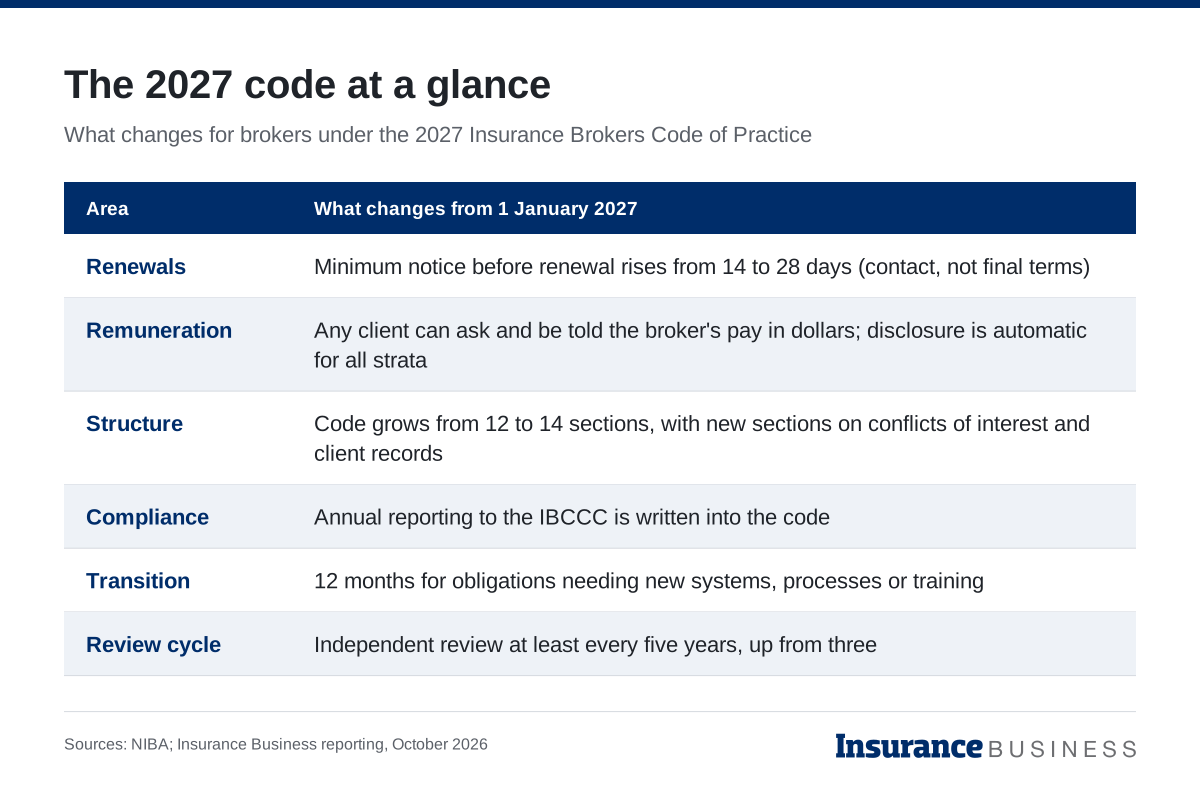
Client records now have a section of their own in the code. It is one of two new sections, taking the document from 12 sections to 14, according to Insurance Business's launch coverage.
The minimum notice before a policy renews doubles from 14 days to 28. Cook said the rule is about getting in touch with the client, not about having final terms ready. "It's not terms to the client 28 days. It is contact with the client in respect to their renewal," he said.
The point, he said, is to get brokers "more on the front foot", so that both the client and the insurers involved know how the renewal negotiation will run.
Renewals are where the code's monitor has found the most problems. In its latest annual report, the Insurance Brokers Code Compliance Committee (IBCCC) said renewal practices accounted for almost half of all reported code breaches in 2025. It also handed out six sanctions in 2025-26, its highest number to date.
Read next: NIBA president Nick Cook: brokers should stop apologising
Remuneration, maybe unsurprisingly, was the most argued-over part of the review. In the weeks before launch, the IBCCC, the independent body that monitors the code, told a federal parliamentary inquiry that the draft fell short because it did not require proactive disclosure to all individual and small business clients, as Insurance Business reported in September.
Under the final code, any client can ask what their broker earns and get an answer in dollars, whatever the product or insurer. Disclosure is automatic across all strata insurance. NIBA chief executive Richard Klipin has argued that the evidence pointed to strata as the main area of concern.
Cook said NIBA also tightened the strata wording so that mixed-use buildings are caught in full. A tower might have a cafe, a restaurant or consulting rooms on the lower floors and apartments above. "We want to ensure that all strata was being captured," he said.
Three consumer groups that walked out of consultation in July, the Australian Consumers Insurance Lobby, Owners Corporation Network and Unit Owners Association of Queensland, have since welcomed the final strata provisions. They still want more done on dual-role conflicts.
Asked why brokers don't simply publish their commission and fees on every placement, Cook said nothing in the code stops them. "We have our regulatory framework. That's the bare minimum. And we have the code which defines us as a profession," he said. "If brokers want to go further than that, nothing's stopping them."
NIBA won't require more for now. Cook said the current position came out of "extensive consultation across all brokers and we feel we've got the right balance".
Read next: NIBA's new strata broker rules win over consumer groups
The code takes effect on January 1 2027, but obligations that need new systems, processes or training have 12 months to be met in full. NIBA has promised a map from the 2022 code to the new one, plus section-by-section implementation guidance, as Klipin set out in a column for Insurance Business.
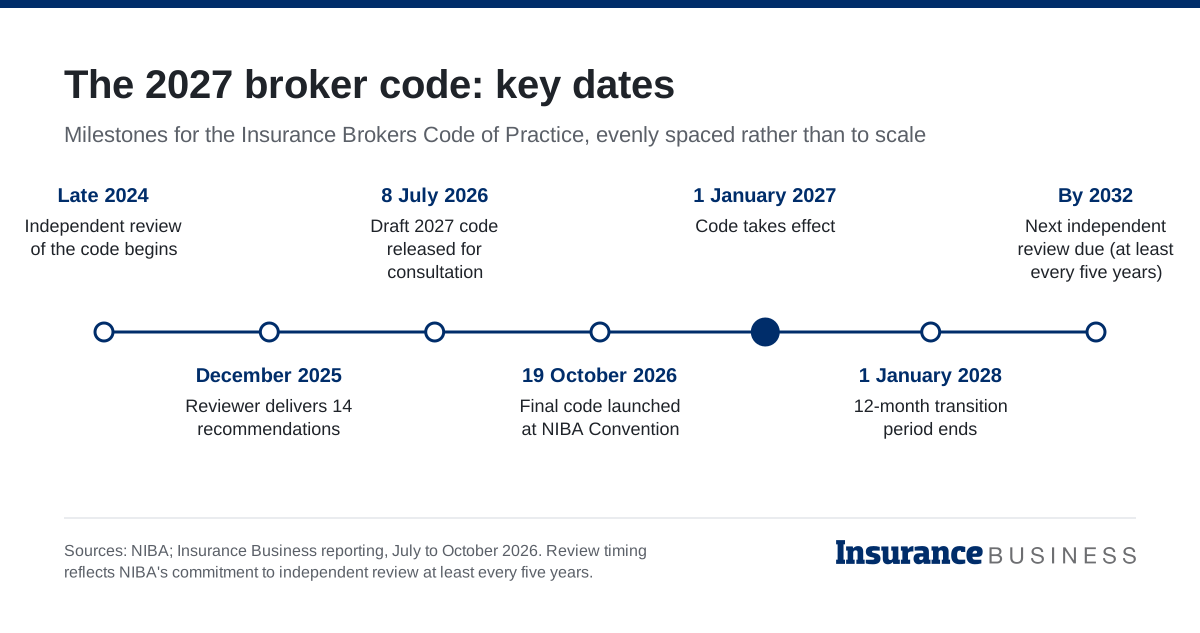
Cook also pointed to the review cycle. Independent reviews will now take place at least every five years, rather than every three. "In five years time, we're going to be looking to do this again," he said. He said the longer gap gives firms time to train their teams before the rules change again.
Read next: Broker code dispute puts mandatory regulation back in focus
The IBCCC says helping brokers implement the revised code will be a focus in 2026-27, alongside its work on conflicts of interest and client communication.