Almost half of Australia's small businesses saw revenue fall over the past year, and most have never formally assessed the risks they face. Anthony Pagano (pictured), head of distribution at Vero, part of Suncorp Group, says that is a great opportunity where brokers can show their value.
"Risk analysis is probably one area that they probably don't spend enough time in," Pagano told Insurance Business, describing owners who are "time-poor" and short of funds.
Times are tough and particularly for SMEs, Pagano called the current period "the most unprecedented time of changes happening in the business environment", with pressure coming through costs, revenue, staff and customers.
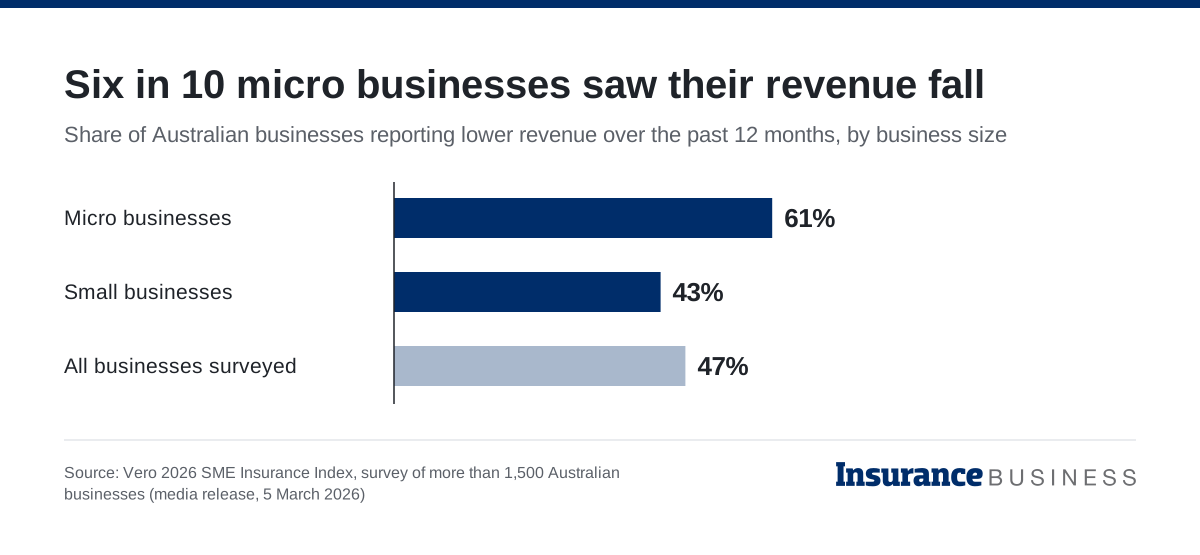
Vero's 2026 SME Insurance Index, now in its 15th year and based on more than 1,500 businesses, found 43% of small businesses had seen revenue fall over the previous 12 months. Among micro businesses it was 61%. At the other end, 39% of large businesses reported growth, which Vero describes as a two-speed economy.
The gap shows up in risk management too. According to Vero's media release, 74% of small businesses had never completed a risk analysis and 75% said their approach to risk was ad hoc, while 64% of large businesses had mature processes. A third of small business owners were unfamiliar with the term business continuity planning, and another quarter knew the term but weren't sure what it involved.
Read next: Most Australian small businesses skip risk analysis - report
Pagano said clients' worries now go beyond price and competition to health and safety, staff wellbeing and what customers expect. In the index, more than half of respondents were concerned about human factors such as mental health and staff retention.
Brokers are often small businesses themselves, he said, so they understand people management and keeping up with regulatory change. "If you can get someone that can protect and also advise at the same time, it's a fantastic thing."
Asked whether brokers act as a kind of in-house counsellor for firms that can't afford one, Pagano said: "Whether it be a corporate counsellor, whether it's a psychologist, a bridge builder, all the above." When a claim happens, he said, the client needs "someone in their corner" to get back to their pre-loss position.
The index offers some support for that view. Eight in 10 businesses had used a broker in the past year and 42% had stayed with the same broker for more than three years. More than half had received risk advice from their broker, and most acted on it. Among heavy broker users, an impressive 95% were satisfied with how their claim was handled.
Read next: One in 10 Australian SMEs report inadequate insurance cover
Pagano described the client base as "a tale of two cities". Younger owners and startups are asking AI for answers, but "they can only get so much information, and then it's how they execute that advice into protecting their assets".
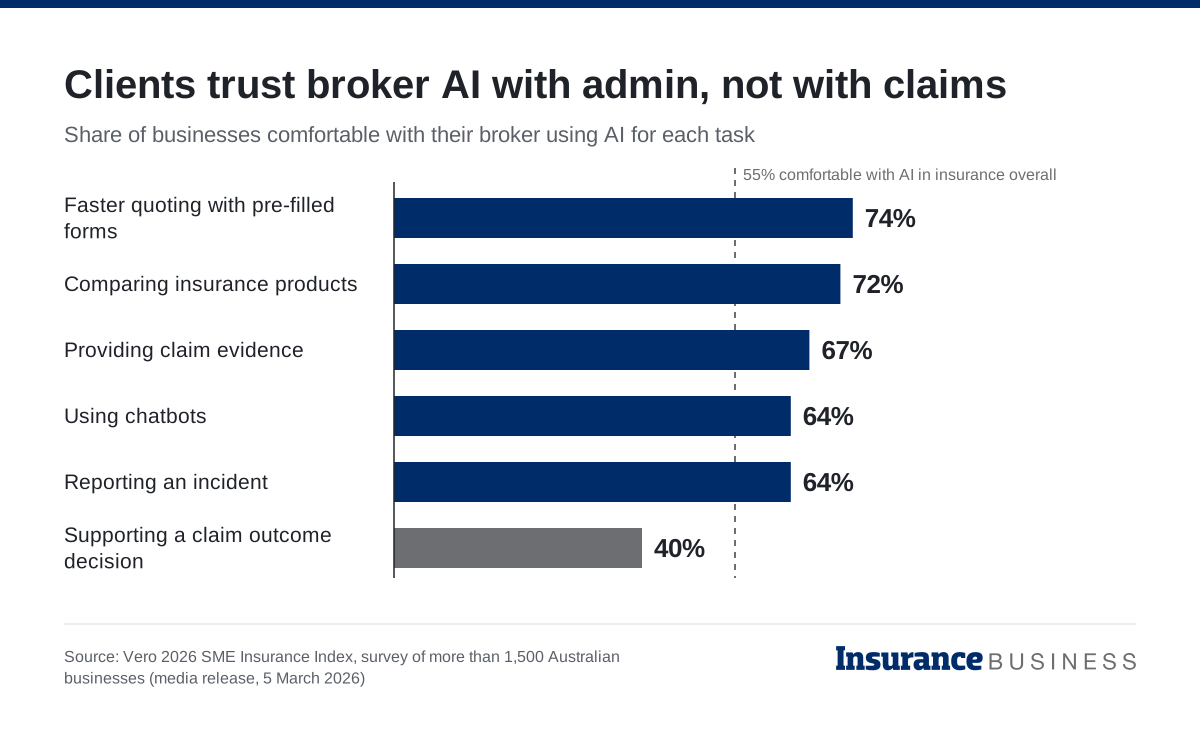
And despite the rapid rise of AI customers aren’t 100% all in – Vero's figures show where clients draw the line. Some 55% of businesses were comfortable with their broker using AI in insurance processes, rising to 74% for pre-filled quote forms and 72% for comparing products. Only 40% were comfortable with AI helping decide a claim.
Read next: NIBA's new strata broker rules win over consumer groups
So as times get tough for clients Vero sees this as a huge opportunity for brokers to show how essential they are to clients’ success.