The US insurance industry has now cut jobs for 11 months running, and Australian insurers are watching from a job market of their own that's starting to cool, with a central bank that hasn't yet finished raising rates.
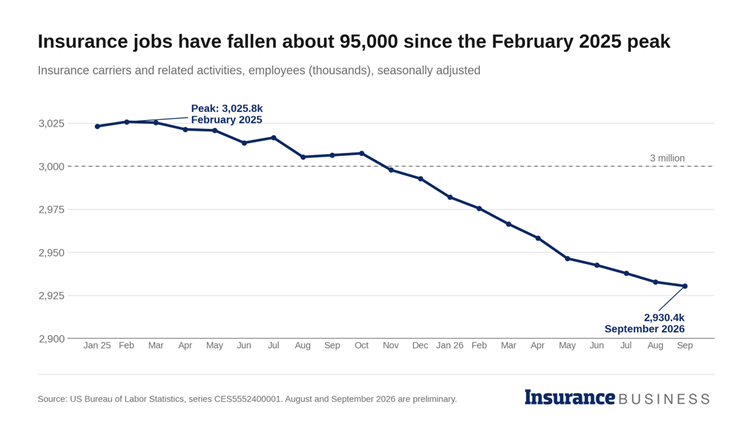
US insurance carriers and related businesses shed another 2,300 jobs in September, according to figures the US Bureau of Labor Statistics released on Friday, leaving the industry with about 2.93 million workers, roughly 95,000 fewer than at its February 2025 peak. That's more jobs than it lost between July 2008 and early 2011, although because the workforce is bigger now, the fall is smaller in percentage terms, at 3.2% compared with 3.6% back then.
Insurers are also cutting deeper than they expected to. In the Q3 2026 Insurance Labor Market Study by The Jacobson Group and Aon, 13% of US property and casualty respondents said in July 2025 that they planned to reduce staff, but by the following July, 26% said they had done so. Among companies still planning cuts, automation has become the most common reason given.
Read next: AI is cutting insurance jobs. The industry is just starting to say so
Nor is this purely an American story. In March, Acenda was reported to be cutting at least 280 roles as it brings together the former MLC Life and Resolution Life businesses, with middle management bearing the brunt. Acenda itself was only formed in 2025, after Nippon Life bought Resolution Life Australasia along with the remaining 20% of MLC Life Insurance from NAB.
Allianz, which has a large Australian operation, has gone a step further. Only weeks after the company topped the 2026 Evident AI Index for Insurance, its chief executive confirmed job cuts that Allianz puts down to AI, following earlier reports that its travel insurance arm, Allianz Partners, planned to cut up to 1,800 roles worldwide.
Read next: Insurer to slash hundreds of jobs
For some companies the answer is yes, and they've said as much. Acrisure pointed to advances in AI and automation when it announced 2,250 job cuts in May, while Allianz's chief executive has confirmed that AI is behind its cuts. The Jacobson and Aon study points the same way: automation was the reason most often given by companies planning to cut staff, cited by 17% of all participants, ahead of overstaffing on 14% and reorganisation on 12%.
Others point to different causes. Acenda's cuts stem from merging two life insurers, and in the UK, Admiral said its plan to cut about 500 roles was about efficiency rather than AI. The US jobs data doesn't record why people lost their jobs either, so there's no way to pin the 95,000 decline on a single cause.
Then there's the question of whether the cuts are doing the companies any financial good. Gartner research found that firms getting strong returns from autonomous technology were cutting jobs at almost the same rate as those getting modest or negative returns, while Bain & Company's 2026 Automation and AI Pathfinder Survey found that nearly 40% of companies measuring their AI cost savings had saved less than 10%, short of targets of between 11% and 20%. The risk is that insurers let staff go before the new systems can actually do the work.
Here, unemployment rose to 4.6% in August from 4.5% in July, according to the Australian Bureau of Statistics. Employment grew by 39,000 people, but full-time jobs fell by 6,000 and the number of unemployed rose by 28,000. The ABS has warned that a change to its survey method may have nudged the August seasonally adjusted figures, but its preferred trend series tells a similar story, with unemployment edging up to 4.6%.
The monthly figures don't break out insurance, so the next clear look at insurance employment will come when the ABS publishes its quarterly industry data for the November quarter.
On September 29, the Reserve Bank of Australia lifted the cash rate by 25 basis points to 4.60%, its fourth rise this year and the highest level since 2011. The board said some of the inflation risks it had flagged in August were starting to materialise, while noting that the economy appears to be slowing after the three earlier increases.
That puts Australia in a different spot from the US, where the Federal Reserve raised rates on 16 September for the first time since 2023 and Friday's weak jobs report has since cooled expectations of another increase. The RBA, by contrast, has signalled it's prepared to keep going even as unemployment climbs, and Governor Michele Bullock said in a speech the week before the decision that unemployment of between 4.5% and 5% could help take some heat out of inflation.
Read next: This CEO announced huge job cuts because of AI – threats followed soon after