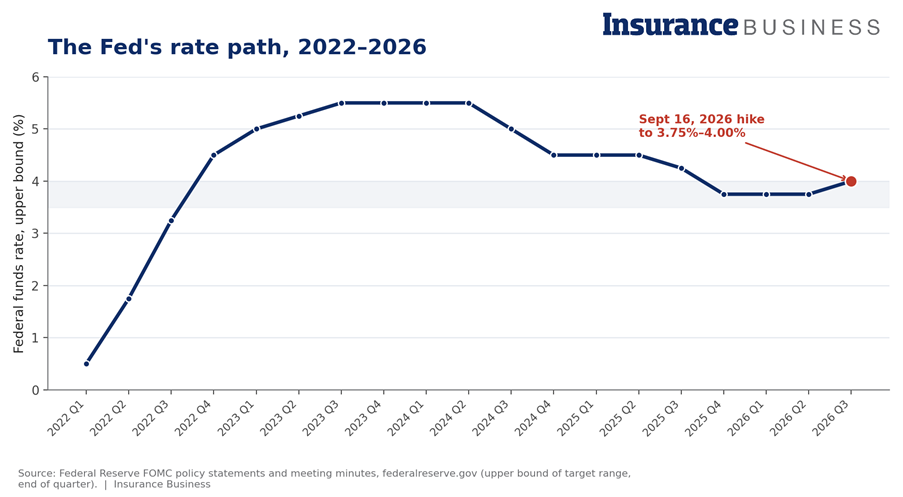
For the first time since 2023, the Federal Reserve has raised interest rates rather than cut them, and the reversal could reshape how carriers price risk, manage reserves and sell annuities over the next several quarters.
The Federal Open Market Committee voted 12–0 on September 16 to lift the federal funds rate by a quarter point to a target range of 3.75%–4%, according to the Federal Reserve's own policy statement. Tthe Fed's updated projections leave the door open to a second hike before year-end.
The catalyst is a fresh bout of inflation tied to the war in Iran, which has pushed oil and fuel prices sharply higher and revived price pressures the central bank thought it had under control. Fed Chair Kevin Warsh told reporters that "price stability is foundational to economic growth," framing the move as necessary even with growth still described in the Fed's own statement as "expanding at a solid pace."
The timing is important because P&C insurers just posted one of their best stretches in years. Net underwriting income for the sector nearly tripled to $31.2 billion in the first half of 2026, with the industry's combined ratio improving four points to 92.5. A separate Verisk/APCIA count put the first-half underwriting gain even higher, at $31.7 billion, with the combined ratio improving to 92.7 from 96.5 a year earlier — though that report also flagged that premium growth has slowed sharply as pricing competition intensifies across commercial lines.
Read next: P&C industry's best half in years hides a casualty problem
That underwriting strength gives carriers a cushion just as the investment side of the ledger gets more uncertain. Rate hikes historically help P&C insurers faster than life insurers, because their shorter-duration bond portfolios turn over and reinvest at higher yields sooner, according to a National Association of Insurance Commissioners analysis of past rate cycles.
Floating-rate holdings such as bank loans and mortgage loans also earn more as benchmark rates climb. The flip side: existing bonds bought during the low-rate years lose market value when yields rise, even though insurers rarely realize that loss since they typically hold to maturity.
Read next: Where are insurers investing?
Here's the catch: this hike is a response to energy-driven inflation, not an overheating economy, and that distinction matters for underwriters. Higher fuel and materials costs feed directly into auto physical damage and property claims. AM Best senior director Jacqalene Lentz had already flagged this dynamic earlier in the year, warning of "rising claims costs attributable to higher prices of materials" for home, commercial property and auto repairs. The comment made was in March, well before this hike, but one that becomes more relevant, not less, if energy-driven inflation persists.
A captives.insure analysis of the broader dynamic notes that while higher rates eventually improve reinvestment yields, the accompanying inflation raises claims costs at the same time — forcing insurers into a balancing act between competitive pricing and reserve adequacy, particularly on long-tail liability lines.
The hike also obviously affects mortgage rates, which matters for carriers whose books are tied to home sales; title insurers, mortgage protection writers and homeowners carriers among them.
Realtor.com chief economist Danielle Hale has said that "the pressure on mortgage rates was here even before the Fed rate hike," and that the higher-rate environment marks a sharp contrast with fall 2025, when rates had dropped below 6.5%. Fewer home sales generally mean less new business for title insurers and slower growth in homeowners policy counts, even if in-force premium keeps rising through rate increases on existing policies.
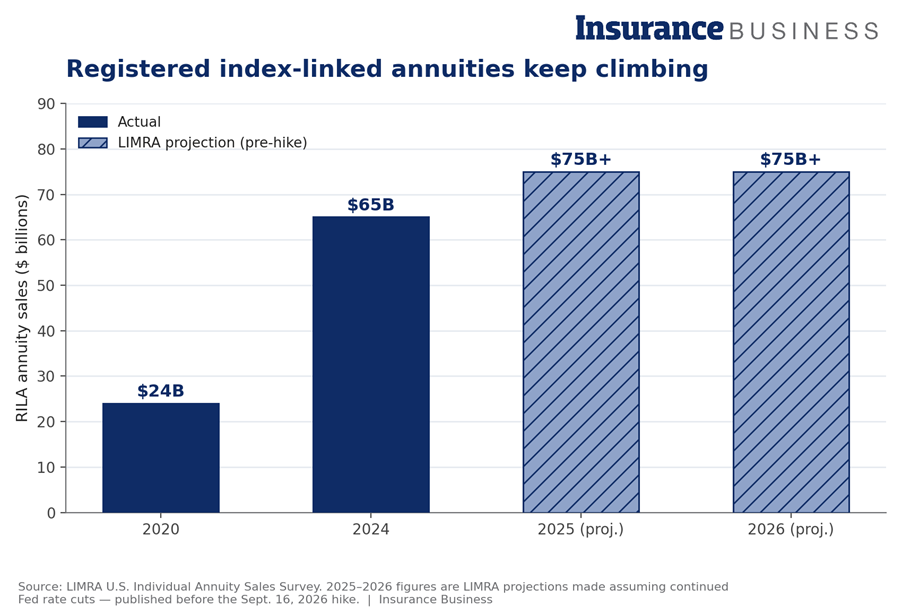
Nowhere is the hike more consequential than in annuities. LIMRA had projected 2026 U.S. annuity sales to stay above $450 billion, a forecast explicitly built on the assumption that the Fed would keep cutting rates gradually through the year. That assumption no longer holds.
Higher policy rates typically let insurers offer more attractive crediting rates on fixed and fixed-indexed annuities, which could reinforce the sector's multiyear sales boom rather than dent it, but nobody has published a forecast that accounts for an actual hike, so how this plays out for annuity issuers over the next two quarters is genuinely unclear rather than a simple extrapolation of the recent trend.
Read next: Where are insurers investing?
PwC's guidance to insurers on rising-rate environments flags a technical wrinkle: higher rates can reduce statutory reserve requirements tied to minimum-guarantee products, freeing up capital, while also requiring insurers to revisit GAAP reserving under long-duration accounting rules.
Whether this hike marks a one-off correction or the start of a new tightening cycle — something the Fed's own dot plot suggests could become clearer if another hike follows before year-end will matter far more to insurers' 2027 planning than the September move itself.