At a glance
Heat has always been a neglected entry on Australia's risk register. According to the Australian Climate Service, it kills more people here than any other natural hazard, yet it almost never triggers a declared catastrophe and rarely makes it into insurers' loss tables.
A data investigation published by Reuters today offers a different way to look at it. The news agency worked with about two dozen climate researchers, crunched hourly temperatures for more than a million grid squares going back to 1960 using data from the European Centre for Medium-Range Weather Forecasts, and came out with a new label for the very biggest events: the heat storm.
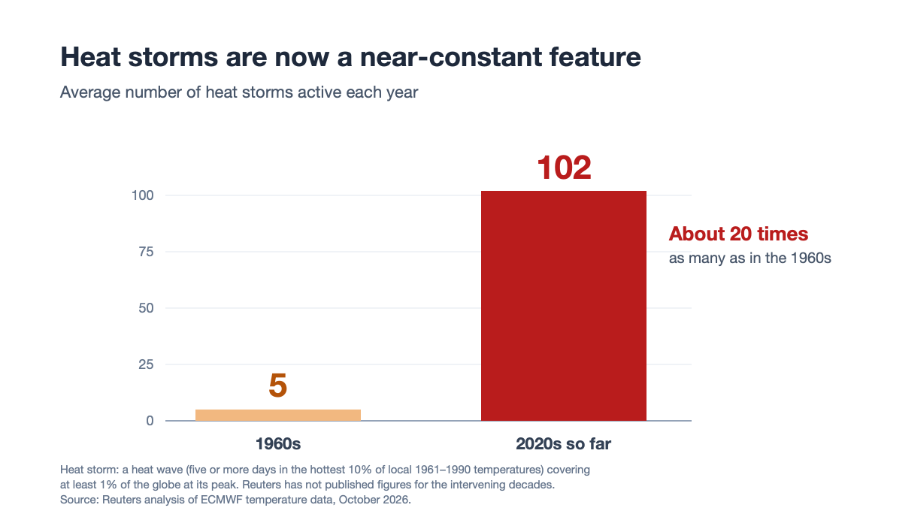
The test is fairly conservative. A heat wave is logged when a location's daily maximum lands in the hottest 10% of its 1961–1990 range for five days in a row. (By comparison, the Bureau of Meteorology uses a three-day threshold.) Once a heat wave sprawls across 1% or more of the Earth's surface – about 5.1 million square kilometres, or two-thirds the size of Australia – Reuters classes it as a heat storm and gives it a name of its own.
Look historically and change is hard to miss. In the 1960s, the planet averaged about five heat storms a year. This decade, the figure is about 102.
Read next: Record El Niño arrives as reinsurance pricing hits cycle lows
The finding most likely to catch the eye of catastrophe modellers is how consistent this threat is. Since 6 July 2008, at least one heat storm has been active somewhere on Earth every single day – a run of 6,681 days by Reuters' count. In the nearly 50 years before that, only five heat storms ever grew to cover more than a tenth of the globe. Since 2008, there have been 56.
Heat storms now account for almost 43% of the planet's abnormally hot days, up from about 3% in the 1960s. Over the same period, carbon dioxide in the atmosphere has risen by more than 30%, and the share of the globe likely to be sitting in a heat wave or heat storm on any given day has grown more than twelvefold. Cold snaps have gone the other way, shrinking in area by almost 80%.
The record-holder, which Reuters has named Vera, lasted 367 days from 29 July 2023 and over that time spread across some 85% of the globe. Two of its knock-on effects stand out for insurers because they hit supply chains rather than buildings. In West Africa, where Ivory Coast and Ghana grow about half the world's cocoa, the harvest fell by half and the cocoa price nearly tripled in 2024. In Spain, the world's largest olive oil producer, heat and drought cut output roughly in half and sent prices up 44%. Those are the kinds of losses that surface in trade credit, crop and contingent business interruption books, not in a catastrophe declaration.
There's an Australian thread here too. Reuters' mapping shows Perth was at times caught up in the same heat storm as cities as far apart as Montreal and Hong Kong.
Vera's peak footprint – 31.3% of the Earth's surface on 5 January 2024 – has already been beaten. Heat Storm Raimundo, which formed on 28 February this year and sat behind Europe's summer of heat and wildfire, covered 33.8% of the globe on 28 August. When Reuters published its analysis, Raimundo was still active and its cumulative footprint was approaching three-quarters of the globe.
"Heat is the biggest killer from climate change," James Renwick, a professor of physical geography at New Zealand's Victoria University of Wellington, told Reuters.
The heat storm is a journalistic framework rather than an official classification, and it won't change how the Insurance Council of Australia declares events. But treating heat as one long-lived system, instead of a string of local hot days, fits with what Australian actuaries have been saying for a while: the costs are real, they're just scattered across lines that never get added up as a catastrophe.
Workers' compensation is the clearest example. When Taylor Fry actuary Dr Xi Lin went through a national dataset of two to three million claims for a UNSW workshop, just 0.05% carried an explicit heat code – which, on Lin's analysis, means the true toll of heat-related workplace injuries could be roughly 20 times what the records show. By the same measure, the most heat-exposed area in the country is East Pilbara in WA, which logs 205 days a year with a wet bulb globe temperature above 28C.
Business interruption is the other unexpected channel. The Australian Energy Market Operator's Quarterly Energy Dynamics report shows average underlying demand on the National Electricity Market hit a quarterly record of 25,496 megawatts in the first three months of 2026, pushed up by January's cooling load, with operational demand peaking at 33,645 megawatts on 7 January. On one South Australian evening, as Adelaide passed 43C, spot prices reached $19,000 per megawatt-hour, Insurance Business has previously reported. The Australian Climate Service puts the annual cost of heat to labour productivity at about $8.7 billion.
Read next: Scientists say this year's El Niño could break records, and the models may not be keeping up
The ICA has revised its 2025 tally up to $4.8 billion in insured losses from declared extreme weather events across 294,000 claims, compared with $585 million in 2024 and $2.35 billion in 2023. APRA's Insurance Climate Vulnerability Assessment, run with five of the country's largest general insurers, found annual weather losses could rise from about $7 billion in 2024 to more than $16 billion by 2050 under a higher physical risk scenario. The regulator estimates about one in seven Australian homes is uninsured today, a figure that could reach one in four by 2050.
Heat also feeds the perils that do get counted. Reuters found that the largest fires on record, from Chile to Europe, burned during heat storms. Here, the Bureau of Meteorology's winter 2026 summary put the national mean temperature 1.45C above the 1961–1990 average, equal third-highest since records began in 1910, with NSW, Victoria and Tasmania each posting their warmest winter on record. That is part of the reason this summer's outlook has forecasters unusually rattled.
Read next: El Niño is here, it could be the strongest since 1950, and the bushfire clock is ticking
Anthony Leiserowitz, director of the Yale Program on Climate Change Communication, told Reuters that naming weather events helps people grasp that something is happening, and that heat waves have never been given that treatment. Reuters has since built a live heat storm tracker into its climate coverage.
In Australia, the sharper problem is that people aren't acting on what they already feel. Research in IAG's Resilient Futures Report found 38% of Australians had experienced heatwave impacts in recent years, but only 23% had added cooling or shading to their homes. NRMA Insurance meteorologist Kathryn Turner has singled out hot nights as the real danger: "What's key to heatwaves is the lack of overnight relief."
For brokers heading into summer, that points to a few concrete conversations. Clients in mining, construction, agriculture and logistics should be asked whether their cover reflects how often their people now work through extreme heat. Business interruption wordings deserve a second look for utility and supply-chain failure. And workers' comp portfolios may be carrying heat claims that are coded as something else entirely.
The Reuters analysis doesn't change Australia's exposure. It does make it much harder to keep treating each summer's heat as a one-off.