What happened: A Queensland tribunal overturned a regulator's rejection of a homeowner's warranty claim over structural building defects, finding the regulator already had the evidence and misclassified the defects
Who's involved: A Mount Gravatt East homeowner, the Queensland Building and Construction Commission (QBCC), and a builder now in liquidation
What's at stake: The cost of rectifying nine structural defects, with standard warranty cover capped at $200,000
Why it matters: The ruling confirms that statutory warranty claims do not require a specific form - substance beats paperwork - and that structural defect classification can determine whether a claim is in time or years too late
Where it stands: Decided on September 25, 2026; the warranty rejection is set aside and returned to the QBCC for reconsideration on the merits
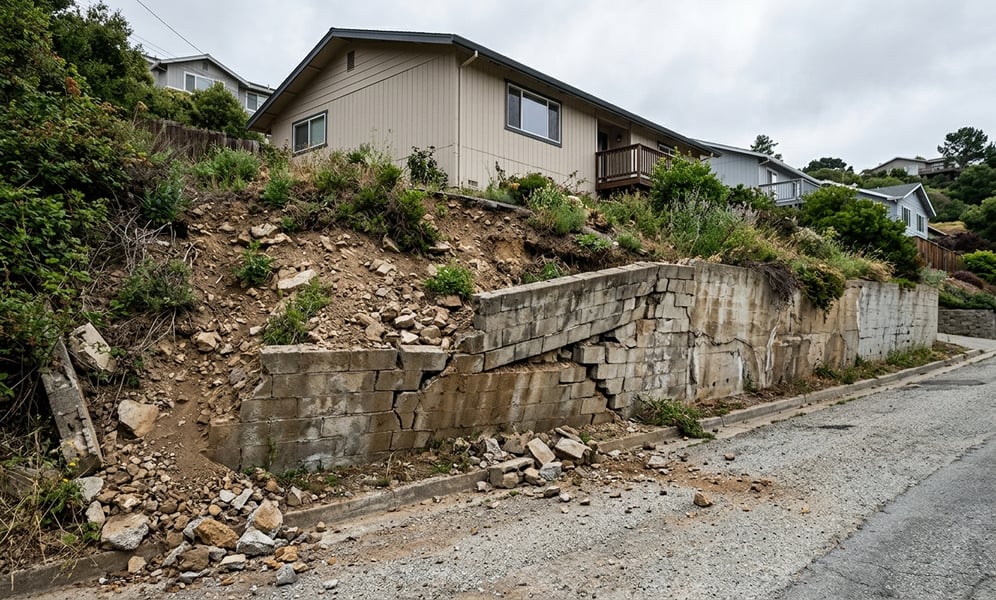
Cavities more than half a metre deep had opened beneath the footpaths. The retaining walls were failing. An engineer warned of potential landslip on the steep site. And the regulator that administers Queensland's home warranty insurance scheme said the homeowner's claim was too late - partly because it could not find the engineering report he had already submitted.
The Queensland Civil and Administrative Tribunal has overturned that rejection in a decision that unpicks how the QBCC handled a warranty claim over serious structural defects at a house in Mount Gravatt East, in Brisbane's south.
The homeowner bought the house and land in April 2021. A final inspection certificate was issued that July. But defects soon became apparent - problems with a retaining wall along the southern boundary and a rendered front boundary fence on the western side.
The homeowner's managing agent tried repeatedly to get the builder to attend to the defects. Nothing happened. He lodged a complaint with the QBCC in May 2022.
When the QBCC inspected in February 2023, the builder's director acknowledged the damage and said the company would fix both the retaining wall and the fence once it finished work on the property next door. The QBCC accepted that undertaking at face value and declined to issue a formal direction to rectify.
Nine months later, the builder was in liquidation.
By then, the homeowner had already engaged an engineer. The April 2023 inspection report described the general standard of construction as "poor" and identified nine defects caused by failure to comply with the National Construction Code, Australian Standard 3727, and the approved structural engineering drawings. The engineer found that site earthworks had not been carried out in the correct order and warned that non-compliant construction "may lead to landslips and significant damage."
Among the findings: retaining walls built contrary to the approved designs, no surface water drainage around the foundations, bracing piers buried in soil with no ground clearance, and washout cavities up to 550 millimetres deep beneath footpath slabs.
The homeowner filed the report with the tribunal and copied it to the QBCC on May 3, 2023. He lodged a formal complaint form in November 2023 at the QBCC's suggestion. But by then, the report had been in the regulator's hands for six months.
In July 2024, the QBCC rejected the warranty claim. It said it was "a requirement" that it receive a complaint form along with the complaint items. It also said the claim had been lodged outside the time limit.
The tribunal disagreed on both counts.
On the form question, the tribunal found the decision-maker was simply wrong. Completing the QBCC's standard form "is not the only method by which a valid claim can be made," the tribunal held, citing earlier authority. The legal test is whether the QBCC has the information it needs to decide the claim. By May 2023, it did - the homeowner had already provided his details, the property location, the purchase contract, and the detailed engineering report.
The QBCC said in its statement of reasons that it had no record of receiving the engineering report on May 3, 2023. The tribunal was unimpressed. A consumer "cannot be expected to be aware of the siloed operations of the QBCC," it said. And the suggestion that a staff member in the QBCC's legal branch "could be expected to take no action on receipt of an engineering report which identifies serious departures from engineering drawings" was rejected outright.
Whether the claim was in time hinged on one question: were the defects structural or not?
For structural defects, a homeowner has three months from becoming aware of the problem - and up to six years and six months from the cover start date. For everything else, the window is far tighter: three months from awareness, but only six months after the work was substantially complete. Under the shorter deadline, the homeowner's claim would have expired years earlier.
The QBCC's building inspector classified the retaining wall and boundary fence problems as non-structural. The homeowner's engineer disagreed. The retaining wall's primary purpose, he said, was to hold the building pad soil in place and prevent foundation movement and landslip on a highly reactive, steep site with compacted fill.
The tribunal preferred the engineer's evidence. "On questions of structural matters, I prefer the evidence of an engineer to the evidence of a building inspector," it said. The defects were structural. The claim, filed in May 2023, was in time.
On the separate question of whether someone should be directed to fix the defects, the tribunal confirmed the QBCC's refusal - but only because the builder was in liquidation and its director had not been joined to the proceedings. The homeowner's application to join the director came more than three years after the deadline. Directing someone who had not had the chance to put their case would be unfair.
The QBCC itself conceded that the retaining wall and boundary fence defects amounted to defective building work. There was, the tribunal noted, "hardly a clearer case" for a rectification direction - if only the builder still existed to receive it.
The warranty claim now goes back to the QBCC to assess on its merits. Standard cover under the Queensland Home Warranty Scheme runs to $200,000 in rectification costs.
The practical point for claims teams and scheme administrators: substance beats form when it comes to statutory warranty notices, and how a defect is classified - structural or not - can be the difference between a live claim and one that expired years ago.