Think about the last time you ordered dinner through an app. You handed over your address, your phone number and your live location to a company you'd never dealt with, then waited for a stranger to knock on your door. Few of us think twice about it. Ask the same people to let their car insurer see how they brake and corner, though, and the mood changes quickly.
Bill Powers, co-founder and chief executive of Cambridge Mobile Telematics (CMT), thinks that gap explains why usage-based insurance has never quite gone mainstream. Sharing the stage with investor Daymond John at InsureTech Connect (ITC) in Las Vegas, Powers told delegates that people are relaxed about a stranger turning up with their food, but monitoring is another matter. "If you have someone measuring your driving performance, that's a problem," he said.
In his view, the resistance has less to do with the data and more to do with who is asking for it. Consumers, he argued, simply see insurers differently from the apps on their phones.
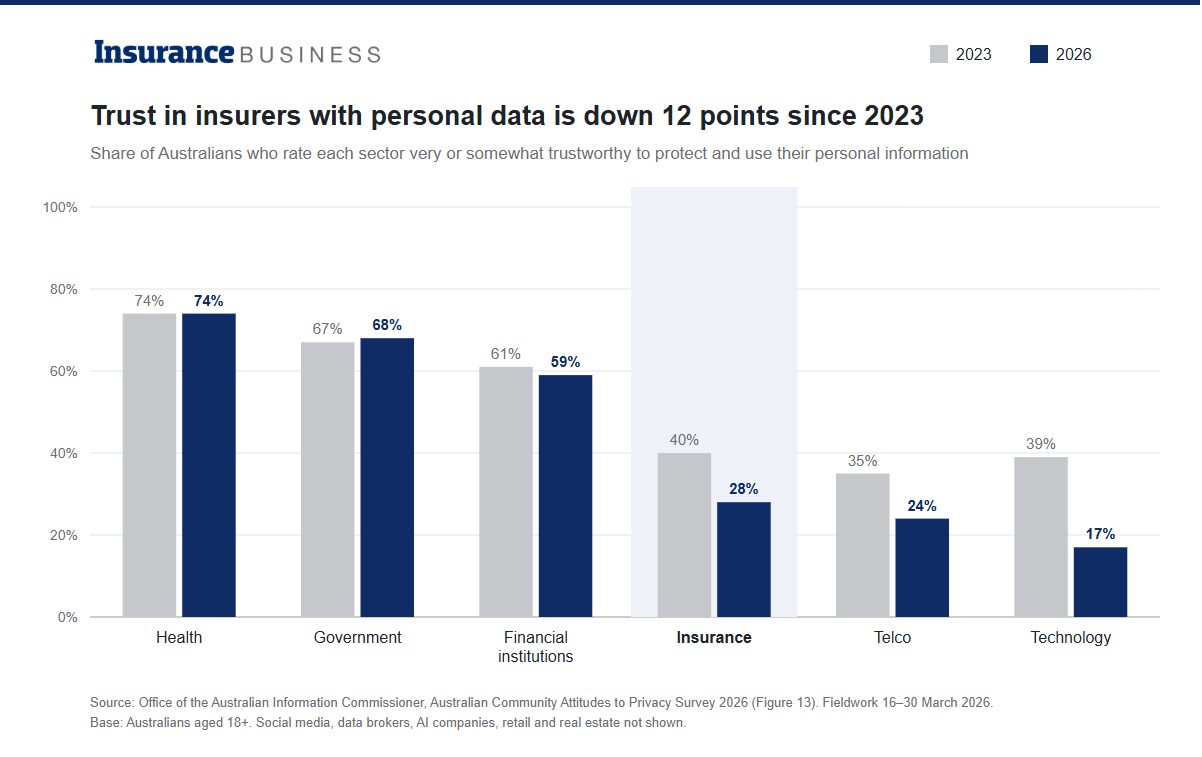
Australian figures suggest he's right, and that the gap is widening. The Office of the Australian Information Commissioner's Australian Community Attitudes to Privacy Survey 2026 found that only 28% of Australians consider insurance companies trustworthy with their personal information. That is down from 40% in 2023, and 40% now rate insurers as untrustworthy. Health providers (74%), government agencies (68%) and banks (59%) all fare far better.
Broader measures of trust are even worse. CHOICE's quarterly Consumer Pulse survey found that only 17% of Australians trusted general insurers in March 2026, the lowest result in the 11 years the consumer group has been asking. Preliminary AFCA figures show 36,022 general insurance complaints in 2025–26, up 5% on the year. Comprehensive motor was again the most complained-about product.
Read next: General insurance claims handling just got a published rulebook
CMT already has a presence in Australia. The Massachusetts-based firm has listed Insurance Australia Group among its customers. In March it raised US$350 million in a round led by TPG and Allianz X, with State Farm also taking part. The company says its platform now covers more than 55 million drivers in 25 countries.
Powers was pressed on the most common objection during the session itself. The moderator, a New York driver, said she would never sign up because the assertive driving needed to survive Manhattan traffic would mark her as a risk. Powers said he hears that all the time, and that the answer is context. CMT's scoring takes location into account. A sudden stop in dense city traffic is normal and isn't counted against the driver. Braking hard at highway speed on an open road sends a very different signal.
For local readers, compare a hard stop on Pitt Street at peak hour with one on the Hume Highway at 110km/h.
Powers went further, saying that cruising at 85mph (about 137km/h) on an empty interstate in the US Midwest isn't dangerous driving. Australian highway patrols would disagree. That speed is above the posted limit on almost every road in the country, which suggests scoring models built offshore may need local tuning before they win over Australian regulators, let alone Australian drivers.
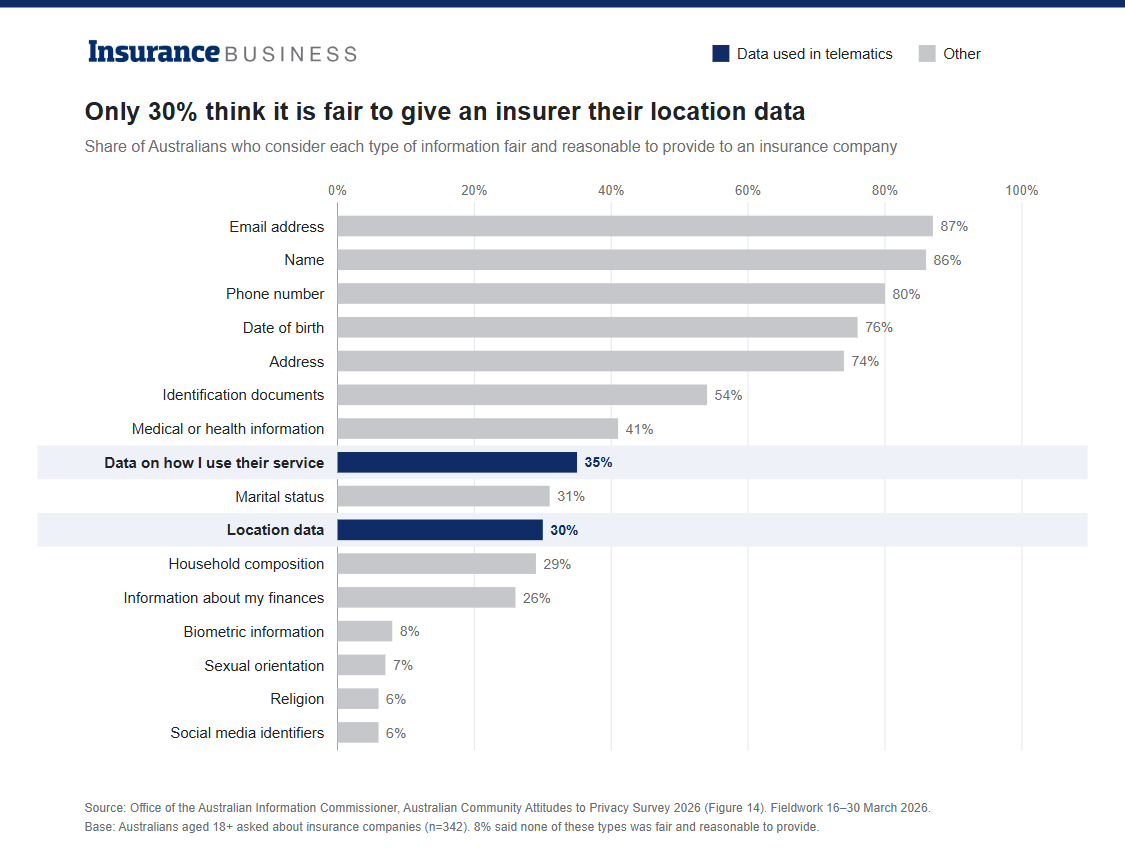
The OAIC survey also shows where the problem lies for insurers wanting to capture data. Only 30% of respondents said it was fair and reasonable to give location data to an insurer when using its services. Just 35% said the same about data on how they use an insurer's service. Both figures sit far below the acceptance rates for basic details such as name or email address, which are in the mid-80s. Nearly all respondents (94%) considered it unfair to track people's location when the service doesn't need it. And 91% objected to differential pricing, meaning people being charged different prices based on personal data such as their location or device.
Telematics providers would argue that pricing on driving behaviour is a different thing. But the onus will be on insurers to explain that clearly, and the survey suggests they start from a weak position. Only 17% of Australians believe insurers handle privacy complaints fairly and effectively, against 46% for banks.
There is an upside, though. Around two-thirds (68%) said they would be more likely to use digital services that require their personal information if they were confident it would be handled fairly and responsibly. Respondents were most comfortable with data collection when the purpose was clear and specific (69%) and when they could opt in (68%). Only 44% said trust in the organisation itself would make collection acceptable, which suggests a well-designed product may matter more than a brand's reputation.
Locally, telematics has gained most traction in commercial motor. Larger fleets are increasingly adopting telematics-based cover as premiums rise and safety rules tighten. Mercurien and Zurich launched a telematics-enabled fleet product several years ago. Personal lines have moved more slowly, and industry figures were blaming privacy fears years ago.
Read next: Telematics adoption accelerates in Australian motor fleet insurance
The law is moving in the same direction. On 31 August the federal government released an exposure draft of the Privacy Amendment (Personal Data Protection) Bill 2026. Its centrepiece is a "fair and reasonable" test for how organisations collect, use and disclose personal information. Under the draft, getting a customer's consent would no longer be enough on its own: the way data is handled would also have to stand up objectively. The Bill would also give organisations 72 hours to notify the regulator of an eligible data breach.
✱ The OAIC has long supported a fair and reasonable test, and its own survey shows how high the community's bar already is. For any insurer selling a driving-score product, Powers' point about trust is fast becoming a compliance question as well as a marketing one.
Asked where AI would change insurance most, Powers pointed to claims. He expects faster turnaround, better evidence and, he hopes, some relief on repair costs and fraud. Fraud is a live issue here. The Insurance Council of Australia is building a national fraud detection and investigations platform with Shift Technology and EXL, starting with motor claims. ICA members identified $560 million in opportunistic motor and property fraud in 2023.
Read next: ICA to build national insurance fraud detection platform
Inside CMT, Powers said AI has been more about reshaping jobs than cutting them. Work that once needed a dozen people now needs about half that, and the freed-up headcount goes to hiring AI specialists. John took a similar line. In his view, AI itself won't take people's jobs. The bigger threat is a colleague who knows how to use it.
John also warned that size alone won't protect big incumbents, because large companies tend to get complacent. For Australian insurers, the technology to price driving risk precisely is already here. The harder part is earning the trust needed for customers to hand over the data, and on the regulator's own numbers, that trust has been falling.