Six months after Internal Affairs declared prediction markets illegal gambling, New Zealanders could still log on to Polymarket and trade on Christopher Luxon's political future. Kalshi, its biggest rival, took a different approach. It pulled out of New Zealand within hours of getting the regulator's letter.
Kalshi is now trying out a new pitch in the US. It wants small businesses to use its contracts as protection against bad weather, tariff rises and power cuts. Its mass emails to American business owners include offers to protect Pennsylvania firms against a snowy December. Brokers who spent the winter explaining why a cold snap doesn't trigger business interruption cover will see why the idea might appeal.
The flagship example is a small New York rice brand, Not So Boring, which is worried about new US duties on Indian rice. It plans to pay about US$9,000 for Kalshi contracts that would return US$30,000 if the extra tariff hits 30%, or US$60,000 at 50%. Chief executive Izzy Sarrafzadeh told the Financial Times that the contract made more sense to her than commodity futures. She added that no bank would build a custom hedge for a company her size.
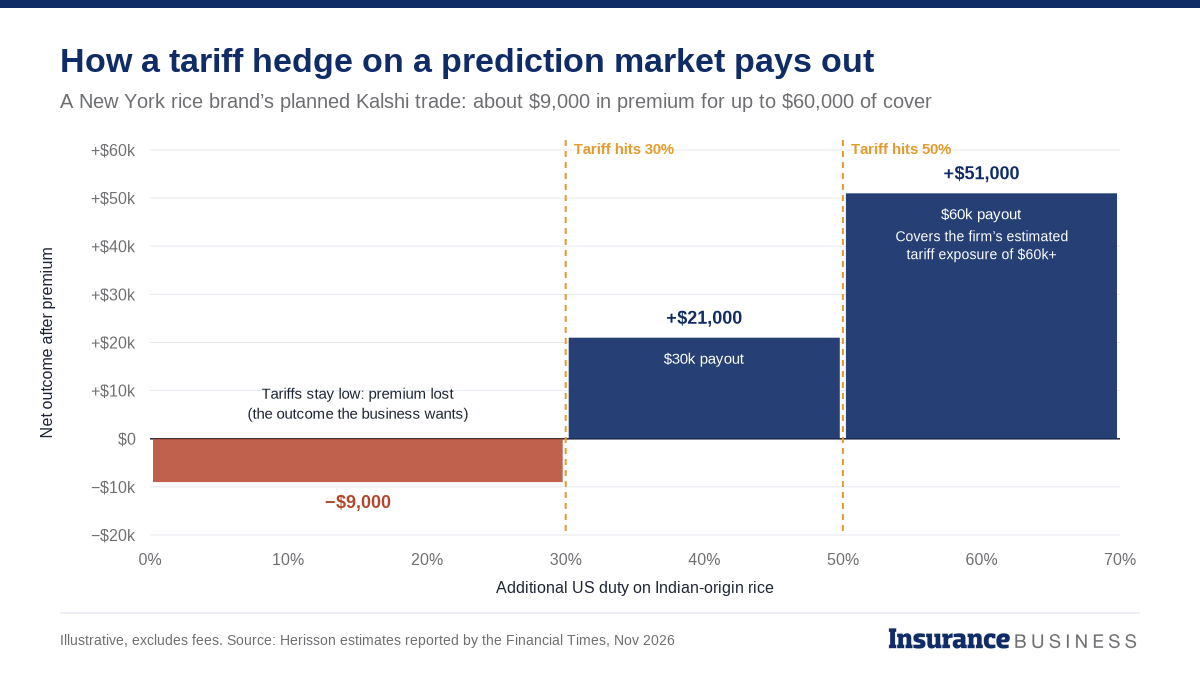
Kalshi says around 500 businesses have hedged on its platform. Nicolas Hull, its director of business development, describes the product as close to microinsurance. He says that most small firms he talks to have never hedged before.
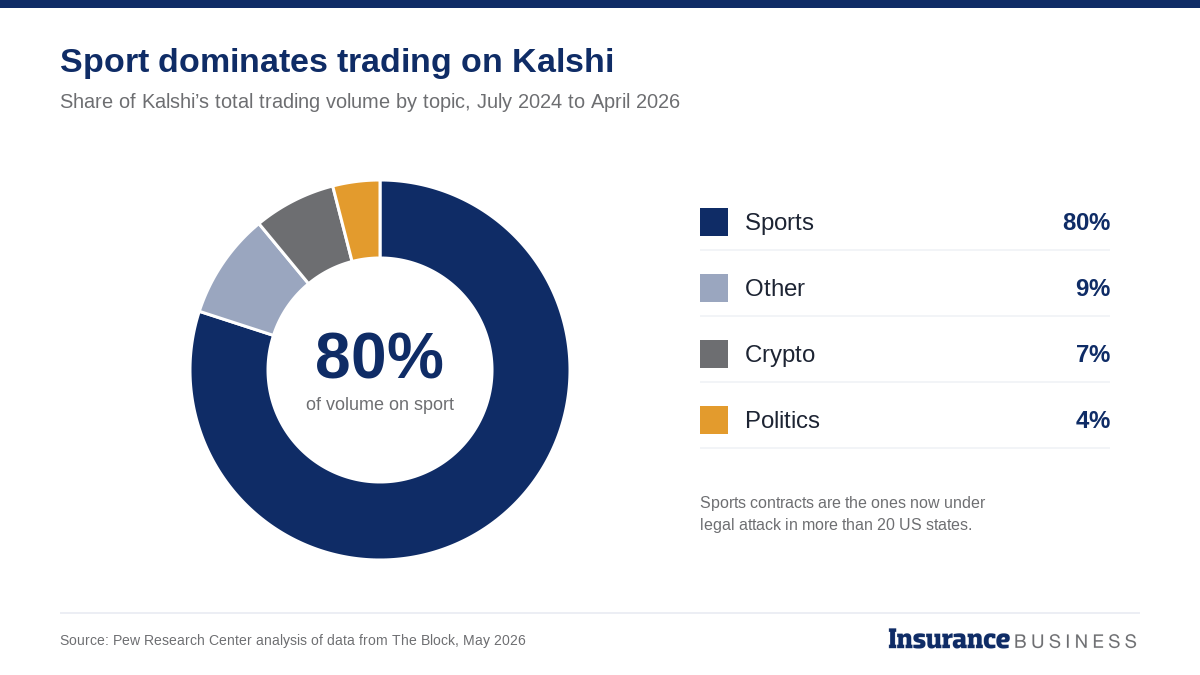
Sport is Kalshi's core business, and that business is under legal pressure. Pew Research Center found sports accounted for 80% of its trading volume from July 2024 to April 2026. More than 20 US states are fighting those contracts in court. Kalshi argues that federal oversight by the Commodity Futures Trading Commission puts it outside state gambling law. That argument has just failed in Utah, which Kalshi has now left.
Kalshi reaches business customers through start-up brokers such as Herisson and Castle Tech, which use AI to spot regulatory and legal changes that could hurt small firms. Finding traders willing to take the other side of the trade is harder. For now these are mainly trading houses such as Jump Trading and Susquehanna, and Kalshi is paying incentives to attract them. Castle co-founder Lucas Cavalieri has acknowledged the problem: broad markets attract money but don't track a single firm's losses well, while tailored ones struggle for traders.
The broking mainstream isn't sold. Lockton's Sarah Downey told the FT that the platforms have been marketing themselves as a fix for insurance gaps, "but we haven't seen much uptake yet."
Read next: The Dunedin cold snap your clients' BI policies may not cover
A business interruption policy pays the insured for a proven loss. A Kalshi weather contract pays whoever holds the right side when, say, snowfall passes a set level, whether they lost money or not. The payout is quick, but if the trigger doesn't match the business's actual loss, the gap is the buyer's problem. There's also no complaints scheme or fair conduct obligation behind the contract.
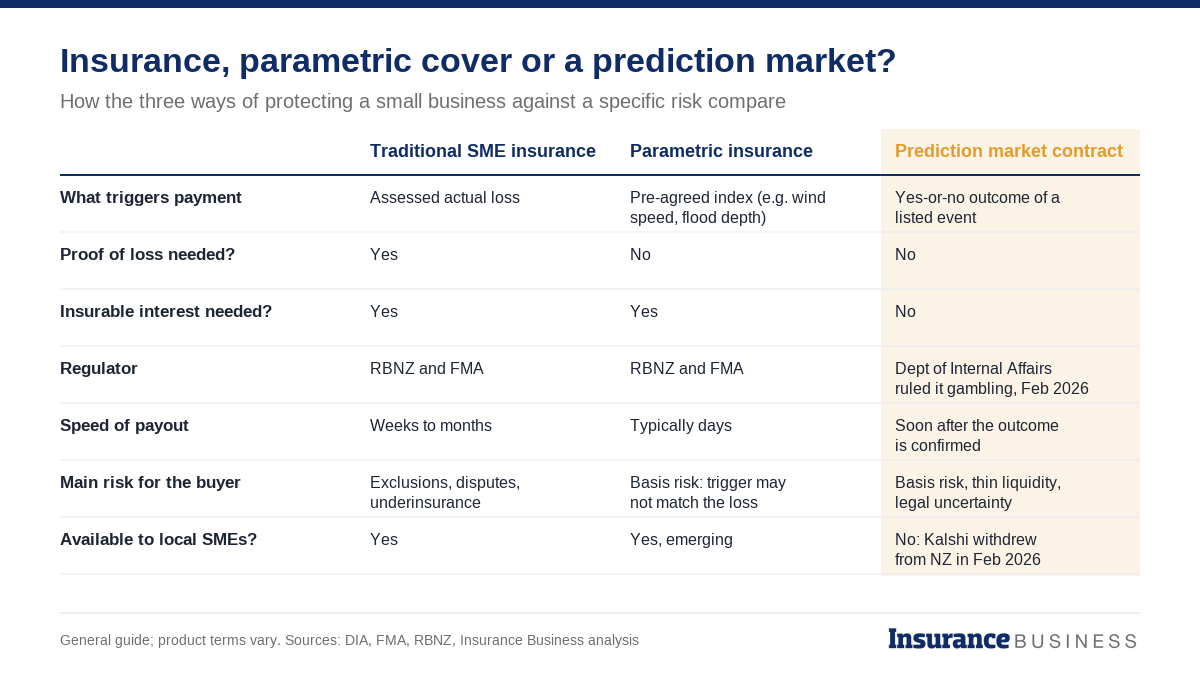
New Zealand has moved early to let these platforms know where they stand . On 16 February the Department of Internal Affairs wrote to Kalshi and Polymarket. It told them their products count as gambling and bookmaking under the Gambling Act 2003 and the Racing Industry Act 2020, and that they must withdraw. Under current law TAB NZ is the only provider allowed to offer online sports and racing wagering.
The DIA says it consulted the Financial Markets Authority, noting that neither platform had applied to the FMA. It says it won't pursue individual users. The ruling has its critics. New Zealand Initiative chief economist Eric Crampton argues that prediction markets shouldn't be classed as gambling at all.
Read next: Is a Kalshi-style weather contract insurance? Look to insurable interest
Keeping Kalshi out doesn't close the cover gap. Vero's New Zealand SME survey, published in March, found more than one in five businesses lacked confidence in their own prospects, the kind of pressure that tempts owners to trim cover. IB has also examined how intact premises with no access can leave firms without BI cover, another case where a simple trigger-based payout would make a real difference.
The insurance market is starting to fill that space. Insurance Council chief executive Kris Faafoi has said parametric cover is beginning to appear in New Zealand and the Pacific. If those products reach SMEs first, the gambling debate may never matter to New Zealand businesses.
Read next: Experts push for new insurance models as costs soar