A number of UK's insurance law specialists have just posted some of the strongest financial results in the sector's history, capping off a year in which private equity cash reshaped the legal market. But look closely at the investment figures, and the story is more complicated than a straightforward boom.
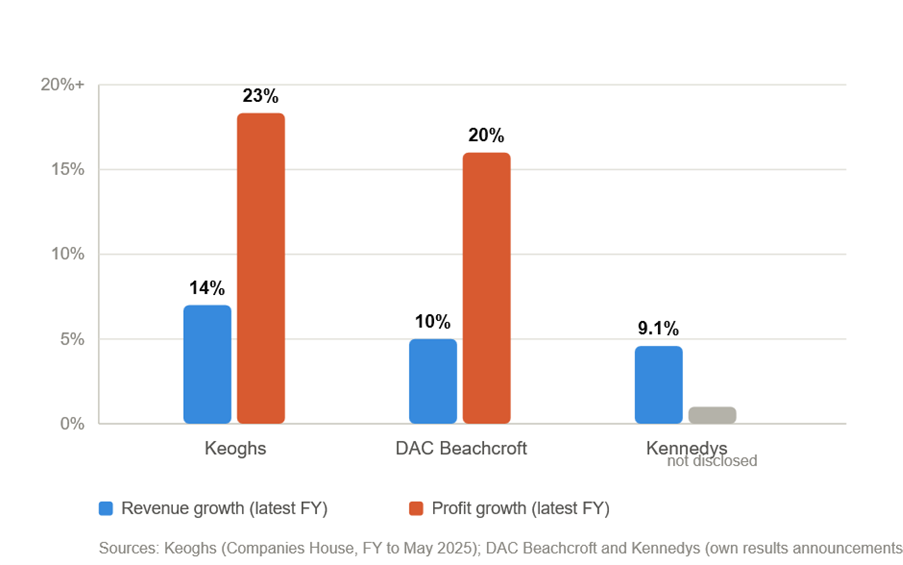
Bolton-headquartered Keoghs, one of the UK's largest defendant insurance law firms, has reported pre-tax profit of £51.5m for the year to May 2025 - a 23% jump on the previous 12 months. Turnover rose 14% to £147m, according to accounts newly filed at Companies House and reported by the Law Society Gazette.
To put the scale of that growth in context, Keoghs turned over just £54m a decade ago, with pre-tax profit of £10.3m. Headcount has climbed by more than 80% over the same period to over 2,100 people across the UK and Ireland, and the number of partners has risen 150% to 176.
Keoghs has been under private equity ownership since 2020, when it became part of Davies Group, the claims and outsourcing business backed by BC Partners. It was actually one of the first UK law firms to take outside investment at all, having sold a stake to LDC as far back as 2012, several years before the practice became commonplace in the profession.
Keoghs' numbers land alongside a run of strong results from its rivals. DAC Beachcroft reported provisional results in July showing pre-tax profit up 20% to £91m for the year to April 2026, on turnover up 10% to £385m - its highest-ever figures, driven partly by continued US expansion. Profit per member passed £800,000.
Kennedys, meanwhile, has now grown its global revenue for 12 consecutive years, hitting a record £457m for the year to April 2026 - a 9.1% rise. That growth came despite a UK legal market that the Thomson Reuters Institute has flagged as facing headwinds in insurance, IP and disputes work specifically, as corporate legal buyers tighten spending. North America and Asia-Pacific were the standout regions for Kennedys, up 22.5% and 20.3% respectively, while UK growth slowed to 3.6%.
Coverage lawyers and claims teams will recognise why: insurers are dealing with a widening range of exposures. Kennedys pointed to Middle East conflict-related claims across marine, aviation and political violence lines, along with major UK cases such as the Grenfell-related investigation and Welsh Water pollution litigation. DAC Beachcroft's own 2026 sector predictions flagged PFAS "forever chemicals," climate litigation, ultra-processed food and weight-loss drug claims as the areas generating the most new work - a reminder that emerging liability risk, not just claims volume, is driving revenue for insurer-side firms.
Put side by side, the three firms' latest growth rates tell a consistent story of an insurance defence market outperforming the wider legal sector.
The received wisdom is that private equity is pouring into legal services, and to an extent that's true: research from the Dye & Durham/Arlington report found 75% of UK law firms seeking investment now prefer a private equity deal over a traditional merger, and roughly £1.2bn has gone into the sector over five years.
But the annual figures tell a bumpier story. According to merger specialist Acquira Professional Services and the UK Legal Services Market Report:
Read together, that's a market where deal value has fallen sharply but deal volume and market share keep climbing - consistent with private equity doing more, smaller bolt-on acquisitions rather than fewer headline-grabbing investments. For insurers, brokers and claims teams working with these firms, that points to continued consolidation among the specialist panel firms they rely on, even if the pace of big-ticket buyouts has cooled.
For insurers and brokers who instruct these firms, the trend has practical implications. Consolidation among defendant firms has been narrowing the pool of specialist providers even as claims volumes and complexity both increase - a dynamic insurers will want to watch when it comes to panel management, pricing and continuity of expertise on long-running or catastrophic claims. The growing use of AI in claims handling, cited by several of these firms as a driver of efficiency on high-volume work, is also freeing up capacity for the increasingly technical disputes - from PFAS exposure to weight-loss drug litigation - that are shaping the next phase of casualty and liability risk.
With Keoghs' next accounts due for the year to May 2026, and DAC Beachcroft and Kennedys both signalling further international expansion, the next 12 months look set to test whether this growth holds up. Two things worth watching: whether DAC Beachcroft's stated openness to a merger or private equity investment translates into an actual deal, and whether the smaller, high-volume defendant firms further down the market start facing consolidation pressure of their own as the larger players scale up. For panel managers, that's a live question about how many genuinely independent specialist providers will be left to choose from in five years' time - and how much price competition they will be able to benefit from.