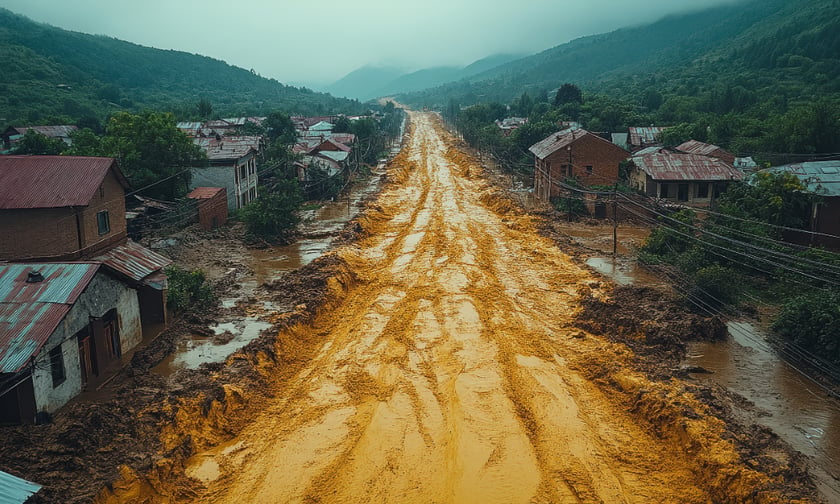
New expert analysis has confirmed that Wednesday's deadly flash flood on the Nepal-Tibet border - which has left nearly 1,500 people missing, including at least 700 foreign nationals - was most likely triggered by the collapse of a glacier, not an earthquake as Nepali officials initially suggested.
Satellite imagery from Planet Labs, reviewed by Reuters and analysed by earth scientist Dan Shugar of the University of Calgary, showed that the lower part of a glacier broke off at approximately 5,200 metres and crashed onto the valley floor roughly 1,200 metres below. Nepal's National Disaster Risk Reduction and Management Authority confirmed the event as a "glacier-inclusive flood" caused by an "ice-rock avalanche" in the Lhende River, originating from a landslide approximately 20km northeast of the Nepal-China border crossing.
The US Geological Survey later clarified that a reported earthquake was in fact seismic energy generated by the collapse itself - the glacier did not fall because of an earthquake. The glacier fell, and the falling generated what looked like seismic activity.
As we reported on August 26, 384 travellers were initially confirmed missing based on records from ten tour and travel agencies, with foreign nationals from India, Malaysia, the UK, South Africa, the US, Australia, and the Netherlands among those unaccounted for. Authorities now say the total missing - including local residents - has risen to nearly 1,500, with close to 170 bodies recovered so far. River levels in the worst-affected areas of Syapru Besi and Timure remain too high for helicopter landings, severely hampering rescue operations.
The confirmation of a glacial collapse rather than an earthquake matters to travel and adventure insurance brokers for a specific reason: the cause of a natural disaster can determine which policy wordings respond and which do not.
Standard travel insurance typically responds to emergency medical evacuation regardless of cause. Non-medical evacuation triggered by natural disaster - the scenario facing hundreds of stranded trekkers in Rasuwa district - is more variable. Some adventure travel policies include natural disaster evacuation as standard; others include it as an add-on; others exclude glacial events or high-altitude incidents entirely. The distinction between a volcanic eruption, a flood, and a glacial collapse may seem academic until a client is stranded at altitude with no way out and a bill that most standard policies will not pick up.
Dan Shugar noted that snow which had covered the glaciers the previous day had largely melted by the time of the disaster - suggesting an unusual warm spell preceded the collapse. Andrew Zolli, Planet's chief impact officer, wrote that "whether [the collapse], in turn, had a climate component is something that I'm sure will get scrutiny in the days to come." Vikram Gupta of India's Sikkim University said construction in the area could also be a factor.
The cause is not yet fully determined. That means the exact policy trigger will be subject to interpretation and, potentially, dispute. For brokers, the cleaner path is not to wait for that interpretation but to ensure adventure travel clients in high-altitude Himalayan destinations are covered under wordings that do not require a precise causal determination before paying out. A policy that responds to "natural disaster evacuation" without requiring the insured to prove whether the triggering event was glacial, seismic, or climatic is the one worth recommending.
This is not the first major flood on this stretch of the Nepal-Tibet border, and brokers advising clients on Himalayan travel should now have two data points to work with rather than one.
In July 2025, a flood on the same Bhote Koshi corridor - the river system through which Wednesday's flood travelled - killed nine people and washed away the Sino-Nepal Friendship Bridge. That event was caused by the drainage of a supraglacial lake in Tibet, according to the International Centre for Integrated Mountain Development. Cross-border trade was halted for months.
The August 2026 event has damaged 430MW of hydroelectric capacity - more than 12% of Nepal's total hydropower output of 3.2GW, according to a Reuters calculation from energy ministry figures - and sent a surge of water, sediment, and boulders through the Bhote Koshi and Trishuli river systems, with water levels at the Galchhi area downstream rising by as much as nine metres within 30 minutes.
The UN noted in 2023 that glaciers in Nepal had melted 65% faster in the last decade than the previous one, wedged as they are between two major carbon emitters. The structural risk in this corridor is increasing, not stabilising.
For brokers with clients currently in Nepal or with bookings for the Himalayan trekking season, the immediate priority is confirming what their policies cover for non-medical evacuation from a natural disaster zone. That is a cost most travellers without specialist adventure cover will bear personally.
For brokers whose clients have not yet departed, the question to ask of any policy being recommended for Nepal travel is whether it explicitly covers evacuation triggered by glacial events, flash floods, and natural disasters at high altitude - not just emergency medical evacuation. The two are different in both their trigger conditions and their cost profiles.
The Himalayan trekking and climbing season draws hundreds of thousands of visitors annually. Nepal's major operators require proof of travel insurance before booking. What they cannot require is that the policy a client presents is adequate for the risks of this specific corridor - that is the broker's job.