Australia’s largest motor insurer has released its third annual electric vehicle (EV) survey finding consumer interest has risen significantly since 2024 – but confidence in resale value has collapsed, repair anxiety persists across the whole market, and a used EV segment is forming faster than the infrastructure to support it. NRMA Insurance released the third instalment of its Changing Gears report on September 2, 2026, tracking Australian attitudes toward EV ownership since 2024. The findings present a market in transition – and surface a set of underwriting and placement risks that brokers should be monitoring actively.
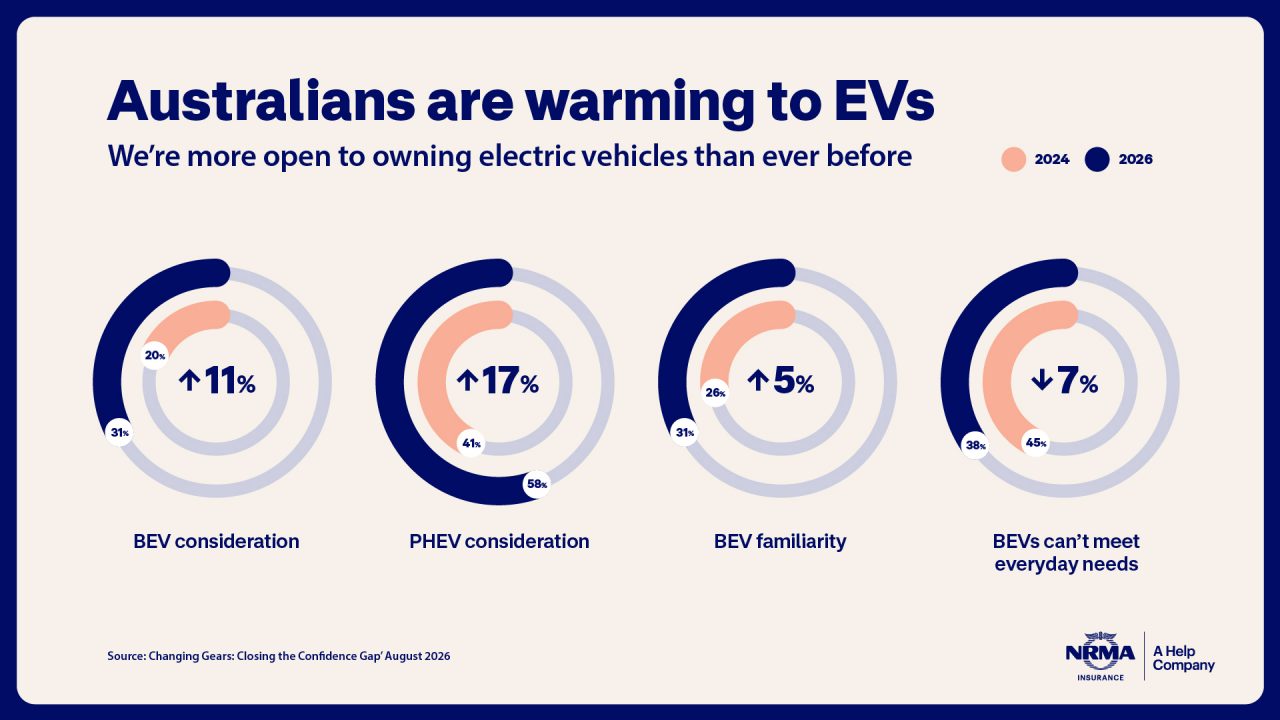
The report, based on a nationally representative Ipsos survey of approximately 2,000 Australians, found consideration of battery electric vehicles (BEVs) has risen from 20% in 2024 to 31% in 2026. Consideration of plug-in hybrid electric vehicles (PHEVs) climbed from 41% to 58% over the same period. Just 17% of Australians now say they would not consider an EV at all. NRMA Insurance CEO Julie Batch said the market has moved beyond the question of whether consumers want an EV, to whether ownership will be practical. “Australians want to know they can charge the vehicle where they live, that their battery is safe and will last, and that a local repairer will be able to fix it if something goes wrong,” she said.
The finding with the most immediate commercial relevance for brokers is not the headline growth figure. Owner confidence in EV resale value has fallen from 76% in 2024 to 56% in 2026 – a 20-percentage-point drop in two years. That deterioration in sentiment reflects real market movement. The Australian Automotive Dealer Association (AADA)/AutoGrab 2025 Annual Automotive Insights Report (AIR), released February 2026, found one-year-old EVs retained 84.5% of their value in 2025 – a depreciation rate of 15.5% – compared to 94.8% retention the year prior, as new model price cuts continued flowing into used valuations. AADA CEO James Voortman attributed the shift to intensifying new-car competition, faster technology cycles, and increased used stock supply. “There are a few potential factors at play, and they’re mostly typical of a quickly evolving technology segment,” he said, as reported by Drive, noting that sharper new-car pricing and improvements in battery range and features can make earlier models look dated more quickly than internal combustion engine equivalents, weighing on resale values.
Battery repair can also present challenges. The Insurance Council of Australia (ICA) has identified limited local battery-repair capability, parts availability, and access to diagnostic information as factors that can contribute to EVs being written off after battery damage, including cases where battery cells may not have been damaged. For brokers, the combination of evolving repair capability and pressure on EV resale values makes valuation an important consideration at renewal. This is particularly relevant for commercial fleets with material EV exposure, where agreed values may need to be reviewed as second-hand market conditions change.
Read next: Drones, EVs and autonomous tractors reshape farm insurance
The report found 57% of all respondents – not only those who would not consider an EV – expressed concern about the availability of trained mechanics in their area. Among confirmed EV non-considerers, 26% cited a lack of qualified repairers as a direct barrier to purchase. Shawn Ticehurst, head of automotive research at NRMA Insurance, acknowledged the gap while pointing to industry momentum: “While 26% of EV non-considerers say a lack of mechanics is a barrier, the industry is rapidly building the skills and training needed to support more EVs on Australian roads. As EV ownership grows, so too does the repair and service network.”
The broader regulatory context reinforces the concern. The ICA’s March 2025 Motor Insurance Policy Paper found repair costs have climbed 26% since 2022 and now account for roughly 60% of total claim costs. In a submission, the ICA argued the Motor Vehicle Service and Repair Information Sharing Scheme (MVIS) has a structural gap – manufacturers can still withhold parts from independent repairers, resulting in longer repair times, higher costs, and vehicles written off that could otherwise be repaired. For brokers placing EV-heavy commercial fleets – particularly in regional areas where certified technician access is thinner – repairer network adequacy is a material factor in both claims duration and total cost of risk.
More than half of prospective EV buyers in the survey (54%) said they would consider purchasing a used EV, with a further 7% saying they would only buy used. Some 82% of respondents said there should be a way to independently monitor and test EV battery health. The report recommends a nationally consistent battery health standard for used EVs, including standardised testing and disclosure at point of sale. Batch noted that independent battery testing is already available in the market but awareness of it remains limited.
Used EV sales increased 54.6% year-on-year in the first half of 2026, according to the Australian Automobile Association’s (AAA) EV Index, even as the broader used vehicle market contracted 6.6%. For brokers, a segment growing at that pace – without a battery health standard and with limited claims history on newer brands – represents a placement gap that will become urgent well before it becomes visible.
Read next: Is insurance ready for the electric vehicle boom?
The Changing Gears report identifies five national priorities for accelerating EV adoption: a national battery health standard, expanded apartment charging access, broader EV repair capability including in regional areas, a battery stewardship framework covering end-of-life management, and targeted investment in regional and remote communities.
For brokers, three of these map directly to placement and renewal conversations. A national battery health standard, if implemented, would give brokers and underwriters a consistent basis for assessing used EV risk at point of placement – closing the gap that currently exists for ex-lease vehicles entering the market in volume. Expanded regional repair capability would reduce claims duration risk for fleet clients operating outside major metropolitan areas, where the 57% mechanic concern rate is most acute. And a battery stewardship framework would affect salvage values on total loss EVs – a factor that feeds directly into the economics of agreed value versus market value cover.
NRMA Insurance – which describes itself as Australia’s largest motor insurer and sits within the IAG group – reported EVs currently represent approximately 2% of IAG’s motor policies, with that share expected to reach 10% by 2030. Tesla accounts for roughly 60% of its battery-electric book. EV insurance quote requests to NRMA Insurance rose 95% year-to-date in 2026.